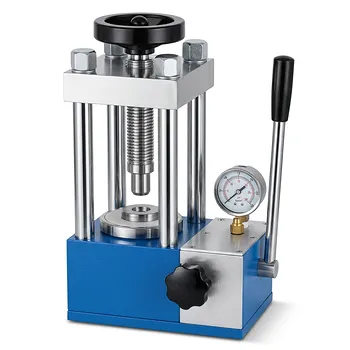
How does the pressure control of a high-pressure hydraulic press affect calcium sulfate anhydrite green bodies? Guide
Updated 3 months ago
The precision of pressure control in a high-pressure hydraulic press is the primary determinant of the density, structural integrity, and sintering performance of calcium sulfate anhydrite green bodies. By applying high axial pressure—often reaching up to 350 MPa—the press forces powder particles to overcome inter-particle friction and rearrange into a tightly packed configuration. This meticulous control reduces internal porosity and eliminates micro-pores, creating a green body with the uniform density and mechanical strength essential for high-performance bioceramic production.
Core Takeaway: Precise pressure control eliminates internal voids and minimizes density gradients, establishing the necessary physical foundation to prevent cracking, deformation, and uneven shrinkage during the subsequent high-temperature sintering process.
Achieving Structural Integrity Through Pressure Control
Particle Rearrangement and Friction Reduction
High-pressure hydraulic presses provide the necessary force to overcome the natural friction between loose calcium sulfate particles. As the pressure increases, particles undergo mechanical rearrangement and, in some cases, plastic deformation. This movement fills the voids between grains, leading to a significantly more compact and stable green body structure.
Pore Elimination and Bulk Density
Precise control allows for the systematic expulsion of air trapped between granulated powders. By reaching specific thresholds (such as 40 MPa to 100 MPa or higher), the press minimizes internal micro-pores and macro-pores. This increase in bulk density is critical because it maximizes the contact area between particles, which is the primary driver for grain growth during sintering.
Mechanical Green Strength
A well-controlled pressing cycle ensures the green body has sufficient mechanical strength for post-forming handling. Without accurate pressure, the body may be too fragile to survive removal from the mold or subsequent machining. The tight packing achieved at high pressures (up to 350 MPa) ensures the green body remains intact before it ever enters the kiln.
Enhancing Sintering Predictability
Minimizing Density Gradients
One of the most vital roles of a hydraulic press is maintaining a uniform internal density distribution. If pressure is applied inconsistently, different zones of the green body will have different densities. These gradients lead to internal stresses that manifest as warping or structural failure when the material is heated.
Controlling Shrinkage and Cracking
Uniform density established during the pressing stage leads to predictable and isotropic shrinkage during sintering. When the initial density is consistent, the green body is far less likely to develop delamination defects or micro-cracks. This is especially important for calcium sulfate anhydrite, where phase transformations and densification rely on a stable physical starting point.
Facilitating Phase Transformation
The close contact between particles achieved through high-pressure compaction facilitates the phase transformation required to reach high-performance ceramic states. By reducing the distance between atoms, the press lowers the energy barrier for the diffusion processes that occur at high temperatures. This ensures the final bioceramic achieves its intended chemical and physical properties.
Understanding the Trade-offs and Pitfalls
The Risk of Delamination and "Capping"
While high pressure is beneficial, exceeding the material's limits or releasing pressure too quickly can cause delamination or capping. This occurs when entrapped air or elastic recovery forces the layers of the green body to separate. Pressure control systems must allow for a gradual release to maintain the structural integrity of the part.
The Role of Pressure-Holding (Dwell Time)
Applying peak pressure is only half the battle; the holding stage is equally critical. Maintaining pressure for a specific duration allows particles to settle and air to escape completely. Skipping this "dwell time" often results in a green body with a lower-than-expected density, even if the peak pressure was theoretically sufficient.
How to Optimize Your Pressing Strategy
To achieve the best results when preparing calcium sulfate anhydrite green bodies, the application of pressure must be tailored to the specific goals of the final bioceramic.
- If your primary focus is Maximum Bioceramic Density: Utilize the highest stable pressure (up to 350 MPa) and implement a longer pressure-holding stage to ensure total particle rearrangement.
- If your primary focus is Geometric Precision: Focus on a moderate, highly consistent pressure (around 40-100 MPa) to minimize internal stresses and prevent uneven shrinkage or warping.
- If your primary focus is Preventing Structural Defects: Ensure the hydraulic system is calibrated for a slow, controlled pressure release to prevent delamination caused by elastic expansion.
By mastering the nuances of pressure application and holding, you ensure that every green body serves as a perfect foundation for high-strength, high-performance ceramics.
Summary Table:
| Key Pressing Factor | Impact on Green Body | Benefit for Final Ceramic |
|---|---|---|
| High Axial Pressure | Overcomes particle friction & rearranges grains | Maximizes bulk density and mechanical strength |
| Pore Elimination | Minimizes internal micro/macro-pores | Reduces grain growth barriers during sintering |
| Dwell Time (Holding) | Allows particles to settle and air to escape | Ensures uniform density and structural stability |
| Pressure Release | Gradual reduction of elastic recovery forces | Prevents delamination, capping, and micro-cracks |
| Density Uniformity | Eliminates internal density gradients | Enables predictable, isotropic shrinkage |
Elevate Your Bioceramic Research with Precision Compaction
Achieving the perfect green body requires more than just force—it requires absolute control. At [Brand Name], we provide complete laboratory sample preparation solutions for material science, specializing in advanced powder processing and compaction equipment.
Our extensive range of high-pressure hydraulic presses—including Cold/Warm Isostatic Presses (CIP/WIP), standard lab presses, XRF pellet presses, and vacuum hot presses—is engineered to provide the precise pressure-holding and release cycles necessary to prevent delamination and ensure uniform density. Beyond pressing, we support your entire workflow with crushers, cryogenic grinders, planetary ball mills, and precision sieve shakers.
Ready to eliminate structural defects and optimize your sintering results? Contact our technical experts today to find the ideal equipment for your material processing needs.
References
- Elif UZUN KART. A NOVEL METHOD TO SYNTHESIS OF CALCIUM SULPHATE ANHYDRITE SELF-DOPED WITH SiO₂ FROM RED MUD AS A BIOCERAMIC. DOI: 10.13168/cs.2021.0036
Mentioned Products
- Hydraulic Double Shaft Disperser for High Viscosity Liquid Mixing and Dispersion
- 6 Ton Variable Frequency Single Punch Tablet Press
- Enhanced 9 Punch Rotary Tablet Press for Powder Compaction
- 6-Ton Small Single-Punch Tablet Press — Laboratory Powder & Granule Tableting Equipment / Tablet Forming Machine
- 5 Ton Single Punch Tablet Press Laboratory Small Batch Production
People Also Ask
- Why is it necessary for an industrial hydraulic press to provide high unit pressure when preparing MMC green bodies? Optimize Densification
- What role does high-speed mixing play in photoanode slurry prep? Optimize Nanoparticle Dispersion for Solar Efficiency
- What are the advantages of a customized dual-blade mixer? High-Shear Mixing for High-Viscosity Pastes
- How does high-precision mixing ensure phase stability in BaO–MgO–ZrO2 ceramics? Achieve Pure Dielectric Performance
- What is the function of high-efficiency mixing and defoaming equipment in catalyst systems? Achieve Molecular Uniformity

Tech Team · PowderPreparation
Last updated on Jun 03, 2026
Related Products
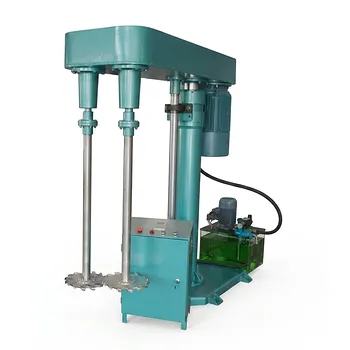
Hydraulic Double Shaft Disperser for High Viscosity Liquid Mixing and Dispersion
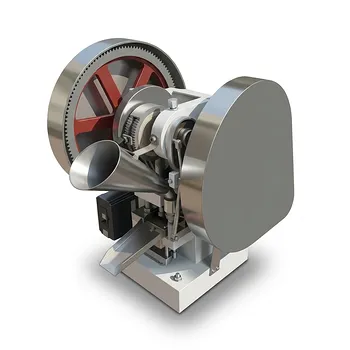
6 Ton Variable Frequency Single Punch Tablet Press
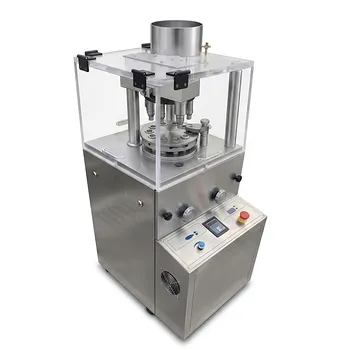
Enhanced 9 Punch Rotary Tablet Press for Powder Compaction
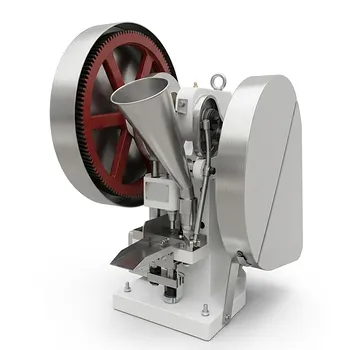
6-Ton Small Single-Punch Tablet Press — Laboratory Powder & Granule Tableting Equipment / Tablet Forming Machine
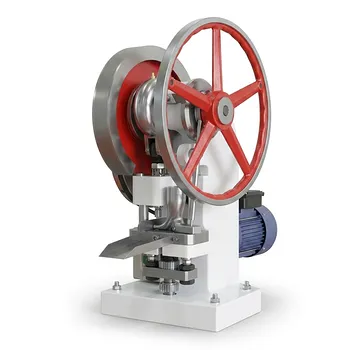
5 Ton Single Punch Tablet Press Laboratory Small Batch Production
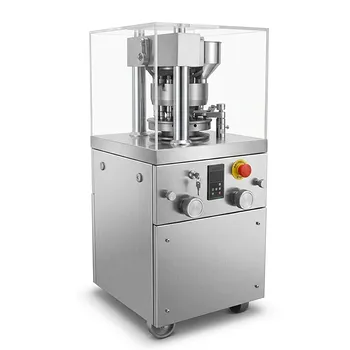
Ordinary Type Rotary Tablet Press for Pharmaceutical Chemical Food Electronic Industries