How does a manual hydraulic press contribute to Sr2FeCoO6 green bodies? Achieve High-Density Powder Compaction
Updated 5 months ago
Achieving high-density $Sr_2FeCoO_6$ ceramics begins with precise powder compaction. A high-pressure manual hydraulic press transforms loose calcined powder into a cohesive "green body" by applying intense uniaxial force, typically around 25 ton/inch. This mechanical compaction is the critical first step in ensuring the final perovskite ceramic reaches its theoretical density and structural integrity.
Core Takeaway: The manual hydraulic press eliminates internal macro-pores and maximizes particle contact, providing the mechanical strength necessary for handling and the physical density required for successful high-temperature sintering.
Particle Rearrangement and Pore Elimination
Overcoming Internal Friction
Calcined $Sr_2FeCoO_6$ powders naturally resist compaction due to inter-particle friction and irregular shapes. The high vertical pressure of the hydraulic press provides the necessary energy to force these particles to slide past one another.
This movement allows the powder to settle into a more stable, tightly packed configuration within the precision mold.
Removing Trapped Air and Macro-Pores
Loose powder contains significant amounts of trapped air and large internal voids known as macro-pores. The application of axial pressure effectively expels this air and collapses the voids.
Eliminating these gaps is essential, as remaining macro-pores can lead to structural weaknesses or "dead zones" where sintering cannot occur effectively.
Establishing the Foundation for Sintering
Increasing Inter-particle Contact Points
For sintering to be successful, particles must be close enough for atoms to diffuse across boundaries. The hydraulic press creates a high contact area between $Sr_2FeCoO_6$ particles by forcing them into intimate contact.
These contact points serve as the "bridgeheads" for mass transport and densification during the high-temperature stage of ceramic production.
Ensuring Dimensional Stability and Green Strength
A "green body" must be strong enough to be handled, machined, or moved into a furnace without crumbling. The press ensures the particles are bonded tightly enough to provide sufficient green strength.
This structural integrity also ensures uniform shrinkage during sintering, which prevents the final ceramic from warping or cracking.
Understanding the Trade-offs
Internal Density Gradients
One primary challenge with uniaxial pressing is the creation of density gradients. Friction between the powder and the mold walls can cause the pressure to be higher at the top than at the bottom.
If these gradients are too severe, the ceramic may experience non-uniform shrinkage, leading to internal stresses or dimensional inaccuracies in the final part.
The Risk of Over-Pressurization
While high pressure is necessary for density, exceeding the material's limits can cause lamination cracks. These are tiny horizontal cracks that form when the compressed air or elastic energy is released too quickly after the pressure is removed.
Maintaining precise pressure control and a steady pressure-holding function is vital to prevent these microscopic structural failures.
How to Apply This to Your Project
Recommendations for Success
- If your primary focus is maximum density: Utilize a high load capacity (25+ ton/inch) and implement a "dwell time" where pressure is held constant to allow for maximum particle settling.
- If your primary focus is structural integrity: Ensure the use of precision-ground stainless steel molds to minimize wall friction and reduce internal density gradients.
- If your primary focus is uniform sintering: Focus on achieving a consistent initial "green density" to prevent macro-cracks or deformation during the 1500°C sintering phase.
Properly executed high-pressure compaction is the definitive factor in transforming raw $Sr_2FeCoO_6$ powder into a high-performance, high-density ceramic component.
Summary Table:
| Key Mechanism | Impact on Sr2FeCoO6 Green Body | Critical Success Factor |
|---|---|---|
| Uniaxial Pressure | Maximizes particle density and contact | Precise pressure control (25+ ton/inch) |
| Pore Elimination | Removes macro-pores and trapped air | Steady pressure-holding (dwell time) |
| Mechanical Bonding | Increases green strength for handling | Use of precision-ground stainless steel molds |
| Particle Rearrangement | Overcomes internal friction for stability | Consistent initial green density |
Elevate Your Ceramic Research with Precision Compaction
Ready to achieve theoretical density in your material samples? We provide complete laboratory sample preparation solutions for material science, specializing in advanced powder processing and compaction equipment.
Whether you are working with $Sr_2FeCoO_6$ perovskites or other technical ceramics, our extensive product line is designed to ensure structural integrity and uniform sintering:
- Compaction Excellence: A full spectrum of hydraulic presses, including Cold/Warm Isostatic Presses (CIP/WIP), standard lab presses, XRF pellet presses, and vacuum hot presses.
- Powder Preparation: Precision crushers (jaw/roll), liquid nitrogen cryogenic grinders, and high-energy mills (planetary ball, jet, sand, rotor).
- Consistency Tools: Sieve shakers, powder mixers, and defoaming mixers to ensure perfectly homogenized starting materials.
Maximize your lab's efficiency and sample quality. Contact our specialists today to find the ideal equipment configuration for your specific material requirements!
References
- S. K. Durrani, M. Siddique. CHARACTERIZATION AND ANALYSIS OF PEROVSKITE OXIDE Sr2FeCoO6 SYNTHESIZED BY GEL-COMBUSTION PROCESS. DOI: 10.71330/thenucleus.2010.905
Mentioned Products
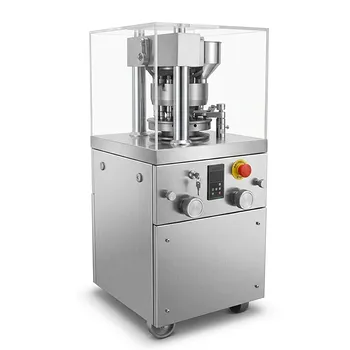
- Manual Tablet Press with Dual Scale Pressure Gauge for Pharmaceutical Food Chemical Laboratory Sample Preparation
- 5 Ton Single Punch Tablet Press Laboratory Small Batch Production
- 6-Ton Small Single-Punch Tablet Press — Laboratory Powder & Granule Tableting Equipment / Tablet Forming Machine
- Enhanced 9 Punch Rotary Tablet Press for Powder Compaction
- 6 Ton Variable Frequency Single Punch Tablet Press
People Also Ask
- What is the function of a laboratory press in Cr-Ti alloy evaluation? Quantify Fracture Stress & Strength
- What is the function of a laboratory press in assessing the hydrophobic performance of modified vermiculite fillers?
- What is the core function of a laboratory press in the forming of ceramic filter element green bodies? Maximize Density.
- What is the function of a laboratory press in the preparation of ceramic feed rods? Master Density and Precision
- Why is vacuum sealing and flexible packaging necessary for Aluminum Titanate powders during CIP? Ensure Peak Density

Tech Team · PowderPreparation
Last updated on May 14, 2026
Related Products
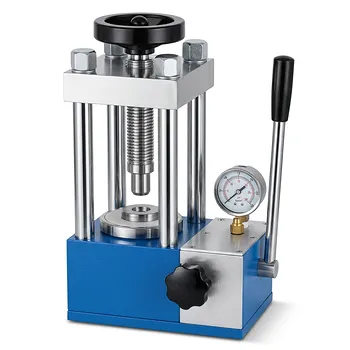
Manual Tablet Press with Dual Scale Pressure Gauge for Pharmaceutical Food Chemical Laboratory Sample Preparation
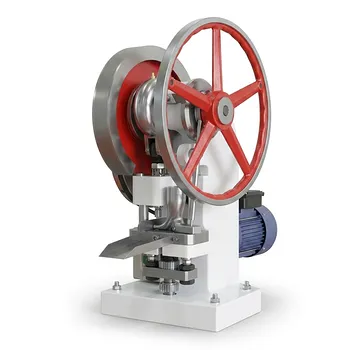
5 Ton Single Punch Tablet Press Laboratory Small Batch Production
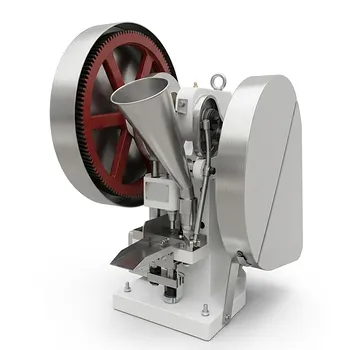
6-Ton Small Single-Punch Tablet Press — Laboratory Powder & Granule Tableting Equipment / Tablet Forming Machine
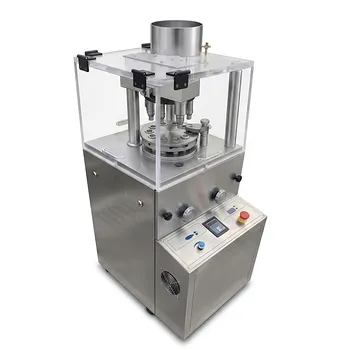
Enhanced 9 Punch Rotary Tablet Press for Powder Compaction
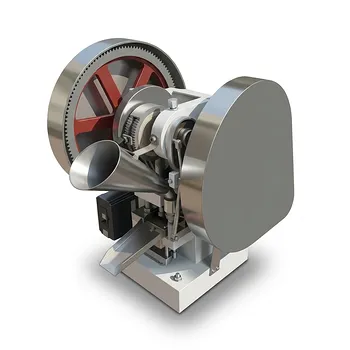
6 Ton Variable Frequency Single Punch Tablet Press
Hydraulic Double Shaft Disperser for High Viscosity Liquid Mixing and Dispersion