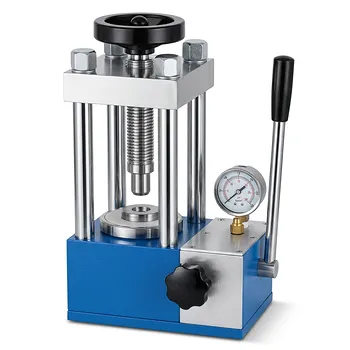
How do lab hydraulic presses and circular molds improve composite specimen precision for reactivity analysis?
Updated 3 months ago
Precise specimen preparation is the foundation of accurate reactivity analysis. Laboratory hydraulic presses and circular molds work in tandem to eliminate physical variables, such as density gradients and air pockets, ensuring that any observed chemical changes are the result of agent reactivity rather than structural defects. By providing stable pressure and standardized geometry, these tools create a consistent "initial state" for high-temperature experiments.
The synergy between controlled hydraulic pressure and precision molding transforms loose powders into dense, uniform composite discs. This standardization is critical because it isolates chemical reactivity as the sole variable, allowing for the accurate observation of mass diffusion and healing reactions.
The Role of Pressure Stability in Chemical Observation
Establishing a Consistent Initial State
A laboratory hydraulic press provides a stable pressure (e.g., 13 MPa) to compress mixtures like yttria-stabilized zirconia (8YSZ) and healing agent powders. This stability ensures that every specimen begins the experiment with the same internal structure. Without this consistency, researchers cannot reliably compare how different agents react under identical conditions.
Eliminating Porosity and Internal Voids
High-pressure molding effectively excludes trapped air bubbles and reduces internal porosity. This process ensures that the matrix material or resin fully occupies the interstitial spaces between particles. By removing these voids, the press creates a dense "green body" that provides a clean environment for observing chemical reactions.
Facilitating Particle Rearrangement
The application of pressure forces powder particles to overcome friction and rearrange into a tighter packing configuration. This increases the contact area between the healing agent and the matrix material. Enhanced contact is the physical foundation required for mass diffusion to occur during subsequent heat treatments.
Geometric Standardization Through Circular Molds
Ensuring Uniform Heat Distribution
Circular molds with specific diameters (e.g., 10 mm) produce specimens with standardized geometries. This uniformity is vital for high-temperature sintering, as it ensures that heat is distributed evenly throughout the sample. Consistent heating prevents localized reaction variances that could skew reactivity data.
Preventing Deformation and Cracking
Precise pressure-holding within a mold eliminates density gradients that often lead to deformation. When a green body is uniform, it is less likely to crack or warp during the thermal expansion associated with chemical reactions. This structural integrity allows for the collection of accurate data on properties like Young’s modulus and hardness.
Standardizing Surface Area for Reactions
Reactivity is often a surface-dependent phenomenon. By using precision-machined circular molds, researchers ensure that the surface-area-to-volume ratio remains constant across all test specimens. This standardization is essential for quantifying the rate and extent of the reaction between the agent and the matrix.
Understanding the Trade-offs and Pitfalls
The Risk of Excessive Pressure
While high pressure reduces porosity, exceeding the material's limit can cause particle crushing or residual internal stresses. These stresses may trigger premature cracking during heat treatment, which can be mistaken for a failure in the healing agent’s reactivity.
Limitations of Mold Geometry
Circular molds are excellent for uniform pressure, but they may not represent the complex geometries found in real-world applications. Edge effects near the mold walls can sometimes create slight density variations if the mold is not properly lubricated or if the powder is not homogenized.
Impact of Loading Speed
The rate at which pressure is applied can impact the degassing phase. Applying pressure too quickly may trap air rather than expel it, leading to internal "lenses" of air that interfere with the chemical bond between the agent and the matrix.
How to Apply This to Your Research
Making the Right Choice for Your Goal
- If your primary focus is high-temperature chemical reactivity: Use a stable pressure (around 13 MPa) and small-diameter circular molds to ensure maximum particle contact and uniform thermal gradients.
- If your primary focus is mechanical strength and density: Prioritize higher pressures (up to 120 MPa) and a degassing phase to fully eliminate internal pores and maximize particle interlocking.
- If your primary focus is repeatable mechanical testing: Ensure a precise pressure-holding function to eliminate density gradients that cause specimen deformation during the curing or sintering stages.
By mastering the variables of pressure and mold geometry, researchers can transform raw composite powders into high-fidelity scientific specimens that yield truly reliable reactivity data.
Summary Table:
| Key Feature | Functional Benefit | Impact on Reactivity Analysis |
|---|---|---|
| Stable Pressure | Ensures consistent internal density | Eliminates structural variables between samples |
| Precision Molding | Standardizes specimen geometry | Guarantees uniform heat distribution during testing |
| Air Exclusion | Removes voids and trapped bubbles | Provides a clean environment for chemical observation |
| Particle Rearrangement | Increases contact surface area | Facilitates accurate mass diffusion and healing reactions |
| Structural Integrity | Prevents cracking and deformation | Ensures reliable measurement of Young’s modulus and hardness |
Elevate Your Material Research with Precision Compaction Solutions
Achieving reliable reactivity data starts with flawless specimen preparation. At [Company Name], we provide complete laboratory sample preparation solutions specifically designed for material science and powder processing.
Our extensive range of equipment empowers researchers to eliminate variables and master specimen consistency:
- Advanced Compaction: A full spectrum of hydraulic presses, including standard lab presses, Cold/Warm Isostatic Presses (CIP/WIP), XRF pellet presses, and vacuum hot presses.
- Powder Processing: High-performance planetary ball mills, jet mills, and cryogenic grinders for perfect homogenization.
- Preparation & Mixing: Precision powder mixers, defoaming mixers, and sieve shakers to ensure material purity.
Whether you are working on healing agents, ceramics, or advanced composites, our tools provide the stable pressure and standardized molding required for high-fidelity scientific results.
Ready to optimize your lab's workflow? Contact our application experts today to find the perfect solution for your research needs!
References
- Soo-Hyeok Jeon, Yeon‐Gil Jung. Effects of Healing Agent on Crack Propagation Behavior in Thermal Barrier Coatings. DOI: 10.4191/kcers.2017.54.6.02
Mentioned Products
- Ordinary Type Rotary Tablet Press for Pharmaceutical Chemical Food Electronic Industries
- Hydraulic Double Shaft Disperser for High Viscosity Liquid Mixing and Dispersion
- 6-Ton Small Single-Punch Tablet Press — Laboratory Powder & Granule Tableting Equipment / Tablet Forming Machine
- Enhanced 9 Punch Rotary Tablet Press for Powder Compaction
- 6 Ton Variable Frequency Single Punch Tablet Press
People Also Ask
- Why is a laboratory hydraulic press required for FT-IR KBr pellets? Achieve Precise Sample Clarity for ZrC–SiC Analysis
- Why is a laboratory hydraulic press required to compress oyster shell powder before XRF analysis? Improve Data Accuracy.
- Why is vacuum sealing and flexible packaging necessary for Aluminum Titanate powders during CIP? Ensure Peak Density
- What are the advantages of using hardened steel molds and graphite spray for titanium powder? Ensure structural integrity
- What role does a high-strength stainless steel mold kit play in the uniaxial die compaction process? Ensuring Precision

Tech Team · PowderPreparation
Last updated on Jun 03, 2026
Related Products
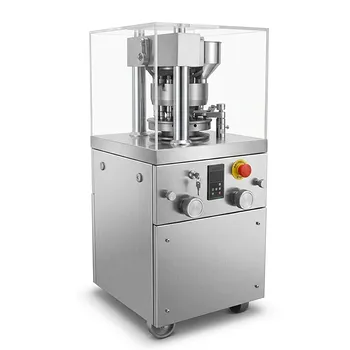
Ordinary Type Rotary Tablet Press for Pharmaceutical Chemical Food Electronic Industries
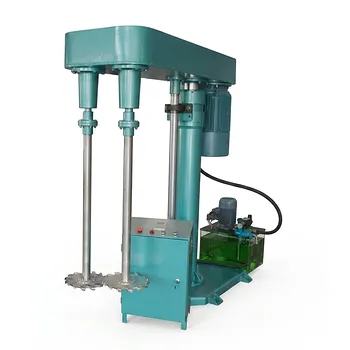
Hydraulic Double Shaft Disperser for High Viscosity Liquid Mixing and Dispersion
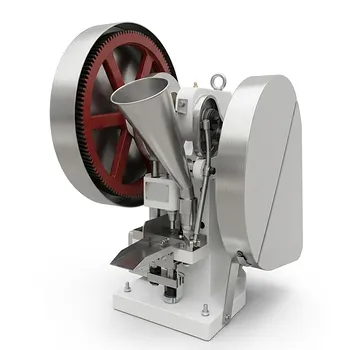
6-Ton Small Single-Punch Tablet Press — Laboratory Powder & Granule Tableting Equipment / Tablet Forming Machine
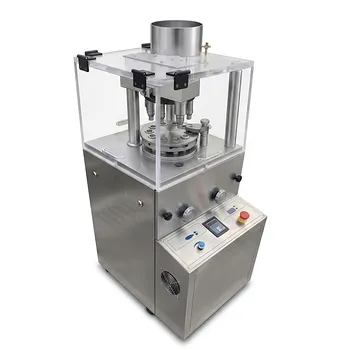
Enhanced 9 Punch Rotary Tablet Press for Powder Compaction
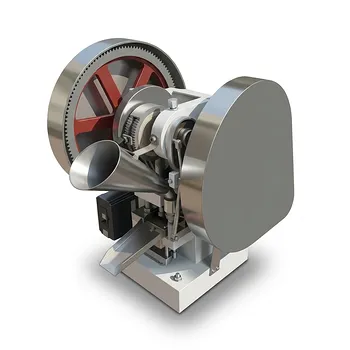
6 Ton Variable Frequency Single Punch Tablet Press
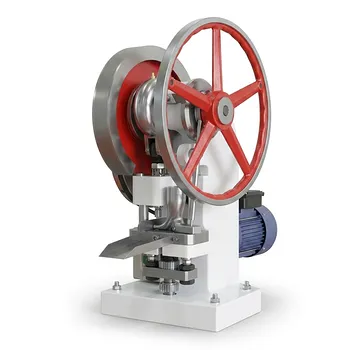
5 Ton Single Punch Tablet Press Laboratory Small Batch Production