Why the Smartest Concrete Fails: The Truth a Hydraulic Press Tells Your Eyes Can’t
Sep 30, 2026
The Sound a Cube Makes When It Breaks
You know it a fraction of a second before the dial peaks. A sharp crack, like a ceramic mug dropped onto a tile floor. The hydraulic press has just shattered a 150mm cube of photocatalytic concrete, and somewhere in that sound is a story about a building that will either stand for a hundred years or fail before the first tenant moves in.
The engineer glances at the digital readout: 58 MPa. He frowns. The spec demanded 60. What happened? Was it the new recycled aggregate? The nano-TiO₂ layer? The loading rate? Or was it something simpler—something that happened long before the press ever touched the test cube?
Most quality control narratives stop at the moment of failure. We draw a number, compare it to a threshold, and decide if a material lives or dies. But that number is a liar if you don’t control everything that came before it. A laboratory hydraulic press isn’t just a crushing machine. It’s an interrogation device—and it only gives honest answers when you’ve asked the right questions with your sample preparation.
The Psychology of Measuring Invisible Things
There’s a cognitive trap in advanced material testing. Because photocatalytic concrete looks like regular concrete, we assume it fractures like regular concrete. It doesn’t. The functional top layer that scrubs NOx from the air is a different beast from the structural base below it. Nano-scale porosity introduced by titanium dioxide changes how compressive forces propagate. What you see on the surface is a uniform gray block. What the press feels is a composite fighting a two-front war.
Morgan Housel once observed that “the threshold of what’s normal constantly adjusts.” In concrete labs, this means we normalize bad data by blaming the mix design, when the real culprit is often sample prep inconsistency. If you don’t standardize how you crush, grind, mix, and press your powder into shape, your test results will vary more from bench to bench than from formula to formula. You end up optimizing for lab noise, not real-world performance.
The Physics the Press Exposes
Stress Isn’t a Single Number
When a hydraulic press applies uniaxial pressure to a cube, it doesn’t just measure “strength.” It maps the failure path of a complex system. Three things matter:
- Ultimate load at failure: The raw number everyone chases (60 MPa, 80 MPa—the magic thresholds).
- Loading rate precision: How fast that load arrived. At 0.25 MPa/s, cracks propagate slowly enough to reveal intrinsic weakness. At 0.50 MPa/s, the same cube might survive by inertia alone.
- Failure mode: Did it explode in a classic hourglass pattern, or did a corner flake off because of eccentric loading?
A high-precision press doesn’t just stamp a pass/fail. It tells you how the material chose to die, and that death certificate is worth more than a hundred pass certificates.
The Layer Nobody Sees
Photocatalytic concrete is a sandwich of purpose. The top layer does chemistry. The bottom layer does physics. Testing one without the other is like judging a car’s safety by only looking at the engine. A laboratory press can test both layers separately or as an integrated system. When a recycled aggregate base layer starts to collapse early, it shows up as a premature drop in the load curve—often before the top layer even cracks. Without precision force recording, you’d miss it entirely and blame the entire cube’s “low strength” on the photocatalyst.
The Life of a Test Cube Before It Enters the Press
It Begins as Powder and Particles
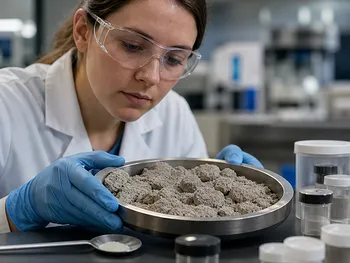
The quality of your compressive strength data is determined days before you start the hydraulic pump. A photocatalytic concrete cube is a statue molded from powder, and its internal architecture was decided the moment you processed the raw materials.
Here’s what that journey looks like:
- Crushing and grinding: Jaw crushers break down recycled concrete aggregate. If particle size distribution skews too coarse, you’ll have hidden weak points. Too fine, and you’ll need more binder than your formula accounts for. A cryogenic grinder can help with tough, heat-sensitive components by keeping them brittle without altering TiO₂’s photocatalytic activity.
- Screening and separation: A sieve shaker with certified test mesh ensures you’re working with consistent particle sizes. Air-jet sieving is even gentler for fine photocatalytic powders that want to agglomerate.
- Mixing and defoaming: Dust doesn’t think; it just clumps. A proper powder mixer eliminates streaks of unreacted sodium silicate, and a defoaming mixer pulls out micro-bubbles that will later turn into stress concentrators.
- Compaction into shape: Whether you’re cold pressing a green body or isostatically pressing a complex ceramic component, this is where internal porosity is either eliminated or locked in for good.
Each step is a lie-detector setup. The pressing step is where you finally hear the truth.
The Micro-Pore Minefield
Imagine holding a translucent rubber sponge. Squeeze it, and the air pockets collapse; it feels denser. That’s what uniaxial pressing does to a powder compact. Now imagine that sponge has a crack inside that you can’t see. When you squeeze, the crack doesn’t close—it twists. That’s an improperly prepared test cube.
A hydraulic press with pressure-holding capabilities (like those used in CIP or WIP processes) applies uniform force from all sides, rearranging particles in three dimensions. It eliminates density gradients that create invisible shear planes. When you finally test that 150mm cube, you’re not testing “did we crush it enough?” You’re testing “did we remove the invisible air first?” The best lab presses let you preset initial porosity by adjusting axial pressure, ensuring your green bodies have that uniform, almost velvety surface that experienced technicians learn to trust.
The Human Bias in the Hydraulic Press
We think of quality control as objective, but it’s full of stories we tell ourselves. There’s a reason Atul Gawande’s work on surgical checklists resonates in material science labs: systematic errors hide in plain sight because no one wants to believe their own hands produce flawed specimens.
The Speed Trap
The human instinct is to speed up something that looks slow. A technician watching a hydraulic ram descend at a regulated 0.25 MPa/s might feel an urge to nudge the valve and get the test over with. This is the “I know this will pass anyway” bias. But some photocatalytic compositions exhibit rate-dependent failure because the top layer’s micro-cracks need time to propagate through the interfacial transition zone. A fast test gives you a flattering lie. A regulated, digitally controlled loading rate gives you the messy truth.
The Alignment Anecdote
A 150mm cube looks symmetrical—until you place it a millimeter off-center in the platen. Then the press creates a bending moment. The cube fails early, and your report claims a strength of 52 MPa instead of 64 MPa. A precision hydraulic press usually has alignment aids and spherical seat platens to compensate, but the machine can only forgive so much. The gap between “the specimen is in the press” and “the specimen is centered” is a territory of unexamined assumptions.
The Environment the Press Doesn’t Control
The press is oblivious to moisture content and temperature. It will faithfully destroy a waterlogged cube and report a low number, never telling you the concrete was fine—the curing room was just too humid. This isn’t a flaw in the machine; it’s a reminder that a hydraulic press is the final link in a chain. If the chain breaks earlier (in grinding, in mixing, in curing), the press simply documents the break.
Making the Press an Honest Witness
To let the equipment do its job, you have to build a workflow that respects physics more than gut feeling. Here’s what that looks like in a research or QC lab setting:
- Verify ultimate load on your 150mm cubes to confidently state your mix exceeds 60 MPa. Don’t just test one; test a statistical population, and ask the press to log the entire load-deflection curve so you can see the shape of failure.
- Separate layer performance testing when developing novel photocatalytic coatings on recycled aggregate bases. Use the press to find out if the weakest link is the coating, the bond line, or the base.
- After thermal exposure (simulating a fire or heat island in a city), run residual strength tests. The press measures the ghost of a material’s former self, telling you if the concrete can still carry a load after the air-cleaning top layer has been chemically stressed.
- Optimize alkali activator ratios for geopolymer photocatalytic mixes. The press can correlate SiO₂/Na₂O ratios with compressive strength across dozens of small cylindrical specimens, guiding your chemistry like a compass.
If you’re serious about photocatalytic concrete, you’re not just buying a press—you’re investing in a truth-telling system that includes the crushers, mills, sieve shakers, mixers, and presses that create the material before the test. Skimp on any one of these, and your hydraulic press becomes a very expensive paperweight that produces very official-looking lies.
The Engineer’s Romantic View
There’s a quiet beauty in watching a precision hydraulic press do its work. The oil flows silently through servo-controlled valves. The ram descends with an inevitability that has no ego. It doesn’t care about your research grant, your promotion, or your deadline. It only reports what the material is.
When it crushes a perfectly prepared cube and the gauge reads 68 MPa, you feel a moment of rare clarity: the weeks of grinding, sieving, mixing, and isostatic pressing have told a complete, honest story. The photocatalytic concrete will scrub the air and hold up the building.
This kind of confidence doesn’t come from a single machine. It comes from an ecosystem of sample preparation and quality control equipment that respects the material from its powder cradle to its final crack.
The Right Toolkit for Honest Concrete Data
A laboratory that can trust its own test results typically relies on a coherent family of instruments:
Sample Preparation (Before the Press Even Matters)
- Crushers and Mills: Jaw crushers, roll crushers, and cryogenic grinders reduce raw materials to precise particle sizes. Planetary ball mills, jet mills, and disc mills handle everything from abrasive recycled aggregates to delicate nano-photocatalysts without degrading their structure.
- Sieve Shakers and Test Sieves: Vibratory and air-jet sieve shakers ensure particle size distributions are consistent—the first line of defense against pack-and-crack density problems.
- Powder Mixers and Defoaming Mixers: These eliminate chemical heterogeneities and micro-bubbles that would otherwise become failure initiation points inside your test cube.
Compaction and Testing
- Cold Isostatic Presses (CIP) and Warm Isostatic Presses (WIP): For eliminating density gradients in complex photocatalytic ceramic components, applying uniform pressure in all directions to create geometrically stable green bodies.
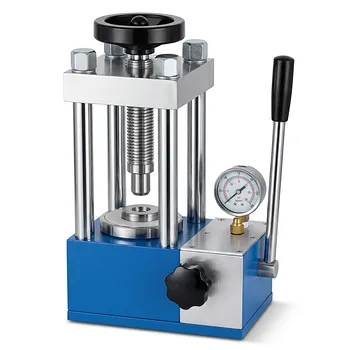
- Standard Laboratory Hydraulic Presses and XRF Pellet Presses: For routine cube preparation, briquette pressing for X-ray fluorescence analysis, and baseline compaction studies.
- Hot Presses and Vacuum Hot Presses: For advanced material development where photocatalytic functionality must survive high-temperature sintering in an oxygen-free environment.
When these systems work together, the 60 MPa test isn’t a terrifying gatekeeper at the end of a project. It’s a predictable milestone in a carefully orchestrated material development pipeline. Your hydraulic press becomes the narrator of a story you expected to hear—not the bearer of bad news you hoped would never come.
Writing a Better Story with Your Next Cube
The difference between concrete that cleans air for decades and concrete that crumbles under a truck’s weight isn’t just in the mix design. It’s in the quiet, unglamorous work of sample preparation and high-precision testing. It’s in the grinders that reduce a post-industrial waste chunk to a uniform powder. It’s in the sieve shaker that catches a rogue 2mm particle. It’s in the mixing paddle that folds activator into precursor without creating a single bubble. And it’s in the hydraulic press that records every newton of resistance until the material confesses its true strength.
The sound a cube makes when it breaks doesn’t have to be a surprise. With the right lab-scale preparation and compaction technology, you can know that sound before it happens—and you can make sure it never happens in a real building, only in your lab, where it belongs.
Quick Links
Suggested Products
Ordinary Type Rotary Tablet Press for Pharmaceutical Chemical Food Electronic Industries Hydraulic Double Shaft Disperser for High Viscosity Liquid Mixing and Dispersion 6-Ton Small Single-Punch Tablet Press — Laboratory Powder & Granule Tableting Equipment / Tablet Forming Machine Enhanced 9 Punch Rotary Tablet Press for Powder Compaction 5 Ton Single Punch Tablet Press Laboratory Small Batch ProductionFurther Reading
The Invisible Architect: How Compaction Psychology Shapes Your LSM Ceramic’s Fate The Cracks You Don’t See: How Pressing Errors Sabotage Self-Reinforced Beta-Si3N4 Ceramics The Invisible Bridge: How Controlled Pressure Shapes the Future of Ceramic-Steel Brazing The Breaking Point: What a Hydraulic Press Reveals About Concrete—and Our Own Biases The 15-Ton Truth: Why Your Elemental Analysis Is Only as Good as Your Pellet
PowderPreparation
Last updated on May 14, 2026
Related Products
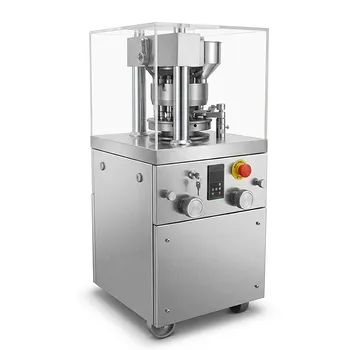
Ordinary Type Rotary Tablet Press for Pharmaceutical Chemical Food Electronic Industries
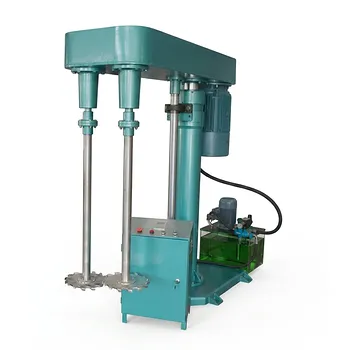
Hydraulic Double Shaft Disperser for High Viscosity Liquid Mixing and Dispersion
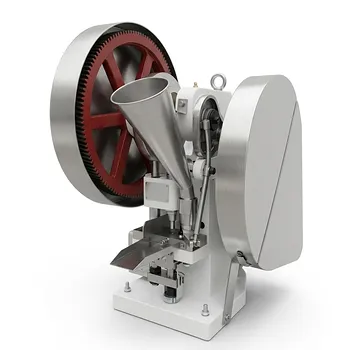
6-Ton Small Single-Punch Tablet Press — Laboratory Powder & Granule Tableting Equipment / Tablet Forming Machine
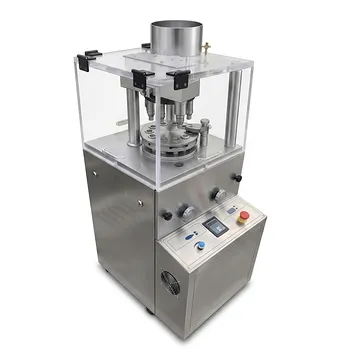
Enhanced 9 Punch Rotary Tablet Press for Powder Compaction
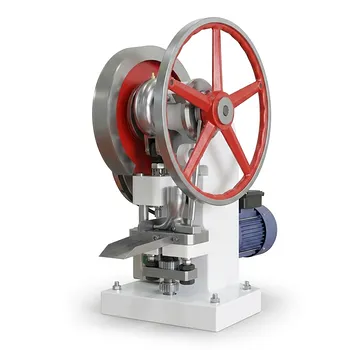
5 Ton Single Punch Tablet Press Laboratory Small Batch Production
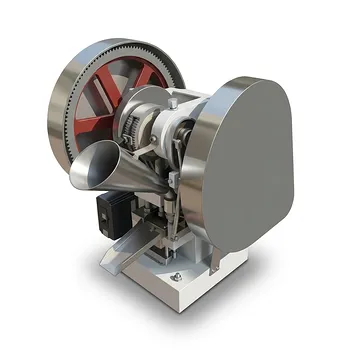
6 Ton Variable Frequency Single Punch Tablet Press