The Invisible Bridge: How Controlled Pressure Shapes the Future of Ceramic-Steel Brazing
Oct 15, 2026
The Moment Before the Furnace
Inside a quiet materials lab, a technician slides a thin foil of silver-copper-titanium between a plate of alumina ceramic and a stainless steel component. The stack looks perfect to the naked eye. But under a scanning electron microscope, minute waviness and sub-millimeter gaps remain invisible.
These gaps are not empty space. They are failure waiting to happen.
When the assembly enters the vacuum furnace at 850 degrees Celsius, the filler melts and seeks to flow. If the contact between ceramic and steel is anything short of intimate, capillary action starves, heat conduction becomes uneven, and atomic diffusion stalls.
The result? A “starved joint.” A bond that looks complete but fractures under modest mechanical load.
This is not a materials problem. It is a pressure problem. And it is solved long before the furnace door closes.
Why Microns of Pressure Define Brazing Quality
Hydraulic presses and precision fixtures serve as the mechanical foundation for joining ceramic and steel. Their role is to create a state of zero-gap intimacy across two materials that have no natural desire to touch each other.
Alignment and Gap Reduction
Fixtures lock the spatial relationship between the ceramic substrate, the filler foil, and the steel. Because these materials expand at drastically different rates during heating, any misalignment before the furnace becomes a permanent defect after.
A hydraulic press applies controlled assembly pressure to “seat” the components together. It flattens microscopic waviness. It pushes filler foil into the surface texture of the ceramic. The goal is not brute force — it is conformity.
Thermal and Atomic Diffusion
Heat must flow uniformly through the assembly to reach the filler’s melting point. A physical gap of even a few microns acts as a thermal insulator. It delays melting locally and creates stress gradients.
Tight mechanical contact builds a high-density thermal path. It transforms the assembly into a single thermodynamic body.
Then comes atomic diffusion. The filler metal needs to migrate into both the ceramic oxide layer and the steel lattice. Pressed contact shortens the diffusion distance and ensures a continuous bond seam. The joint becomes metallurgically sound, not just mechanically touching.
The Backstory: How Ceramic Components Are Born
Brazing quality is not decided only at assembly time. It begins much earlier — in powder form.
From Loose Grain to Predictable Structure
Before a ceramic part can be brazed, it must survive sintering at temperatures that would liquefy steel. That survival depends on the density and defect population locked into the “green body” during compaction.
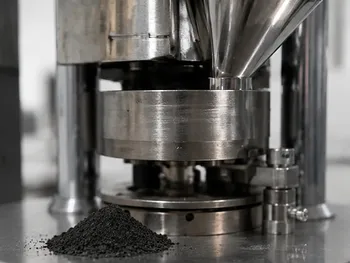
Hydraulic presses — and especially cold isostatic presses (CIP) — apply uniform pressure from all directions to compact oxide powders. This erases internal density gradients. It crushes irregular pores before they can evolve into critical flaws during high-temperature processing.
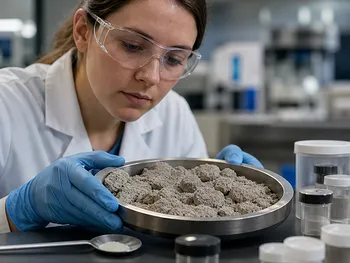
Our planetary ball mills first reduce raw powders to fine, uniform particle sizes. Air-jet sieving then classifies the powder to remove oversized grains that would act as stress concentrators. Finally, CIP or uniaxial lab presses compact the powder into green bodies with consistent wall thickness and internal structure.
Without this chain of pressure events, post-sintering ceramic will harbor sub-surface micro-cracks. Brazing will expose them.
Pressure as a Quality Detective
Hydraulic presses also serve as testing instruments. A ceramic specimen can be loaded under precise compression until fracture. The pressure at which it fails reveals its true load-bearing capacity.
This is not destructive for its own sake. It is verification. It answers the question: Will this ceramic formulation survive the mechanical clamps, thermal shocks, and service loads it is designed for?
Our standard lab presses double as compressive test stations, giving engineers direct feedback on material quality before brazing begins.
The Three Pitfalls That Pressure Must Navigate
Applying pressure to a brittle ceramic is a delicate act. Three risks dominate.
1. Brittle Fracture by Point Load
Ceramics cannot redistribute stress the way metals do. If a press platen is not perfectly flat or alignment is off, the load concentrates on a single high spot. Micro-cracks initiate and propagate instantly.
Precision-ground tooling and uniform force delivery are non-negotiable. Our hydraulic presses incorporate adjustable pressure profiles and parallel pressing surfaces to protect ceramic integrity.
2. Thermal Expansion Mismatch
Steel expands more than ceramic during the brazing cycle. If the fixture is too rigid, it constrains this differential, building internal stress. The bond either breaks during heating or carries residual stress into service.
Fixtures must be designed with calculated compliance, using materials that match the component’s CTE or incorporating spring elements. This is a design challenge solved before the press ever moves.
3. Inconsistent Pressure Across Large Surfaces
When brazing large-area plates, pressure applied at a few points creates stress gradients. The seam becomes non-uniform: too thin here, too wide there.
Isostatic pressing principles solve this. Cold isostatic presses (CIP) and warm isostatic presses (WIP) apply fluid pressure uniformly across the entire component surface, ensuring every square millimeter of the bond line receives identical compression.
Choosing the Right Pressure Strategy
Every brazed ceramic-metal assembly has a different priority. The pressure strategy must match.
| If your primary goal is… | The critical equipment | What it ensures |
|---|---|---|
| Joint strength and hermeticity | High-precision hydraulic lab presses with flat platen fixtures | Zero-gap contact; uniform filler flow; no voids |
| Dimensional stability and green body quality | Cold isostatic presses (CIP) or uniaxial compaction systems | Homogeneous density; reduced sintering defects |
| Powder preparation and particle control | Planetary ball mills, jet mills, air-jet sieves | Repeatable ceramic microstructure; no oversized grains |
| Verification of material capability | Lab presses used in compressive test mode | Quantified load-bearing capacity before brazing |
| Complex multi-material assemblies | Vacuum hot presses | Simultaneous heat and pressure for reactive bonding |
These are not separate processes. They are a continuum. The ceramic that enters the brazing furnace has already been shaped by pressure at multiple stages — milling, powder consolidation, sintering, and final assembly alignment.
The Invisible Bridge in Your Workflow
Think of a brazed joint as a bridge between two materials that were never meant to meet. The filler alloy is the visible arch. But the foundation below — the micron-level contact, the gradient-free density, the removed defect — is built by controlled mechanical pressure.
That foundation is invisible in the finished product. But its absence will announce itself through every premature fracture, every leak path, every unexplained field failure.
We provide complete laboratory sample preparation solutions that make this foundation solid. From liquid-nitrogen cryogenic grinders for temperature-sensitive powders to vacuum hot presses that combine bonding heat with precise force, our equipment ensures your ceramic-steel assemblies meet the highest standards — from powder to performance.
The technical distance between a failed joint and a reliable one is often just a few microns of uniform pressure. We help you conquer those microns.
Quick Links
Suggested Products
Ordinary Type Rotary Tablet Press for Pharmaceutical Chemical Food Electronic Industries Hydraulic Double Shaft Disperser for High Viscosity Liquid Mixing and Dispersion Enhanced 9 Punch Rotary Tablet Press for Powder Compaction 6 Ton Variable Frequency Single Punch Tablet Press Manual Tablet Press with Dual Scale Pressure Gauge for Pharmaceutical Food Chemical Laboratory Sample PreparationFurther Reading
The Invisible Architect: How Compaction Psychology Shapes Your LSM Ceramic’s Fate The Cracks You Don’t See: How Pressing Errors Sabotage Self-Reinforced Beta-Si3N4 Ceramics The Breaking Point: What a Hydraulic Press Reveals About Concrete—and Our Own Biases The 15-Ton Truth: Why Your Elemental Analysis Is Only as Good as Your Pellet The Moment of Truth in Solid‑Lubricant Composites: Why Your Hydraulic Press Decides Everything
PowderPreparation
Last updated on May 14, 2026
Related Products
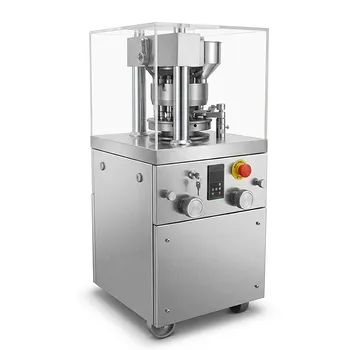
Ordinary Type Rotary Tablet Press for Pharmaceutical Chemical Food Electronic Industries
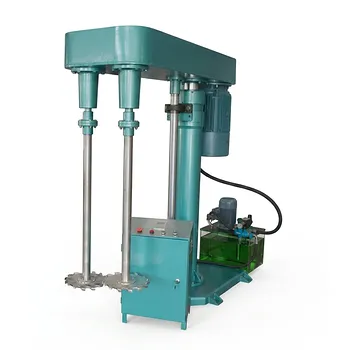
Hydraulic Double Shaft Disperser for High Viscosity Liquid Mixing and Dispersion
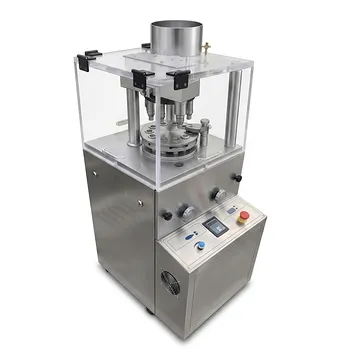
Enhanced 9 Punch Rotary Tablet Press for Powder Compaction
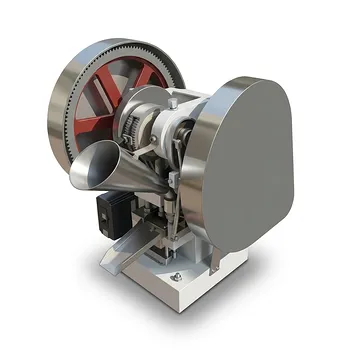
6 Ton Variable Frequency Single Punch Tablet Press
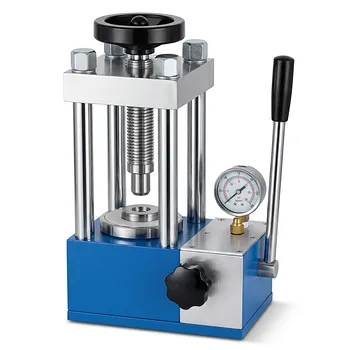
Manual Tablet Press with Dual Scale Pressure Gauge for Pharmaceutical Food Chemical Laboratory Sample Preparation
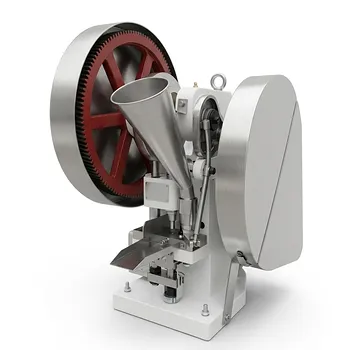
6-Ton Small Single-Punch Tablet Press — Laboratory Powder & Granule Tableting Equipment / Tablet Forming Machine