The Moment of Truth in Solid‑Lubricant Composites: Why Your Hydraulic Press Decides Everything
May 22, 2026
Few decisions in materials engineering are as quietly consequential as the one you make about compaction.
When you formulate a solid‑lubricant composite, you are designing a material that must cheat friction for years. You carefully select the matrix powder, the lubricant phase, the reinforcement particles. You mix them into a homogeneous blend. At that point, you are holding a jar of potential.
Potential that has no mechanical integrity, no geometry, and no future unless the next stage is flawless.
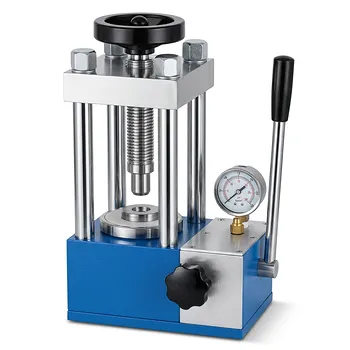
The powder is not a material yet. It is a possibility. And the machine that converts possibility into a tangible, testable green body is a laboratory hydraulic press.
That machine does far more than simply “press powder.” It writes the structural destiny of your composite before any heat touches it.
The Physics That a Hydraulic Press Must Manage
What happens inside a die during compaction is a violent, micron‑scale rearrangement. Loose particles — many of them irregular, some coated with lubricant layers — must slide past each other, break some of their own surface asperities, and settle into a configuration dense enough to hold together.
It is a problem of mechanical persuasion, not melting. And persuasion demands pressure.
A laboratory hydraulic press delivers that pressure axially, often reaching hundreds of megapascals. The force does three things at once:
- It overcomes inter‑particle friction so the powder can reorganize.
- It causes plastic deformation at contact points, creating mechanical interlocking.
- It evacuates trapped air that would otherwise become internal voids.
Miss any of those, and the green body is a fiction — a shape that looks solid but carries internal defects that will propagate during sintering.
The Air You Don’t See Is the Problem You Will Feel Later
When you compress a powder, air has only one escape route: up and out through the clearances in the tooling. If the press cannot maintain dwell time at peak pressure, or if the pressure ramps unevenly, air becomes trapped inside the compact.
These bubbles survive compaction. During sintering, they expand or collapse into micro‑cracks. Suddenly the theoretical density you calculated means nothing.
The real‑world result: scatter in your mechanical testing data that you cannot explain — because the flaw was sealed inside the green body months earlier.
Why Pressure Uniformity Determines Lubricant Distribution
Solid‑lubricant composites are unique because they contain a phase that is intentionally weak — the lubricant — dispersed in a load‑bearing matrix. If the press creates density gradients, the lubricant‑rich zones become structural weak points. Worse, during sintering, differential shrinkage from those gradients can tear the material apart internally.
The hydraulic press’s ability to apply and hold pressure uniformly across the entire pellet face is what locks the lubricant distribution in place. This is not primarily about average compaction pressure. It is about the absence of gradients.
A press that allows slight tilting in the platen, that does not compensate for die wall friction, or that releases pressure too abruptly will produce a green body that is geometrically perfect on the outside and structurally broken on the inside.
The Psychological Trap of “It Looked Fine”
Many researchers avoid optimizing compaction because the problem is invisible. The green body appears intact. You only discover the failure after sintering, during polishing, or when the tensile curve fractures early.
That delay creates a dangerous feedback loop: you adjust powder composition or sintering profiles to fix a problem that actually lives in the compaction step. You spend months changing the wrong variables.
This is the Morgan Housel truth: the cost of a mediocre press is not the purchase price — it is the quiet cost of wasted research time, misleading data, and a material that never reaches its potential.
Tooling Is Not Accessory; It Is Part of the Machine’s Capability
No hydraulic press performs better than the die it drives. The relationship between press and tooling is intimate, and when it goes wrong, the consequences are immediate.
A high‑precision die made from hardened stainless steel will distribute pressure evenly and survive hundreds of cycles. But if you push pressure too high, too fast, you risk galling, die wall scoring, or catastrophic die lock.
This is the operational trade‑off: density versus tooling life. A press with programmable pressure ramp profiles — not just a pressure setpoint — gives you the ability to navigate that trade‑off intelligently. You can approach peak pressure gradually, give the particles time to rearrange, and then hold the final load for a defined duration.
That control is not a luxury. For self‑lubricating composites, where the lubricant is soft and compressible, rapid loading can segregate the phases before they are locked in place.
How Compaction Choices Cascade Into Sintering Outcomes
Sintering is when your green body becomes a real material. But sintering does not rescue bad compaction; it amplifies it.
A green body with high, uniform density will sinter predictably. The shrinkage is isotropic. The final dimensions can be estimated. The mechanical properties — hardness, Young’s modulus, transverse rupture strength — will have tight distributions.
A green body with density gradients will sinter unevenly. Warpage, cracking, and unpredictable shrinkage become normal. The lubricant may exude to the surface or accumulate in pockets. The matrix may not densify fully because contact points between matrix particles were never established.
The Pre‑Sintering Gate You Cannot Skip
Think of compaction as the gate through which every particle must pass before it can participate in diffusion bonding. A hydraulic press that lets you systematically vary pressure and dwell time turns that gate into a controlled experiment. You can map green density to sintered density for every new composition.
Without that control, you are guessing. And guessing in materials science is expensive.
Choosing the Right Press for Your Goal
The application dictates the specification, not the other way around.
If Your Goal Is Data Accuracy
Choose a press with a digital pressure gauge and an automated holding timer. Identical compaction cycles produce identical green bodies. That reproducibility is the foundation of credible mechanical data.
If Your Goal Is New Phase Development
Use the highest practical pressures — 200 MPa and above — to maximize inter‑particle contact. More contact points mean more diffusion pathways during heat treatment. This is how novel solid‑lubricant chemistries emerge.
If Your Goal Is Complex Geometry or Binder‑Assisted Forming
Look for a press that can integrate controlled heating of the die. Warm compaction improves the flow of binders and allows the lubricant phase to distribute more uniformly before the matrix locks.
The Broader Workflow: Compaction Is the Heart, Not the Whole Body
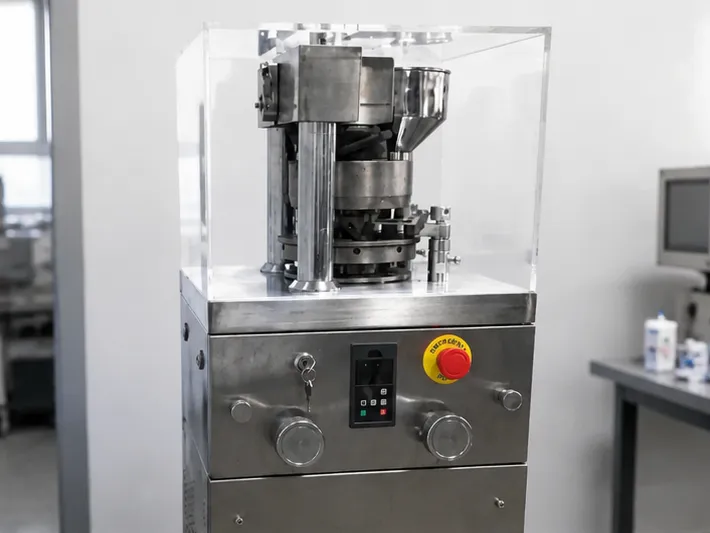
A laboratory hydraulic press is the central event, but it sits inside a sequence. The quality of the powder entering the die determines what pressure can achieve. The way the specimen is removed and handled determines whether green‑body defects are introduced after compaction.
This is why complete sample preparation matters. Before you can press a powder into a uniform green body, you must first reduce it to the right particle size, ensure homogeneity, and perhaps cryogenically treat it to preserve lubricant integrity.
After compaction, you must be able to verify density, inspect for cracks, and then move to thermal processing with confidence that the intermediate product is sound.
How a Complete Portfolio Supports Every Step
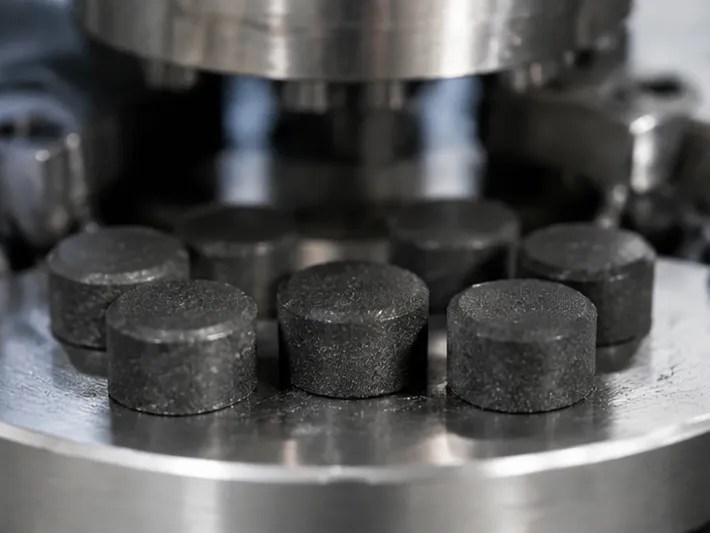
A laboratory that develops solid‑lubricant composites needs more than a press. It needs a workflow that starts with raw material and ends with a characterizable solid.
For size reduction, jaw crushers and roll crushers handle coarse fragments, while liquid‑nitrogen cryogenic grinders make brittle materials fracture without damaging thermally sensitive lubricant phases.
Fine milling — planetary ball mills, jet mills, disc mills, rotor mills — gives you control over particle size distribution and morphology, both of which influence compaction behavior. Vibratory sieve shakers and air‑jet sieve shakers ensure that only the target fraction reaches the die, eliminating outliers that would create density inhomogeneities.
Powder mixers and defoaming mixers then homogenize the matrix‑lubricant blend without leaving gas bubbles trapped in the powder itself.
And the compaction stage is not limited to standard uniaxial pressing. Cold Isostatic Pressing (CIP) allows you to produce green bodies with truly isotropic density — critical for larger self‑lubricating components. Warm Isostatic Pressing (WIP) combines temperature and isostatic pressure for even greater densification. Vacuum hot presses take compaction and sintering into a single integrated step, eliminating handling of fragile green bodies entirely.
A Table of Compaction Pathways
| Press Type | Pressure Mode | Key Advantage for Solid‑Lubricant Composites |
|---|---|---|
| Standard Lab Hydraulic Press | Uniaxial, room temperature | Rapid prototyping, precise density control for small pellets |
| XRF Pellet Press | Uniaxial, high reproducibility | Ideal for analytical specimens with exact geometry requirements |
| Cold Isostatic Press (CIP) | Isostatic, room temperature | Eliminates density gradients; perfect for larger preforms |
| Warm Isostatic Press (WIP) | Isostatic, elevated temperature | Improves binder distribution and lubricant homogeneity |
| Vacuum Hot Press | Uniaxial, vacuum + heat | Combines compaction and sintering; reduces oxidation risk |
Each of these presses exists within a larger ecosystem of crushers, mills, sieve shakers, and mixers. Together, they form a complete sample‑preparation chain that turns the powder‑in‑a‑jar into reliable material property data.
The Engineer’s Responsibility Is to the Stage No One Sees
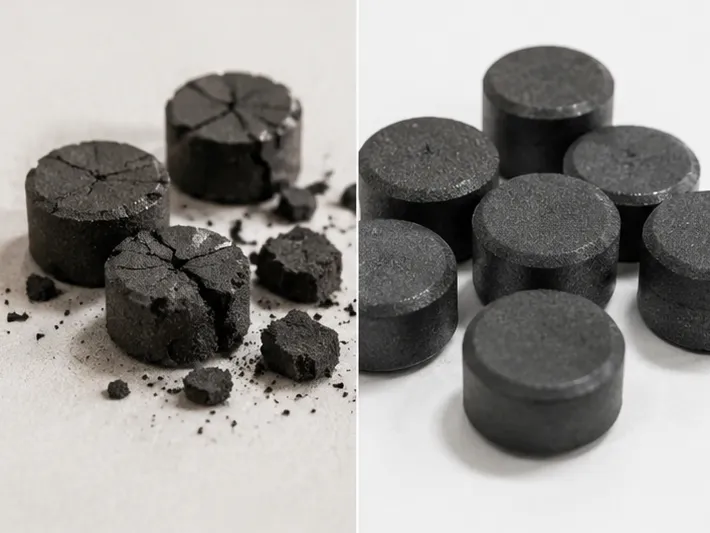
Compaction is not glamorous. It happens before the furnace, before the polishing, before the instron curve that ends up in a journal paper. Most process‑development conversations skip directly to sintering profiles or lubricant chemistry.
But every failure mode that appears later was already present in the green body, waiting.
A precision laboratory hydraulic press — one that offers programmable pressure ramps, accurate dwell control, and a robust tooling interface — is the cheapest insurance you can buy against wasted sintering runs and irreproducible data.
When you accept that the compaction stage decides the material’s fate, you stop treating the press as a utility and start treating it as an instrument. The difference shows up in every data point, every polished cross‑section, and every material that survives its design life without structural failure.
If you are building the next generation of self‑lubricating composites, begin your optimization where the material is actually born — in the die, under controlled pressure, with nothing left to chance.
Quick Links
Suggested Products
Ordinary Type Rotary Tablet Press for Pharmaceutical Chemical Food Electronic Industries Hydraulic Double Shaft Disperser for High Viscosity Liquid Mixing and Dispersion 6-Ton Small Single-Punch Tablet Press — Laboratory Powder & Granule Tableting Equipment / Tablet Forming Machine Enhanced 9 Punch Rotary Tablet Press for Powder Compaction 5 Ton Single Punch Tablet Press Laboratory Small Batch ProductionFurther Reading
The Invisible Architect: How Compaction Psychology Shapes Your LSM Ceramic’s Fate The Cracks You Don’t See: How Pressing Errors Sabotage Self-Reinforced Beta-Si3N4 Ceramics The Invisible Bridge: How Controlled Pressure Shapes the Future of Ceramic-Steel Brazing The Breaking Point: What a Hydraulic Press Reveals About Concrete—and Our Own Biases The 15-Ton Truth: Why Your Elemental Analysis Is Only as Good as Your Pellet
PowderPreparation
Last updated on May 14, 2026
Related Products
Ordinary Type Rotary Tablet Press for Pharmaceutical Chemical Food Electronic Industries
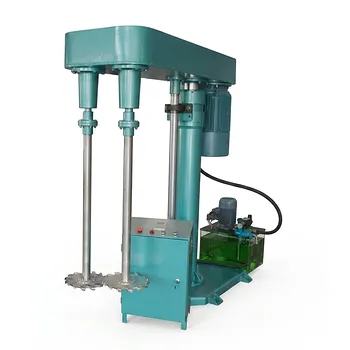
Hydraulic Double Shaft Disperser for High Viscosity Liquid Mixing and Dispersion
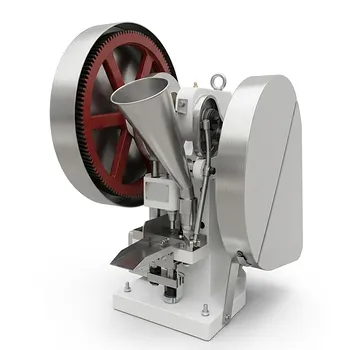
6-Ton Small Single-Punch Tablet Press — Laboratory Powder & Granule Tableting Equipment / Tablet Forming Machine
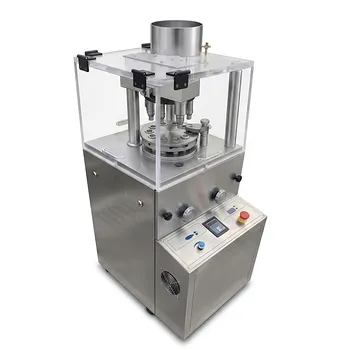
Enhanced 9 Punch Rotary Tablet Press for Powder Compaction
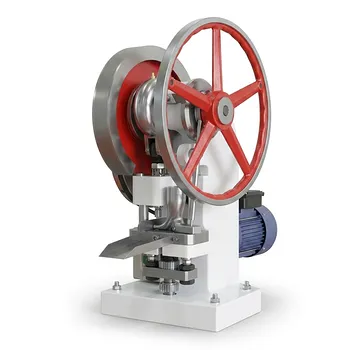
5 Ton Single Punch Tablet Press Laboratory Small Batch Production
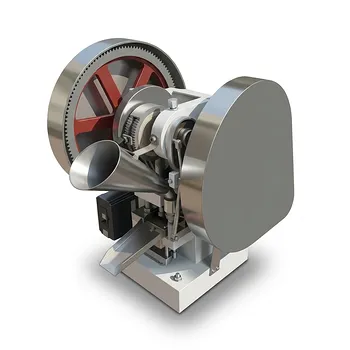
6 Ton Variable Frequency Single Punch Tablet Press