The Hidden Mechanics of Density: How a Simple Press Transforms Brittle Powder into Unbreakable Composites
May 19, 2026
The Problem That Sits in Every Lab Oven
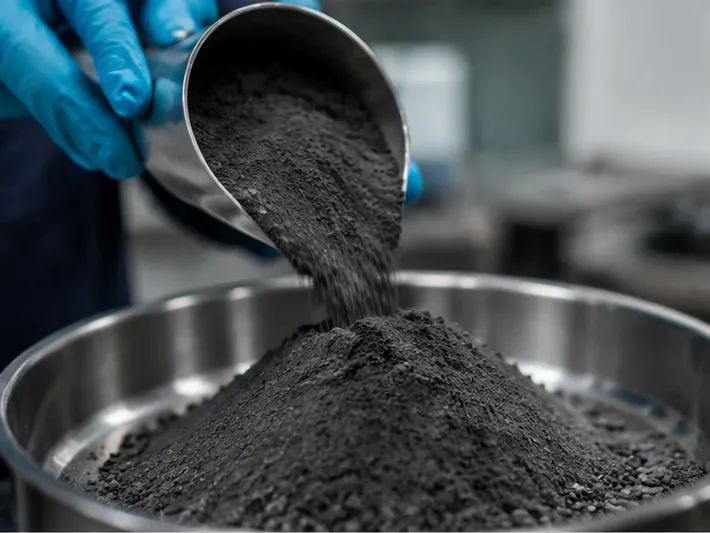
A researcher loads a die with a careful blend of silicon carbide and vanadium carbide powder. The mixture has the consistency of dry, abrasive flour. It goes into a furnace. Temperatures climb. Atoms begin to diffuse. And then, at the end of a long cycle, the sample comes out looking solid but acting brittle—full of microscopic voids that no amount of heat alone could close.
This is the limit of pressureless sintering. You can raise the temperature as high as you like, but thermal energy moves atoms at random. It does not direct them. It does not force them into the lonely corners between particles where porosity lives.
A uniaxial hydraulic system changes that. It grabs hold of the powder bed with a steady 45 MPa of mechanical force and says: You will rearrange. You will flow. You will become dense.
This is not just a process upgrade. It is a philosophical shift in how we think about material creation.
The Moment Force Beats Heat
We tend to believe that more energy in means better properties out. Heat it higher. Hold it longer. But at a certain point, the furnace cannot help you. Grain growth starts trapping pores inside the microstructure, locking in weakness forever.
The insight—and it’s one that material scientists keep rediscovering—is that porosity is a mechanical problem that demands a mechanical solution.
A uniaxial hydraulic press integrated with the sintering cycle provides exactly that. It applies a continuous axial pressure of approximately 45 MPa, creating a driving force that thermal diffusion alone cannot match.
What That Force Actually Does
The powder bed experiences three sequential transformations:
- Particle sliding. The pressure overcomes static friction between SiC and VC grains. Particles skate past one another into tighter packing configurations, filling micro-voids that would otherwise persist as defects.
- Thermal softening meets mechanical flow. As temperature rises, the material enters a pliable state. The press now drives plastic flow—the bulk migration of softened material into remaining gaps.
- Pore closure before entrapment. With precise timing, internal pores collapse below the 8.2% porosity threshold before grain boundaries can advance and seal them in place.
The result is not incremental improvement. It is a step-change in density, hardness, and fracture toughness that no amount of atmospheric sintering can approach.
The Psychology of Density: Why We Underinvest in Force
Morgan Housel once wrote that the most powerful forces in finance are the ones people underestimate because they seem too simple. Compound interest. Patience. A long time horizon.
The same is true in materials processing.
A hydraulic press looks like a blunt instrument. It pushes. That’s all. So researchers often over-invest in sophisticated thermal profiles while treating pressure as an afterthought—a fixed setting you dial in and forget.
But the truth is more nuanced:
- Pressure has a timing problem. Apply it too early, when powders are still cold and brittle, and you fracture particles instead of rearranging them. Apply it too late, and grain boundaries have already walled off the pores you needed to eliminate.
- Pressure has a geometry problem. If your sample’s height-to-diameter ratio is too large, friction against the die walls dissipates force before it reaches the center. You get a dense shell and a porous core—a hidden weakness.
- Pressure has a tooling problem. Sustaining 45–50 MPa at elevated temperatures punishes your molds. Ordinary materials deform or contaminate the sample. You need high-strength plungers and dies designed for this exact abuse.
These are not reasons to avoid uniaxial pressing. They are reasons to respect it—to treat pressure as a precision parameter, not a commodity input.
The Density–Toughness Trade-off You Didn’t Know You Were Making
Here’s a mental model that helps: Every pore in your composite is a pre-installed crack.
Under load, stress concentrates at the edge of each void. A crack initiates. It propagates. If the material is porous, nothing stops it—there are no dense bridges of well-bonded SiC and VC to deflect the fracture path.
A uniaxial hydraulic system eliminates those pre-installed cracks. It forces the matrix and reinforcement phases into intimate contact, creating a microstructure where VC particles can do their job: deflect, bridge, and arrest cracks before they become catastrophic failures.
The data backs this up:
| Densification Mechanism | What the Press Does | Why It Matters for Your Part |
|---|---|---|
| Particle Rearrangement | Overcomes internal friction via axial force | Fills micro-voids before heating even begins |
| Plastic Flow | Drives material migration at temperature | Eliminates pores that thermal diffusion cannot reach |
| Pore Collapse Timing | Applies peak pressure during optimal softening window | Prevents pore entrapment by advancing grain boundaries |
| Directional Consolidation | Maintains uniform force along a single axis | Minimizes density gradients that cause warping or cracking |
| Controlled Depressurization | Enables gradual release during cooling | Avoids micro-cracking from uneven thermal contraction |
This is not a table of abstract mechanisms. It is a recipe for reliability.
The Engineer’s Romance: When a Press Becomes a Sculptor
There is something quietly beautiful about watching a hydraulic cylinder descend on a column of powder. You start with dust—disconnected, random, fragile. You apply heat and pressure with the kind of timing that takes years to learn, and you end with something that can withstand thousands of degrees and still resist fracture.
Atul Gawande would recognize this as a system problem. The press, the die, the temperature ramp, the powder preparation upstream—all of it must work together. A flaw in any one element undoes the rest.
That’s why the equipment you choose matters more than most labs admit.
When you’re working with SiC–VC composites at 40 wt.% carbide loading, you need presses that can deliver steady, controllable force through the entire thermal cycle. You need hot presses and vacuum hot presses that integrate seamlessly with your sintering protocol. You need cold and warm isostatic presses for pre-compaction steps that ensure uniform green density before the uniaxial force even enters the picture.
And you need the upstream preparation—the crushers that reduce your raw materials to consistent particle sizes, the cryogenic grinders that prevent phase transformations during milling, the jet mills and planetary ball mills that give you the narrow size distributions that density well, the sieve shakers that verify your particle size before you ever load a die.
Densification is a chain. The press is only one link—but it’s the one where force meets matter.
Optimizing for Your Outcome: A Decision Framework
What you optimize for changes how you use the hydraulic system. Here’s how to think about it in human terms:
If You’re Chasing Maximum Hardness
You’re trying to make something that resists indentation and wear. Your enemy is residual porosity of any size. Your strategy: maintain steady pressure through the entire peak-temperature dwell. Don’t cycle the force. Don’t back off early. Let the plastic flow finish its work.
If You’re Preventing Micro-Cracks
You’ve had parts fail during cooling. The surface looks intact, but internally there are stress fractures from uneven contraction. Your strategy: focus on the controlled release of pressure. Ramp down slowly. Let the part contract uniformly while still supported by a diminishing axial load. This is where vacuum hot presses with programmable pressure profiles become essential, not optional.
If You’re Reinforcing with High VC Content (40 wt.%+)
Vanadium carbide particles don’t sinter as readily as SiC. They need mechanical interlocking. Your strategy: the press must do more work because thermal diffusion will not bridge the gap. Higher pressures, longer dwells under load, and careful attention to particle size and mixing homogeneity are non-negotiable.
The Equipment Advantage You Can’t Afford to Ignore
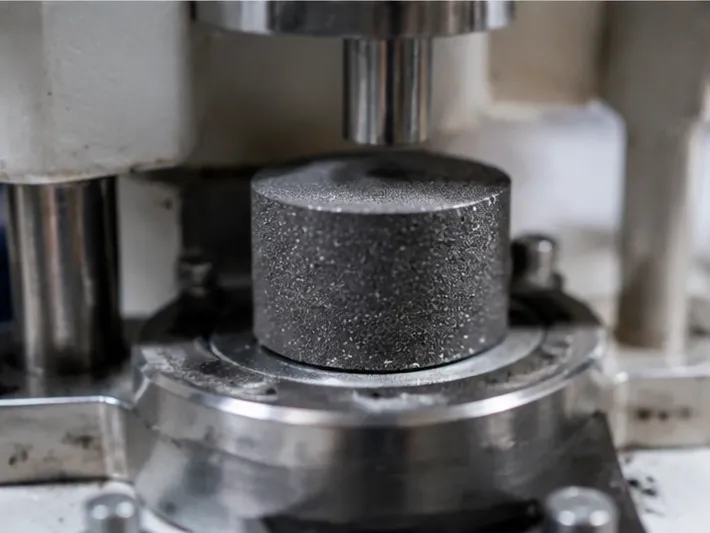
Every one of these strategies depends on having the right tools. Not just a press—an ecosystem.
That ecosystem includes:
- Hot Presses and Vacuum Hot Presses that deliver uniaxial force with precise timing, temperature control, and atmosphere management. These are the core of thermo-mechanical densification.
- Cold and Warm Isostatic Presses (CIP/WIP) that pre-compact powders into uniform green bodies, eliminating the density gradients that uniaxial pressing can sometimes create in tall samples.
- Jaw Crushers, Roll Crushers, and Liquid Nitrogen Cryogenic Grinders that reduce your starting materials without introducing contamination or unwanted phase changes.
- Planetary Ball Mills, Jet Mills, and Bead Mills that give you the particle size control required for consistent packing and flow under pressure.
- Sieve Shakers and Precision Test Sieves to verify your particle distribution before it ever reaches the die.
- Powder Mixers and Defoaming Mixers that ensure every gram of your SiC–VC blend is homogeneous—because segregation in the powder translates to weak spots in the final part.
When the equipment is designed to work together, the result is not just a dense composite. It’s a reproducible process that turns out reliable, high-performance materials cycle after cycle.
The Closing Argument: Force Is Not Forgotten
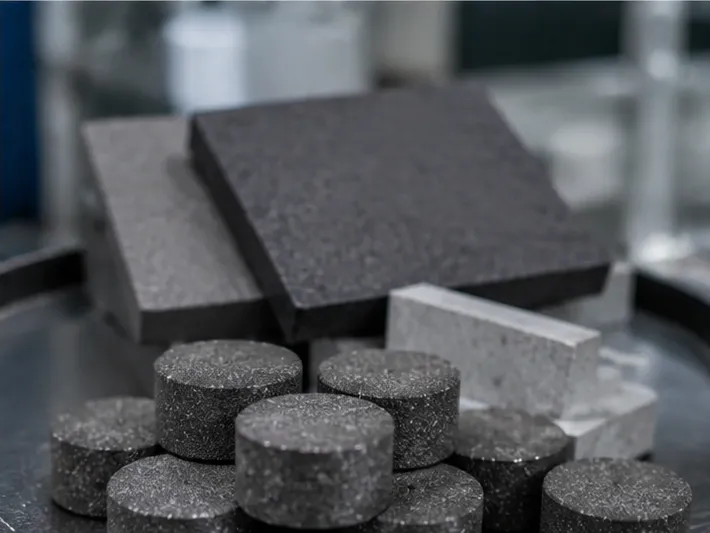
We remember the heat. The glowing elements. The controlled atmosphere. The hours of ramping and holding. But the force—the quiet, sustained push of a hydraulic cylinder—is the unsung hero of every high-density ceramic that survives a demanding application.
Without it, you are asking diffusion to do a job it was never designed to do. With it, you are no longer sintering. You are engineering density itself.
If you’re ready to move beyond the limits of pressureless processing and into the precision of thermo-mechanical consolidation, we should talk. Our laboratory solutions for powder processing and compaction are built for exactly this kind of work—from raw particle preparation to final densification under controlled force.
Quick Links
Suggested Products
6-Ton Small Single-Punch Tablet Press — Laboratory Powder & Granule Tableting Equipment / Tablet Forming Machine 6 Ton Variable Frequency Single Punch Tablet Press 5 Ton Single Punch Tablet Press Laboratory Small Batch Production Manual Tablet Press with Dual Scale Pressure Gauge for Pharmaceutical Food Chemical Laboratory Sample Preparation Enhanced 9 Punch Rotary Tablet Press for Powder CompactionFurther Reading
From Dust to Data: How Precision Laboratory Presses Forge Truth in Mineral Testing The Layers That Wouldn’t Lie Flat: Why Nine Sheets of Ceramic Demand a Laboratory Press That Thinks in Microns The Hidden Fracture: Why Ceramic Feed Rods Fail Before the First Melt The Invisible Architect: How Compaction Psychology Shapes Your LSM Ceramic’s Fate The Invisible Architect of Powder: How a Single Additive Saves Ductile Metals from Themselves
PowderPreparation
Last updated on May 14, 2026
Related Products
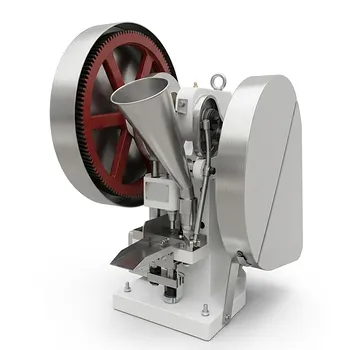
6-Ton Small Single-Punch Tablet Press — Laboratory Powder & Granule Tableting Equipment / Tablet Forming Machine
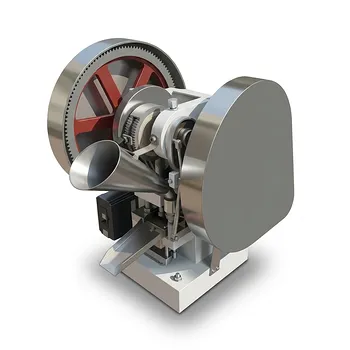
6 Ton Variable Frequency Single Punch Tablet Press
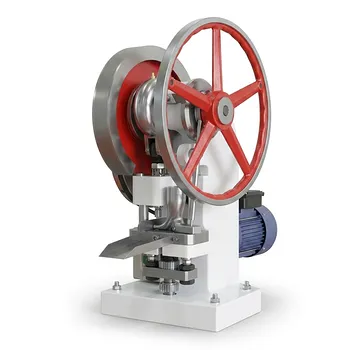
5 Ton Single Punch Tablet Press Laboratory Small Batch Production
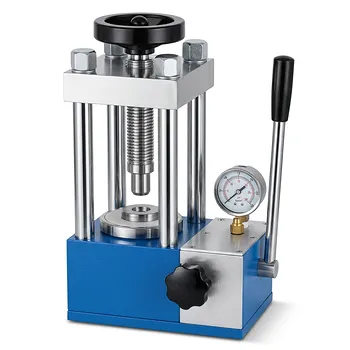
Manual Tablet Press with Dual Scale Pressure Gauge for Pharmaceutical Food Chemical Laboratory Sample Preparation
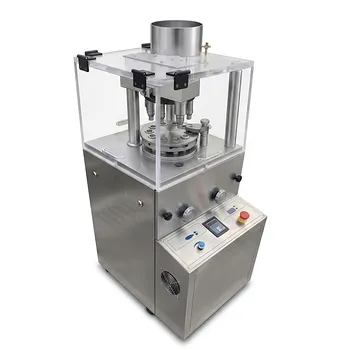
Enhanced 9 Punch Rotary Tablet Press for Powder Compaction