The Crack in the Crucible: A Systems Approach to Perfect Bismuth Ferrite Targets and the Hidden Physics of Powder Compaction
Jun 04, 2026

The Survivorship Bias of a Ceramic Disc
The graduate student held the third cracked bismuth ferrite target of the month. The sintering log was perfect: a textbook 900 °C ramp, precise dwell times, controlled atmosphere. The failure, the professor insisted, must have been a contamination problem.
It was not.
The crack was born five days earlier, inside a hydraulic press, at room temperature, in the silence of a powder grain that never quite found its neighbor. Nobody saw it because structural flaws at the green-body stage are invisible to the naked eye. They are latent. They wait for thermal stress to reveal them. And then they break your heart.
This is the psychology of compaction failure. We blame the furnace. We blame the powder chemistry. But the true culprit is often an undervalued, under-instrumented step: the uniaxial pressing of a 1-inch ceramic target.
Understanding that step doesn’t just save a batch of bismuth ferrite. It forces you to rethink sample preparation as a system, not a sequence of disconnected machines.
Why Bismuth Ferrite Punishes Poor Compaction
Bismuth ferrite (BiFeO₃) is a multiferroic darling. It promises room-temperature coupling between magnetic and electric order. But it is a demanding ceramic. Its perovskite structure tolerates very little internal drama.
During sintering, differential shrinkage across a poorly compacted green body creates tensile stresses that the nascent ceramic cannot accommodate. Cracks propagate. Targets become expensive paperweights.
The problem is systemic:
- Fine powders agglomerate.
- Agglomerates bridge, leaving micron-sized pores.
- Pores become stress concentrators during thermal expansion.
- Pressures that are too low fail to break agglomerates; pressures that are too high create lamination.
A uniaxial hydraulic press is where you negotiate peace between these forces.
The Mechanics of Green-Body Integrity
Particle Rearrangement: The First and Most Humble Dance
Uniaxial pressure—typically 50 MPa to 80 MPa for bismuth ferrite—overcomes the van der Waals and electrostatic repulsions that keep fine grains apart. Under this force, particles don’t crush; they slide, spin, and nest.
What you see: a powder column shrinking in height. What actually happens: a chaotic ensemble of sharp, irregular grains reorganizes into a near-hexagonal order where every particle finally touches its neighbors.
This is the step that eliminates the largest pores. Miss it, and those voids collapse unevenly during sintering, pulling the structure apart.
Mechanical Bonding at Room Temperature
Without heat, the bonds are weak. But they are numerous. Edge contacts create enough mechanical strength—often a few MPa in diametral compression—to survive ejecting the pellet from the die and carrying it to the furnace.
This handling strength is not a luxury. A cracked green body goes into the furnace already doomed. The press gives the ceramic target its spinal column.
Pressure Uniformity and the 1-Inch Advantage
A 1-inch (25.4 mm) diameter is forgiving. Friction between the powder and the die wall does create a pressure gradient—top pressure can be 15% higher than mid-sample—but in a thin, inch-wide puck, that gradient is manageable.
The trick is lubrication. A thin film of stearic acid or a properly formulated binder reduces wall friction, flattening the density profile from edge to center.
Table: Key Compaction Parameters for Bismuth Ferrite Green Bodies
| Parameter | Recommended Value | Consequence of Deviation |
|---|---|---|
| Compaction Pressure | 50–80 MPa | <50 MPa: residual porosity. >80 MPa: risk of lamination. |
| Die Material | High-Cr steel or Tungsten Carbide | Soft dies deform, producing non-parallel faces. |
| Powder Conditioning | Granulated with 1–2% PVA binder | Improves flow, reduces bridging, enhances green strength. |
| Pressure Release Rate | Slow (dwell 10–30 s at peak) | Rapid decompression causes elastic springback and "capping" cracks. |
| Target Diameter Tolerances | ±0.05 mm | Ensures fit in sputtering guns; diameter drift indicates die wear. |
The Capping Paradox: When More Pressure Destroys
High pressure makes us feel safe. We equate it with density. But powder compacts have memory; after plastic deformation, grains still store elastic energy.
The moment the load is removed, those grains try to return to their original shape. If the pressure was too high, or the decompression too abrupt, the stored energy releases as a horizontal fracture plane—capping. The pellet separates like a biscuit.
The psychology here is dangerous: “If 70 MPa is good, 100 MPa must be better.” It is not better. It is a failure mode wearing a mask of over-achievement.
A controlled release cycle is not a finishing touch; it is a fundamental compaction parameter.
The Unseen Prerequisites: What Happens Before the Press
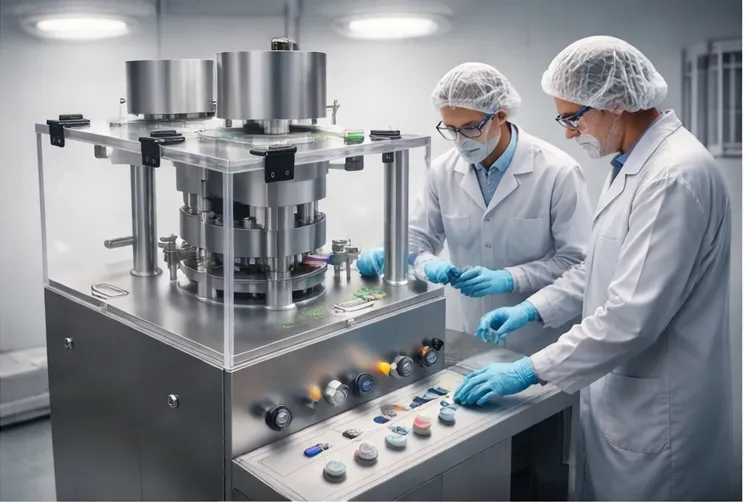
A hydraulic press can only save a powder that arrives prepared.
- Agglomerate control: Jaw crushers and planetary ball mills reduce precursor oxides to a uniform particle size distribution. An agglomerate larger than 50 µm is a guaranteed pore in a 1-inch target.
- Sieving precision: Vibratory sieve shakers with calibrated test sieves ensure that the powder fed to the die has a known, narrow size distribution. Air-jet sieving prevents blinding of fine meshes.
- Homogeneous mixing: Powder mixers that avoid dead zones ensure bismuth oxide and iron oxide are uniformly distributed. Chemical inhomogeneity creates regions of different sintering kinetics—another crack source.
- Cryogenic grinding: For sensitive or ductile precursors, a liquid nitrogen cryogenic grinder prevents oxidation and preserves stoichiometry. The alternative—heating during grinding—can alter phase composition before sintering even begins.
What looks like a single compaction step is actually the culmination of an entire powder processing ecosystem. The press is the final architect, but it builds with the materials the upstream processes deliver.
Extending the Principle: From Lab to Production and Beyond
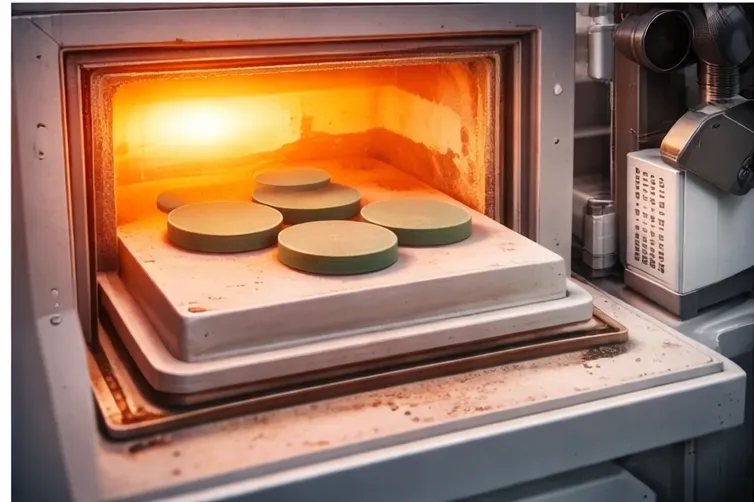
The same compaction physics governs XRF pellets, isostatically pressed ceramics, and hot-pressed advanced composites.
- Cold Isostatic Pressing (CIP) takes the uniform pressure concept and applies it in all three dimensions via a fluid medium. It eliminates the die-wall friction gradient almost entirely. For targets larger than 2 inches, CIP is the natural evolution.
- Warm Isostatic Pressing (WIP) adds moderate heat, activating diffusion mechanisms that enhance green density without the full energy cost of sintering.
- Vacuum Hot Pressing merges compaction and sintering into a single step under controlled atmosphere, ideal for non-oxide ceramics where oxidation must be avoided.
- XRF Pellet Presses demand flat, parallel faces and reproducible density for accurate fluorescence analysis; the same care in dwell time and pressure stability applies.
A laboratory that understands the continuum from uniaxial pressing to isostatic densification is one that stops fighting cracks and starts engineering reliability.
Building a Laboratory System That Sees the Invisible
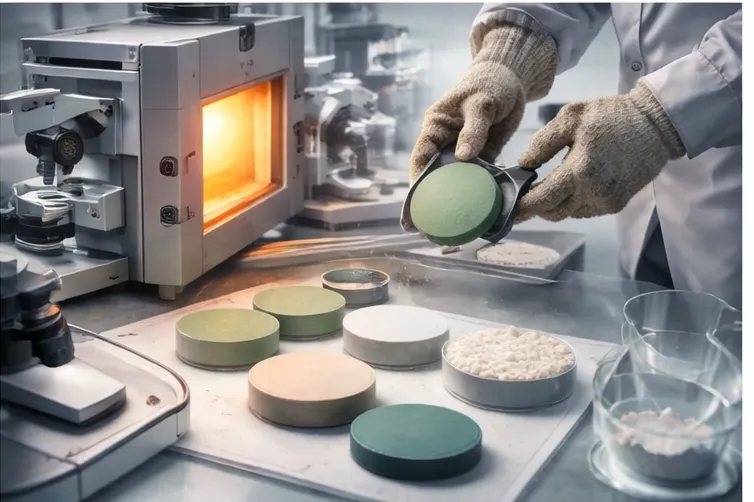
To make a perfect bismuth ferrite target, you need to start with the end in mind. The sintering furnace will reveal every mistake. You cannot negotiate with 900 °C. You can only ensure that the green body it receives is dense, homogeneous, and free of internal stress singularities.
This requires:
- Precise, repeatable pressure control and slow decompression.
- High-rigidity, precision-ground dies.
- Upstream powder preparation that respects particle size, morphology, and moisture.
- The humility to accept that 80 MPa is enough, and that over-compaction is a silent killer.
It is a systems-level problem dressed in a simple ceramic disc. And that is what makes it worth solving properly.
The equipment that surrounds your hydraulic press matters as much as the press itself. A complete, integrated sample preparation workflow—from initial crushing and cryogenic grinding through controlled sieving and mixing, and finally to exact uniaxial or isostatic compaction—turns a fragile research process into a robust material synthesis pipeline. When every step is engineered to preserve chemistry and manage stress, the result is a bismuth ferrite target that emerges from the furnace whole, ready for deposition, and free of the hidden defects that sabotage thin-film science. To build a process that eliminates the unknown, explore laboratory sample preparation systems designed from the ground up for material science. Contact Our Experts
Quick Links
Suggested Products
Enhanced 9 Punch Rotary Tablet Press for Powder Compaction Manual Tablet Press with Dual Scale Pressure Gauge for Pharmaceutical Food Chemical Laboratory Sample Preparation 6-Ton Small Single-Punch Tablet Press — Laboratory Powder & Granule Tableting Equipment / Tablet Forming Machine 6 Ton Variable Frequency Single Punch Tablet Press Multi Dimensional Universal Mixer for High Uniformity Powder BlendingFurther Reading
Before the Furnace, a Conversation with Chaos: How Precision Powder Processing and Compaction Shape Nuclear Fuel Reliability The Invisible Bridge: How Controlled Pressure Shapes the Future of Ceramic-Steel Brazing The Cracks You Don’t See: How Pressing Errors Sabotage Self-Reinforced Beta-Si3N4 Ceramics The Moment of Truth in Solid‑Lubricant Composites: Why Your Hydraulic Press Decides Everything The 15-Ton Truth: Why Your Elemental Analysis Is Only as Good as Your Pellet
PowderPreparation
Last updated on May 15, 2026
Related Products
Enhanced 9 Punch Rotary Tablet Press for Powder Compaction
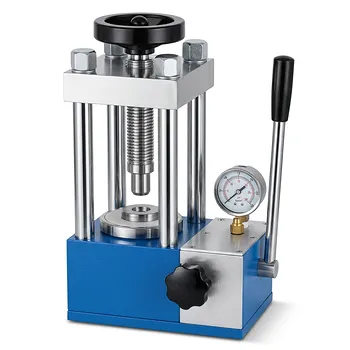
Manual Tablet Press with Dual Scale Pressure Gauge for Pharmaceutical Food Chemical Laboratory Sample Preparation
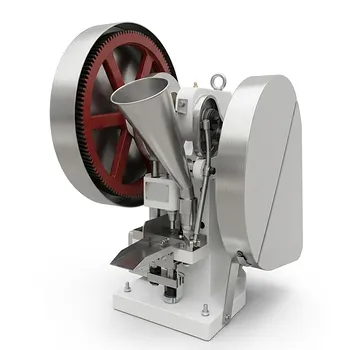
6-Ton Small Single-Punch Tablet Press — Laboratory Powder & Granule Tableting Equipment / Tablet Forming Machine
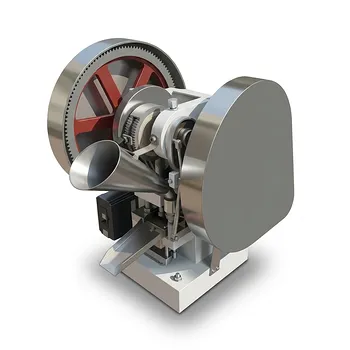
6 Ton Variable Frequency Single Punch Tablet Press
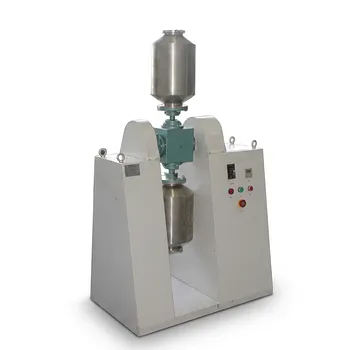
Multi Dimensional Universal Mixer for High Uniformity Powder Blending
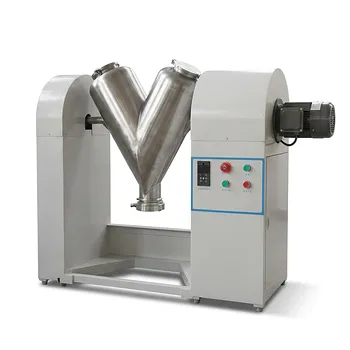
V-Type Powder Mixer for Uniform Blending of Dry Powders and Granules
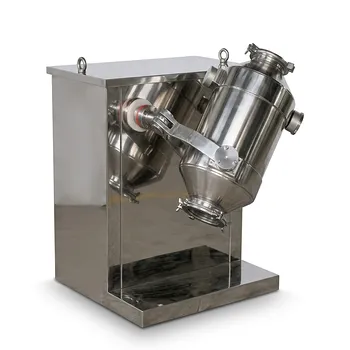
Three-Dimensional Motion Mixer for Laboratory Powder and Granule Blending
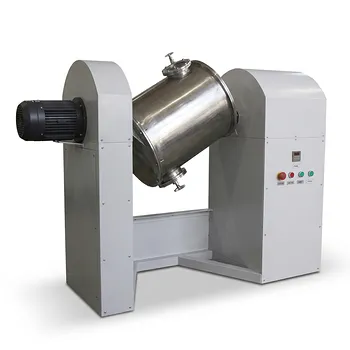
Inclined Mixer for Homogeneous Powder Blending and Grinding
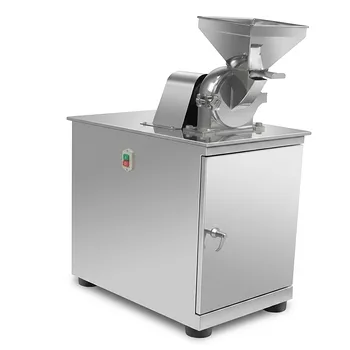
Universal Laboratory Pulverizer Grinder for Small Batch Powder Processing and Material Science Research
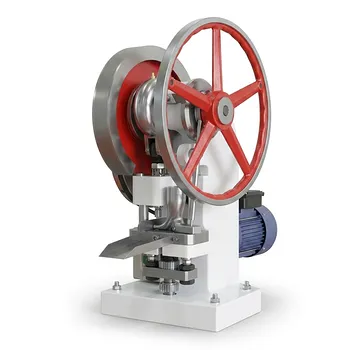
5 Ton Single Punch Tablet Press Laboratory Small Batch Production
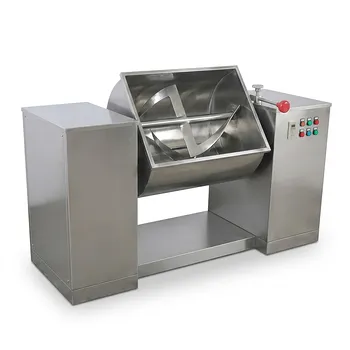
Horizontal Trough Mixer for Uniform Powder and Paste Blending
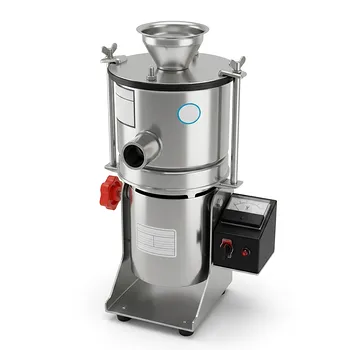
Air Guided Ultrafine Pulverizer High Speed Laboratory Powder Grinder for Chemical and Material Processing
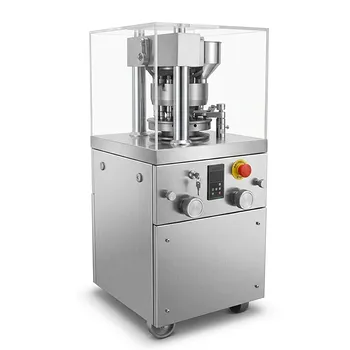
Ordinary Type Rotary Tablet Press for Pharmaceutical Chemical Food Electronic Industries