The Invisible Error: When Powdered Feldspar Lies to Your XRF Spectrometer
Sep 11, 2026
The Morning the Numbers Stopped Making Sense
At a mineral processing lab in Inner Mongolia, a quality engineer named Zhang stared at two printouts. They were supposed to represent the same shipment of feldspar concentrate. Same truck. Same hour. Same spectrometer. Yet the iron content reading differed by 12 percent — enough to flag a batch or miss a penalty clause.
He checked the spectrometer three times. He recalibrated. He ran the reference standard. The machine was fine.
The problem lived in something far more humble: the sample he had given it to read.
One specimen was a haphazard scoop of loose powder, tapped gently into a cup. The other was a dense, glassy pellet pressed under 25 tons. The data weren’t telling him what was in the feldspar. They were telling him what the shape of the feldspar was doing to X-rays.
This is the story of why something that feels like a formality — pressing a pellet — is actually the boundary between noise and signal in X-ray fluorescence analysis. And it’s a story most labs learn only after a quiet, costly mystery.
The Spectrometer Is Honest; Your Sample Isn’t
We treat XRF machines like oracles. Pour something in, get an answer out. That confidence is dangerous. The physics of fluorescence demand that the specimen present a specific kind of interface to the beam. Loose powder refuses every one of those demands.
The Three Deceptions of Raw Powder
A pile of feldspar grains, no matter how fine, carries three structural lies that corrupt what the detector perceives:
1. Particle Size Variance — The Chaos of Scattering Grains are not soldiers. They come in a mess of diameters. Larger grains scatter more primary X-rays sideways rather than admitting them into the atomic lattice. Smaller grains let the beam in differently. The result is a fluorescence yield that depends on topography, not chemistry.
2. Voids and Air Gaps — The Silent Attenuators Between every two particles sits a micro-cavity of air. For light elements and trace metals like iron, the characteristic fluorescence lines are soft — low energy. Air absorbs them greedily. A loose powder with 20% void volume attenuates those lines unpredictably, especially under vacuum conditions that change the gas environment around the grain.
3. Surface Irregularities — The Distance Problem X-ray intensity decays with distance. When the sample surface looks like a gravel road rather than a mirror, the source-to-sample distance varies point by point. That translates into intensity shifts the software cannot fully correct. Some regions are slightly farther from the beam; some are slightly closer. The machine assumes a flat plane. When you lie about the geometry, the math breaks.
The most expensive spectrometer in the world cannot rescue a sample that is physically incapable of being measured correctly. The sample is the measurement.
The Psychology of the Press: Why Labs Underinvest in Preparation
Morgan Housel has a line: “The seduction of complexity makes us overlook the simple things that actually matter.” In analytical labs, that seduction lands on the instrument budget. We buy better tubes, higher-resolution detectors, fancier software. We spend hours debating matrix correction algorithms.
Then we prepare our sample by hand with a mortar and pestle and push it into a flimsy ring with a hand press.
It is a classic cognitive bias: we trust what we paid for. The spectrometer cost a fortune, so it must be the source of truth. The pellet press — maybe ten thousand dollars — feels like an accessory. Reversing that logic is the moment a lab moves from data production to actual quality control.
The Architecture of Truth: What a High-Density Pellet Actually Does
When you press feldspar concentrate into a solid disc at 25 to 30 tons, you are not making “a nice solid”. You are engineering a physical standard that satisfies the unspoken demands of X-ray physics.
Homogenization of the X-ray Interaction Volume
The X-ray beam penetrates only a few microns into the pellet. Within that microscopically thin layer, every point must look the same. Pressure crushes grains together, removing protrusions and creating a unibody surface. The beam no longer sees individual grains; it sees a continuum.
Void Collapse and Signal Fidelity
Under high load, air gaps close. The pellet’s density approaches the true mineral density. The soft fluorescence lines from iron and potassium now travel through solid matter — not half air — on their way to the detector. Signal intensity rises. Signal-to-noise improves proportionally.
Geometric Standardization
A flat, rigid pellet ensures constant source-to-sample distance across the entire analyzed spot. No shadowing. No height variations. Reproducibility shot to shot, day to day, operator to operator.
Vacuum Integrity
Many modern XRF instruments operate under vacuum to eliminate air absorption during measurement. Loose powder can outgas or physically “pouf” into the chamber, contaminating optics and damaging the system. A properly pressed pellet stays where it belongs — as a solid, silent witness to the beam.
The Trace Element Conundrum
For feldspar, iron is often the element that makes or breaks a commercial deal. A few hundred parts per million can determine whether the material is suitable for glass, ceramics, or electronics. Yet iron K-lines sit in a region where backgrounds matter and intensities are modest.
A high-density pellet does two things for trace analysis:
- Maximizes the number of iron atoms in the analysis zone, increasing the absolute fluorescent count.
- Reduces background scatter from voids and irregular surfaces, sharpening the peak against its surroundings.
The result is a detection limit that feels like you paid for a better detector — but you achieved it with physics, not hardware.
The Workflow Behind the Pellet
No press works in isolation. A high-density pellet is the final act of a five-step preparation discipline. Cut corners anywhere upstream, and the pellet betrays you.
| Preparation Stage | Equipment Need | Why It Matters |
|---|---|---|
| Size Reduction | Jaw crusher, planetary ball mill, jet mill | Grain size below 75 µm eliminates mineralogical heterogeneity within grains. |
| Sieving & Classification | Vibratory sieve shaker, air-jet sieve | Ensures a controlled particle size distribution; no rogue large grains. |
| Homogenization | Powder mixer, defoaming mixer | Eliminates local enrichment of heavy minerals; every scoop is identical. |
| Binder Addition | Precision balance, mixer | A tiny amount of wax or cellulose prevents crumbling without diluting the signal beyond correction. |
| High-Pressure Pelletization | XRF pellet press, isostatic press (CIP/WIP) | Creates the dense, flat, vacuum-stable specimen that XRF demands. |
A lab that masters this chain doesn’t just get better feldspar numbers. It gets a reputation for reliability that clients trust — and that trust is worth more than any single analysis.
The Trade-offs You Need to Know
Binders: The Necessary Dilution
Pure feldspar sometimes refuses to hold together. Adding a binder solves the mechanical problem but introduces dilution. If you don’t mathematically correct for the binder mass, your elemental concentrations will read systematically low. Good method development bakes that correction in.
Pellet vs. Fusion: When to Upgrade
Pressed pellets remove particle size and surface effects, but they don’t erase mineralogical effects. If your feldspar contains a mix of microcline, albite, and quartz in varying ratios, the different crystal structures still absorb and fluoresce X-rays slightly differently. For absolute reference-level accuracy, lithium borate fusion turns the sample into a true glass, destroying all mineral memory. But it costs more and takes longer.
Until that becomes necessary, a high-density pellet is the sweet spot between speed and truth.
The Complete Solution: From Ore to Answer
This isn’t about buying a press. It’s about accepting that sample preparation is not an accessory — it is the measurement system’s front end. An unreliable front end makes every subsequent dollar spent on the spectrometer a gamble.
We at PowderProcessing Solutions build complete sample preparation workflows for material science, with a specific focus on the powder-to-pellet chain for XRF analysis. That includes:
- Crushing & Grinding: Jaw and roll crushers; planetary ball mills, jet mills, rotor mills, and sand mills to bring feldspar down to the analytical sweet spot.
- Cryogenic Options: Liquid nitrogen cryogenic grinders for heat-sensitive or elastic materials that would otherwise clog a traditional mill.
- Sieving & Classification: Vibratory and air-jet sieve shakers with certified test sieves to lock in your particle size distribution.
- Mixing & Defoaming: Homogenizers that ensure binders and sample powder form a single, consistent body.
- The Press Portfolio: Standard lab presses, dedicated XRF pellet presses (20–40 ton range), cold/warm isostatic presses (CIP/WIP) for larger or more delicate geometries, hot presses, and vacuum hot presses for advanced materials.
Every unit is engineered to deliver the pressure uniformity, die alignment, and structural rigidity that transforms heterogeneous powder into a standardized solid — reliably, year after year. For distributors, our equipment lines offer complete category coverage, OEM/ODM flexibility, and consistent on-time supply supported by rigorous factory certification.
When your feldspar data demand absolute fidelity, the machine isn’t the bottleneck. The sample is. And the sample can be fixed.
Quick Links
Suggested Products
6 Ton Variable Frequency Single Punch Tablet Press Ordinary Type Rotary Tablet Press for Pharmaceutical Chemical Food Electronic Industries Enhanced 9 Punch Rotary Tablet Press for Powder Compaction 6-Ton Small Single-Punch Tablet Press — Laboratory Powder & Granule Tableting Equipment / Tablet Forming Machine 实验室旋转式压片机 多冲模单压式自动连续压片Further Reading
The Invisible Architect of Powder: How a Single Additive Saves Ductile Metals from Themselves The Layers That Wouldn’t Lie Flat: Why Nine Sheets of Ceramic Demand a Laboratory Press That Thinks in Microns From Dust to Data: How Precision Laboratory Presses Forge Truth in Mineral Testing The Hidden Fracture: Why Ceramic Feed Rods Fail Before the First Melt The Art of Persuading Wood: How a Laboratory Hot Press Solves the Flaw in Nature’s Blueprint
PowderPreparation
Last updated on May 14, 2026
Related Products
6 Ton Variable Frequency Single Punch Tablet Press
Ordinary Type Rotary Tablet Press for Pharmaceutical Chemical Food Electronic Industries
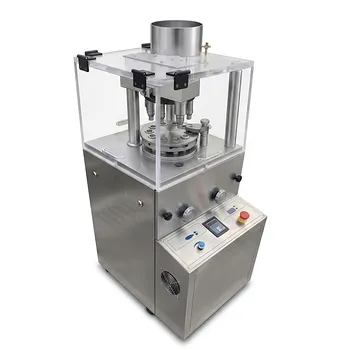
Enhanced 9 Punch Rotary Tablet Press for Powder Compaction
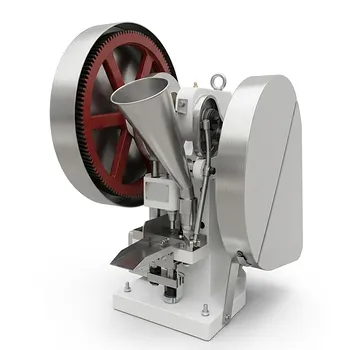
6-Ton Small Single-Punch Tablet Press — Laboratory Powder & Granule Tableting Equipment / Tablet Forming Machine
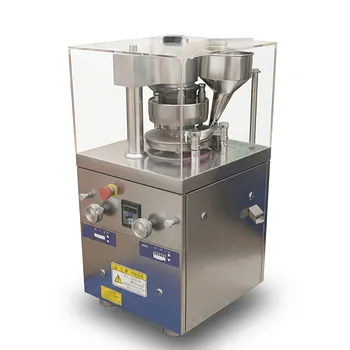
实验室旋转式压片机 多冲模单压式自动连续压片
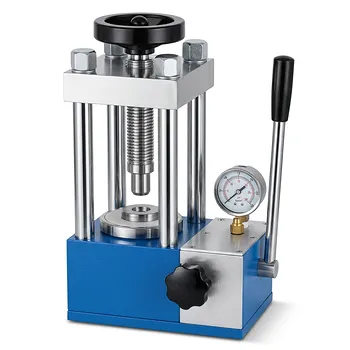
Manual Tablet Press with Dual Scale Pressure Gauge for Pharmaceutical Food Chemical Laboratory Sample Preparation