The Hidden Fractures: Why Your Zirconia Green Body Fails Before It Ever Sees Fire
May 29, 2026
The Crack That Appears From Nowhere
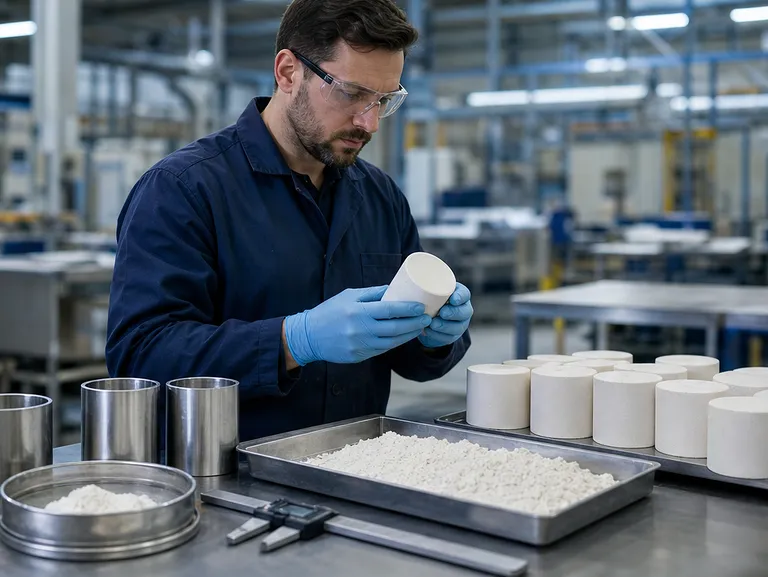
You pull the sintered zirconia crucible from the kiln. It looks fine at first. Then you see it—a hairline crack running along the base. Not on the surface where you expected, but deep inside, where no tool ever touched it. The failure was baked in long before the furnace ever warmed up.
Most engineers blame the sintering profile. They tweak ramp rates, hold times, atmosphere. But the real culprit often sits upstream, in a quiet moment of intense pressure that nobody watched closely enough. The green body held a secret. And the hydraulic press that built it either told the truth or buried a lie.
The Invisible Architecture
A dry-pressed zirconia refractory doesn't start as a ceramic. It starts as a pile of powder—particles of yttria-stabilized zirconia, each a tiny, brittle crystal, surrounded by air.
The press does something almost magical. It shoves these particles together with force that can exceed one ton per square centimeter. This force doesn't just squeeze out air. It forces particles to slide, rotate, and pack into arrangements they would never find on their own.
What Happens Under One Ton Per Square Centimeter
The densification happens in stages. None of them are visible from outside the die.
- Rearrangement first. Particles glide past one another, collapsing internal voids like a building with the floors removed. The bulk of volume reduction happens here, but the bonds are still weak.
- Then plastic deformation. At contact points, pressure spikes to incredible levels. Zirconia particles yield slightly, creating cold-welded bridges. These bridges give the green body its structural integrity—its green strength.
- Finally, a locked structure. Air is reduced to a minimum. Pores shrink to sizes that can actually heal during sintering instead of becoming crack initiators.
This sequence feels mechanical, but it's emotional too. Every void you leave behind will demand a price later. And the press operator has to feel that tension between speed and completeness.
Why Uniform Density Haunts Your Sleep
Here is the psychological trap: you can measure the average density of a green body and feel satisfied. It matches the spec. But you didn't measure the gradient inside it.
The Hourglass Shape That Kills Components
Most lab and industrial presses apply pressure uniaxially—from one or two directions. Powder near the punch compacts more than powder in the center. The density profile develops an hourglass shape. Dense at the top and bottom, less dense in the middle.
During sintering, this uneven density translates into differential shrinkage. The middle shrinks more than the edges. Internal stresses build until the part warps, bows, or simply cracks. You open the kiln and blame the thermal cycle. The press gets away without a scar.
A Personal Story of an Invisible Gradient
I once watched a technician press a series of zirconia setter plates. The dimensions were perfect green. Density checks with Archimedes method came back within tolerance. But every fifth plate cracked at the same corner during sintering.
The problem wasn't the furnace. It was a worn seal on the press cylinder that caused a subtle pressure drift during the hold phase. The gradient was invisible to our measurement because we checked only global average density. We were blind to the spatial story.
The Sweet Spot Between Too Little and Too Much
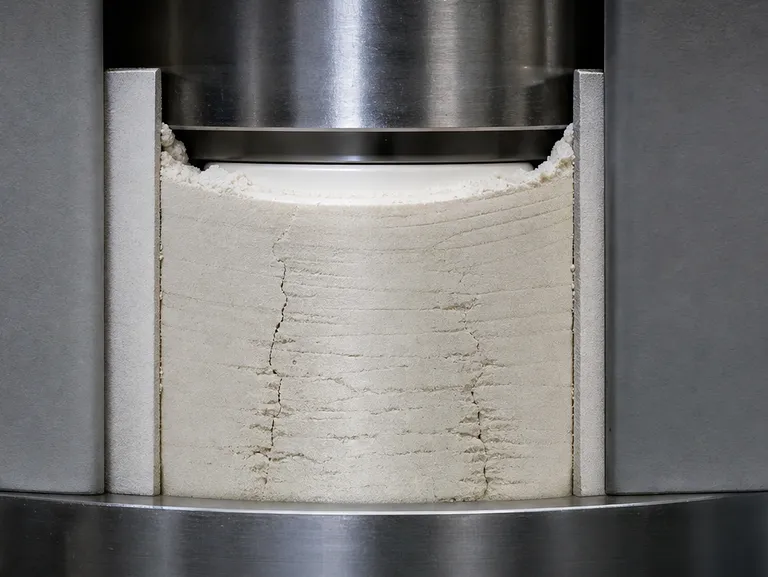
Pressure is a drug, and overdosing is easy. You think, “If 80 kN is good, 100 kN is better.” The powder disagrees.
The Over-Compaction Trap
Excessive pressure stores elastic energy inside the compacted zirconia particles. When the punch retracts and the part ejects, that energy releases suddenly. The green body delaminates into layers—a defect called capping or lamination. It looks like a deck of cards being pulled apart.
These parts are worse than failures. They are time thieves. They look intact enough to go through handling, maybe even green machining. They fall apart only during sintering, destroying batches and trust.
Dwell Time: The Engineer's Dilemma
Dwell time—how long you hold peak pressure—allows air to escape and bonds to stabilize. But every extra second of dwell is a second not making another part. Production throughput drops. The operator feels the pressure (the psychological kind) to hurry.
This is where precision control becomes identity. A press that holds pressure with less than 1% drift lets you shorten dwell without sacrificing uniformity. You stop guessing and start trusting the machine's memory of pressure curves.
How We Build Presses That Remember Every Particle
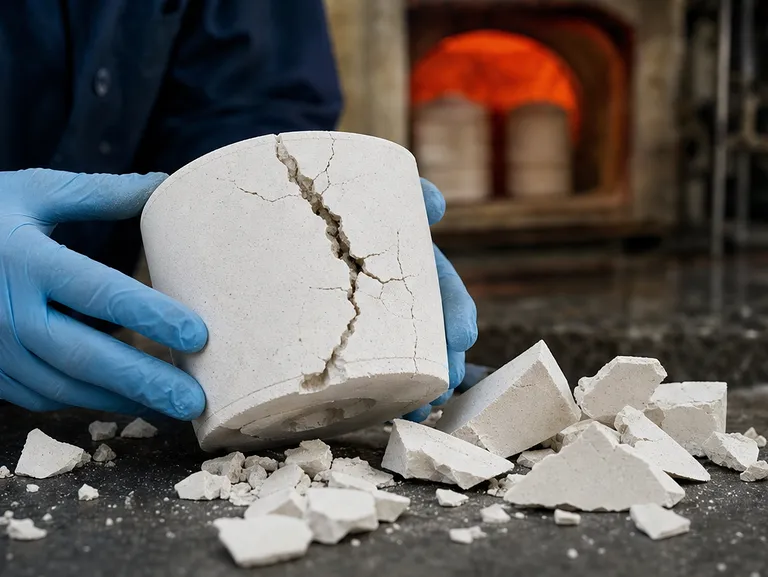
At Our Laboratory Solutions, we see the hydraulic press not as a brute force machine, but as a precision instrument for material architecture. The equipment becomes a partner that eliminates variance.
A Spectrum of Compaction for Every Zirconia Challenge
The problems you face depend on where you sit in the material science chain. Are you producing a single XRF pellet for analysis, or a batch of crucibles for high-temperature synthesis? The pressing solution changes.
| Your Primary Goal | The Right Press Philosophy | Why It Matters for Zirconia |
|---|---|---|
| Maximum Structural Density | Cold Isostatic Pressing (CIP) at up to 300 MPa | Eliminates uniaxial gradients; uniform compaction in all directions |
| High-Throughput Precision | Lab-scale uniaxial press with programmable pressure | Balances speed and repeatability for consistent green strength |
| Thin Discs or Pellets | XRF pellet press with precise force control | Prevents capping in thin geometries by managing elastic springback |
| Advanced Sintering Prep | Vacuum hot press | Combines pressure and temperature to pre-densify for field-assisted sintering |
Beyond the Press: The Complete Powder-to-Green-Body System
The press doesn't work alone. Particle size distribution, moisture content, granulation, and even the die wall friction determine final quality. That's why we've built an ecosystem around the press:
- Milling and Grinding: Planetary ball mills, jet mills, and cryogenic grinders give you the exact particle morphology needed for reliable packing.
- Sieve Shakers and Test Sieves: Air-jet and vibratory systems ensure your powder's size distribution doesn't drift batch to batch.
- Powder Mixers and Defoaming Mixers: Homogeneous mixing prevents segregation that would create its own density gradients before the press ever touches the powder.
This entire workflow controls the information that the powder carries into the die. You give the press a consistent story to write.
The Romance of the Flawless Architected Part
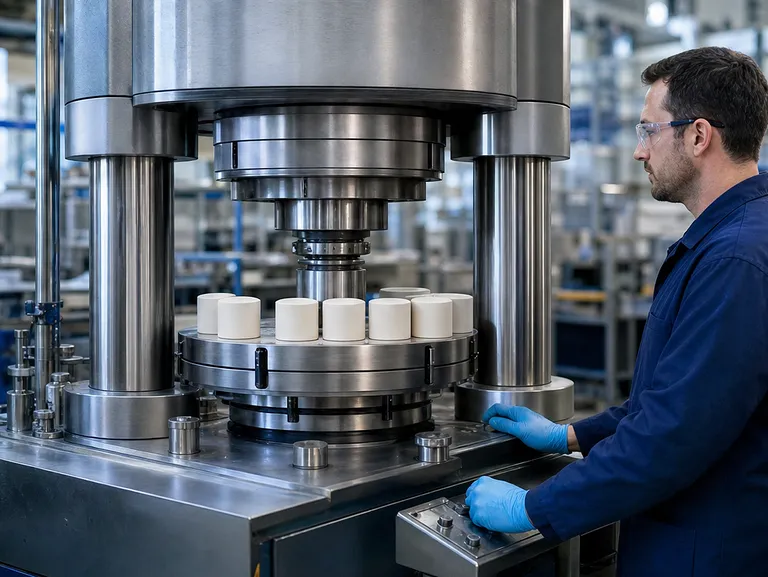
There is a moment in the lab when you eject a green body and hold it in your hand. It's still just a powder compact, fragile and cool. But it already carries the blueprint of the sintered component it will become.
If you pressed it correctly—with controlled force, managed gradients, and respect for dwell—that blueprint has no hidden fractures. The sintering will be a fulfillment, not a revelation of hidden flaws. The part will shrink uniformly, crystallize cleanly, and enter service carrying the same integrity you gave it.
That's the engineer's romance. Not the machine itself, but the chain of causation it enables—from powder to product, from force to function.
We help you close that chain. Contact Our Experts to find the pressing, milling, and sieving system that turns your zirconia powder into components you trust before they ever see fire.
Quick Links
Suggested Products
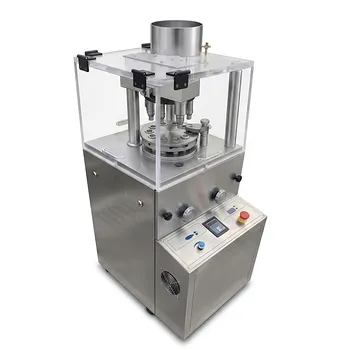
Enhanced 9 Punch Rotary Tablet Press for Powder CompactionFurther Reading
The Crack in the Crucible: A Systems Approach to Perfect Bismuth Ferrite Targets and the Hidden Physics of Powder Compaction Before the Furnace, a Conversation with Chaos: How Precision Powder Processing and Compaction Shape Nuclear Fuel Reliability The Invisible Bridge: How Controlled Pressure Shapes the Future of Ceramic-Steel Brazing The Cracks You Don’t See: How Pressing Errors Sabotage Self-Reinforced Beta-Si3N4 Ceramics The Moment of Truth in Solid‑Lubricant Composites: Why Your Hydraulic Press Decides Everything
PowderPreparation
Last updated on May 15, 2026