Before the Furnace, a Conversation with Chaos: How Precision Powder Processing and Compaction Shape Nuclear Fuel Reliability
Jun 24, 2026
The Morning a Pellet Spoke Back
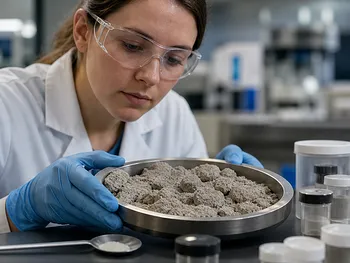
The researcher placed another green pellet on the measurement stage. Dimensions perfect. Weight perfect. Yet under the microscope, a hairline internal lamination whispered a truth he already felt in his gut: this one would crack during sintering. It would not become fuel. It would become another data point in the folder labeled Unacceptable.
Nuclear fuel manufacturing looks, from the outside, like a story of extremes. Temperatures that make steel glow like taffy. Densities chasing the theoretical maximum. But the quiet, uncomfortable truth is that most failures are born much earlier—in the first touch between powder and die, in the compromises we make when we treat compaction as a brute-force act rather than a delicate, multi-variable negotiation.
Uranium dioxide (UO₂) doesn't forgive.
The Illusion of Simple Compaction
We love leverage. The hydraulic press is one of engineering's most seductive devices: apply force, get density. It feels deterministic.
It is not.
In nuclear fuel laboratories, the goal of cold pressing UO₂ powder into “green bodies” masks a series of trade-offs that very few operating procedures adequately capture. You squeeze too hard, you laminate. You squeeze too softly, the pellet crumbles before it ever meets the sintering atmosphere. You use an uneven pressure distribution, and the sintering kinetics later turn your perfect cylinder into a warped ceramic banana.
Systematically, the problem looks like three nested psychological traps:
- The Pressure Obsession Trap: Believing that higher force automatically translates to better fuel. It ignores particle rearrangement physics.
- The Geometric Ignorance Trap: Forgetting that a die set is a living, wearing component, slowly erasing the dimensional tolerances you claim to hold.
- The Particle History Trap: Treating precursor powder as a standardized input, when in reality its agglomerates, moisture, and particle size distribution are the true masters of your final density.
Green Density: The Foundation That Sintering Cannot Fix
Sintering furnaces are magnificent. They drive atomic diffusion, fuse contacts, and shrink the ceramic body toward its theoretical density. But here is the uncomfortable truth that Atul Gawande would appreciate: a furnace cannot outrun a bad foundation. No amount of thermal finesse will fully rescue a pellet with non-uniform green density.
When you press UO₂ powder, you are not just shaping a cylinder. You are building a network of particle contacts. The quality of that network—its uniformity, its density distribution, its residual stress field—becomes the script the furnace must follow. If the script writes dramatic tension into the pellet, the furnace will faithfully amplify that drama into cracks, warping, and internal porosity gradients.
The press does not just prep the material. It pre-writes the failure modes.
The Three Pillars of Pellet Quality at the Press Stage
| Pillar | What It Really Means | What Happens When You Ignore It |
|---|---|---|
| Green Density | Maximized without inducing micro-cracks | Laminations during ejection or “capping” on pressure release |
| Density Uniformity | The center and edge of the pellet compress similarly | Non-uniform shrinkage in sintering, warped fuel |
| Geometric Precision | Every green body matches fuel rod spec before sintering | Stress concentrations in the cladding, pellet-clad interactions |
These are not three independent checkboxes. They are interdependent. Chasing more density without revisiting die clearance can introduce geometry defects. Fixing geometry with a stiffer die set while ignoring powder flow characteristics can hurt uniformity. The system demands a balanced approach.
The Particle History Trap No One Talks About
Most failure analyses start with the press. They should start earlier.
UO₂ powder, fresh from conversion, comes with memories. Memory of agglomeration. Memory of moisture absorption. Memory of particle size distributions that shift based on how the powder was handled, stored, and transferred. If you feed a laboratory hydraulic press with inconsistent powder, you are asking for consistent results from an inconsistent starting material—a form of insanity Morgan Housel would recognize instantly.
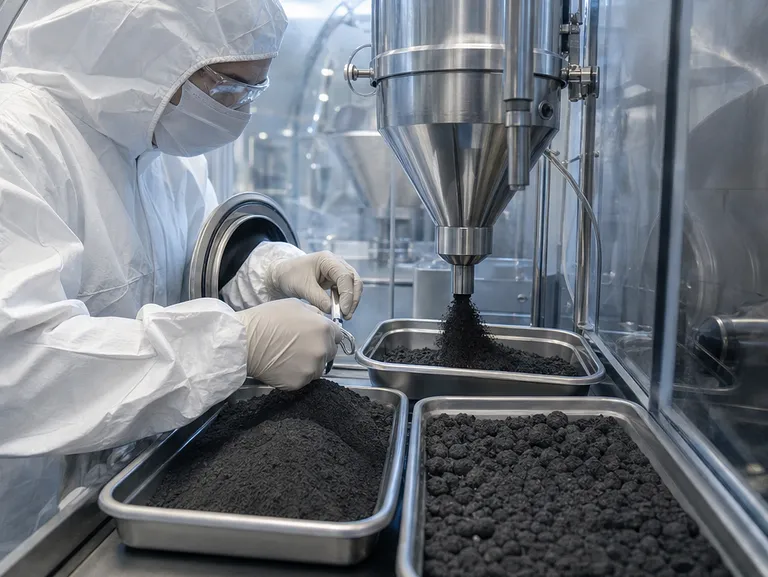
This is where the less glamorous equipment earns its place. A planetary ball mill, carefully operated, breaks down agglomerates and narrows particle size distribution without introducing excessive contamination. A fluidized-bed jet mill goes further, using particle-on-particle impact to avoid media wear altogether, critical when chemical purity matters as much as physical form. Cryogenic grinding systems for certain ceramic precursors prevent thermal degradation, preserving stoichiometry.
The psychology here is subtle: we often under-invest in powder preparation because the press seems like the hero tool. But in nuclear fuel research, the powder preparation stage is the conversation that determines everything the press can achieve.
Equipment That Speaks to the Whole Problem
When a lab treats powder processing as an afterthought, the press inherits chaos. Consider the upstream toolkit:
- Crushing and Coarse Grinding: Jaw crushers and roll crushers reduce calcined UO₂ aggregates to manageable feed sizes.
- Fine Milling: Planetary ball mills or jet mills deliver the tight particle size distributions that enable high and uniform green density.
- Sieving and Classification: Vibratory sieve shakers and air-jet sieving systems guarantee that no rogue oversized particles sneak into the die, which would act as stress concentrators during both pressing and sintering.
- Mixing and Defoaming: For labs adding pore formers or other additives, high-efficiency powder mixers ensure homogeneity. Defoaming mixers remove entrained air that could later become shrinkage pores.
These are not optional extras. They are the systematic de-risking of the powder stream before compaction. In a nuclear fuel context, where the cost of a single failed pellet run can mean days of lost time and kilograms of expensive material, upstream precision is economic hygiene.
Choosing the Right Press: A Psychology of De-Risking
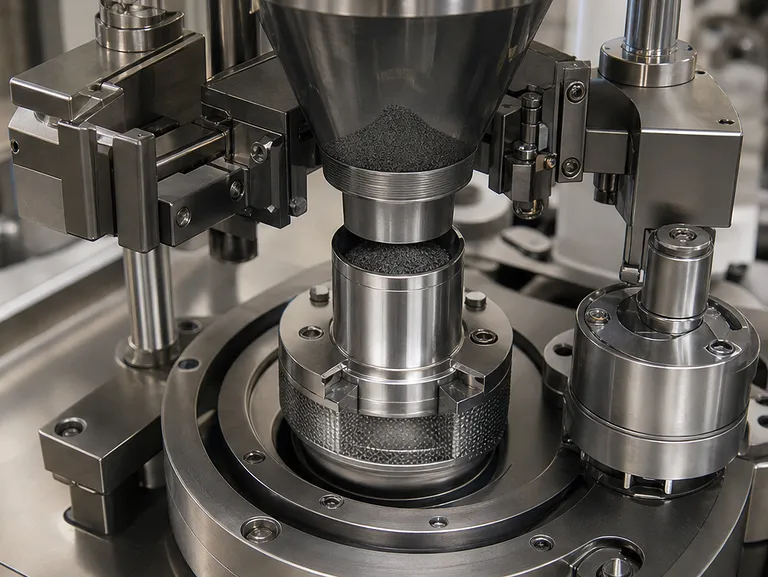
If the powder is uniform, the next decision tree narrows to the press itself. Not all hydraulic presses are equal in the eyes of UO₂ green bodies.
Standard Uniaxial Lab Presses
For early-stage scoping studies, a calibrated, stiff-frame laboratory hydraulic press with precise pressure control provides the baseline. It is straightforward, affordable, and perfect for screening binder systems or sintering cycle windows.
But uniaxial pressing has a known vulnerability: powder-wall friction. The pressure applied by the top punch decays as it travels down the compact, leaving the bottom of the pellet slightly less dense than the top. In a full-scale fuel pellet, this gradient can drive asymmetric shrinkage. It is the kind of detail that disappears in summary reports but reappears in reactor performance.
Cold Isostatic Pressing (CIP): The Uniformity Enforcer
When the goal shifts from “can we make a pellet?” to “can we make a pellet that will behave predictably under 400°C and intense neutron flux?”, Cold Isostatic Pressing enters the conversation.
CIP surrounds the powder-filled mold with liquid medium and applies pressure uniformly from all directions. This eliminates the wall-friction density gradient almost entirely. The resulting green compact exhibits minimal internal stress and exceptionally uniform density distribution. For UO₂, where sintering shrinkage models depend on uniform starting conditions, CIP is less a luxury and more a strategic investment in predictability.
Warm Isostatic Pressing (WIP) and Vacuum Hot Pressing
In specialized research—for example, developing accident-tolerant fuel concepts or studying mixed-oxide compositions—temperature-assisted pressing becomes valuable. Warm Isostatic Pressing maintains the isotropic pressure advantage while adding moderate heat to reduce powder yield strength, enabling higher green densities without crossing into defect territory.
Vacuum hot pressing blends compaction and sintering into a single step under controlled atmosphere, useful for materials where oxygen stoichiometry must be preserved during densification. These tools, while more complex, offer nuclear researchers the ability to decouple variables that are normally intertwined in conventional press-and-sinter sequences.
A Decision Logic Table
| If Your Research Priority Is… | Consider This Press Approach | Why |
|---|---|---|
| Screening compositions and sintering aids | Standard lab hydraulic press | Quick, low-cost, sufficient for relative comparisons |
| Achieving minimal density gradients for sintering models | Cold Isostatic Press (CIP) | Isostatic pressure eliminates wall friction, yielding near-perfect uniformity |
| Maximizing green density without lamination in hard-to-press powders | Warm Isostatic Press (WIP) | Heat softens particles, enabling higher compaction before defect onset |
| Studying coupled densification-atmosphere effects | Vacuum Hot Press | Combines compaction and sintering, controls stoichiometry |
The Furnace Awaits, But the Pact Is Sealed
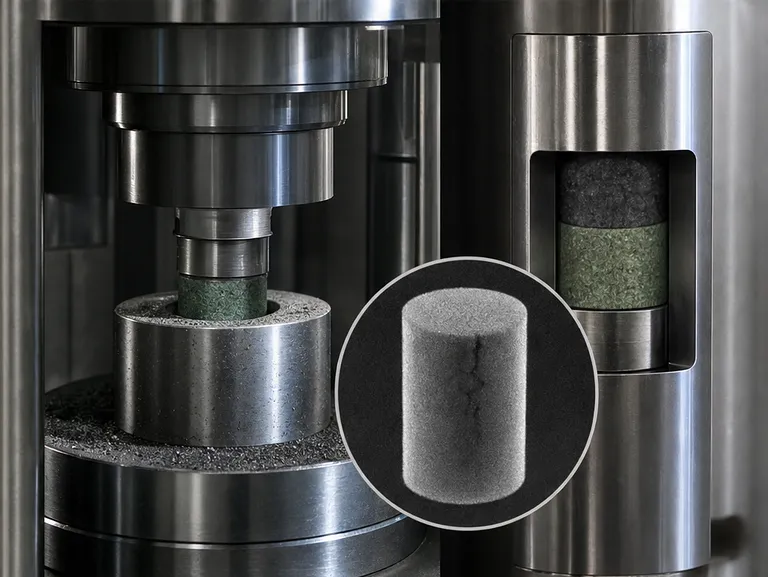
We have not discussed the sintering furnace in detail. That is intentional. The furnace can only complete a conversation the press and powder preparation already started. The thermal profiles, the heating rates, the dwell times—they are critical, but they are downstream of a foundational truth: the green compact's quality is the single most powerful lever for reducing sintering variability.
Sintering furnaces excel at driving diffusion and eliminating residual porosity. They cannot repair internal laminations. They cannot correct a density gradient that the press locked in. They cannot homogenize a particle size distribution that was never consistent to begin with.
In nuclear fuel research, the error chain starts early. The solution must start earlier.
The Engineer’s Romance: Listening Before Pressing
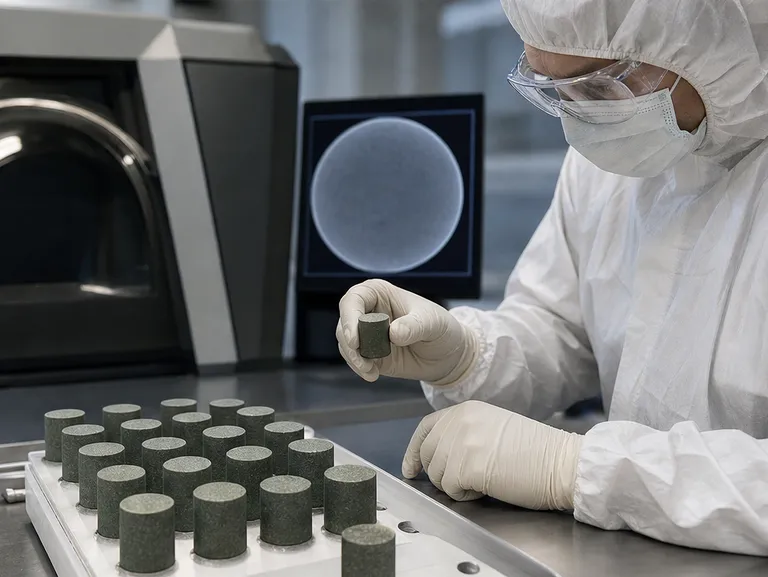
There is a quiet romance in preparing nuclear fuel the right way. It is not the romance of glowing furnaces or immense tonnage. It is the romance of control in the face of chaos. It is the ball mill operator who checks the particle size distribution one extra time, the technician who chooses a CIP mold design that eliminates a phantom density gradient no one else noticed, the researcher who refuses to accept “the press did its job” when the pellet tells a different story under the scanning electron microscope.
This systematic care requires equipment that respects the material’s sensitivity. Jaw crushers and roll crushers that preserve stoichiometry. Planetary ball mills and jet mills that deliver reproducible fines without contamination. Sieve shakers and air-jet classifiers that guard against outlier particles. Hydraulic presses—uniaxial, isostatic, warm, and vacuum—that translate powder into potential with faithfulness instead of variability.
When you control the entire chain from powder to green pellet, you stop asking “why did this pellet fail?” and start asking “how much better can we make the next one?” That is not just sample preparation. That is the foundation of nuclear fuel reliability.
Quick Links
Suggested Products
Enhanced 9 Punch Rotary Tablet Press for Powder Compaction Manual Tablet Press with Dual Scale Pressure Gauge for Pharmaceutical Food Chemical Laboratory Sample Preparation 6-Ton Small Single-Punch Tablet Press — Laboratory Powder & Granule Tableting Equipment / Tablet Forming Machine Air Guided Ultrafine Pulverizer High Speed Laboratory Powder Grinder for Chemical and Material Processing 6 Ton Variable Frequency Single Punch Tablet PressFurther Reading
The Crack in the Crucible: A Systems Approach to Perfect Bismuth Ferrite Targets and the Hidden Physics of Powder Compaction The Invisible Bridge: How Controlled Pressure Shapes the Future of Ceramic-Steel Brazing The Cracks You Don’t See: How Pressing Errors Sabotage Self-Reinforced Beta-Si3N4 Ceramics The Moment of Truth in Solid‑Lubricant Composites: Why Your Hydraulic Press Decides Everything The 15-Ton Truth: Why Your Elemental Analysis Is Only as Good as Your Pellet
PowderPreparation
Last updated on May 15, 2026
Related Products
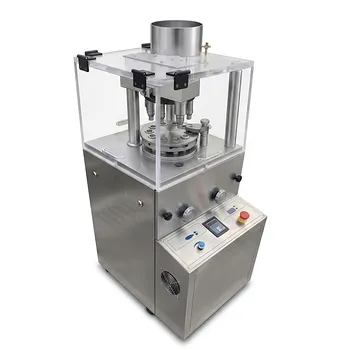
Enhanced 9 Punch Rotary Tablet Press for Powder Compaction
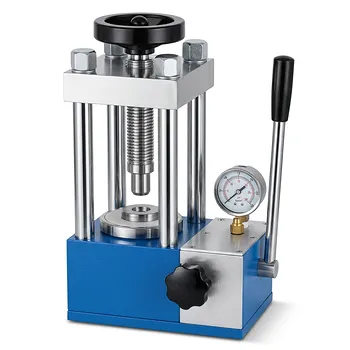
Manual Tablet Press with Dual Scale Pressure Gauge for Pharmaceutical Food Chemical Laboratory Sample Preparation
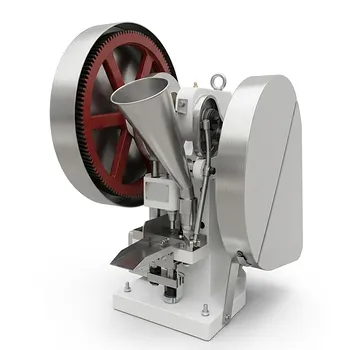
6-Ton Small Single-Punch Tablet Press — Laboratory Powder & Granule Tableting Equipment / Tablet Forming Machine
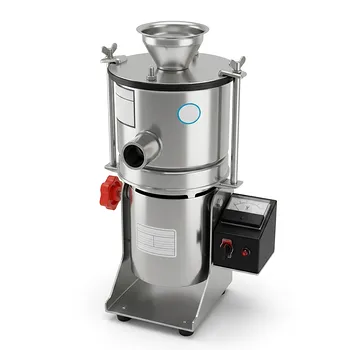
Air Guided Ultrafine Pulverizer High Speed Laboratory Powder Grinder for Chemical and Material Processing