The Hidden Architecture of Electrode Performance: Why Your Choice of Grinding Media Rewrites Battery Chemistry
Sep 20, 2026
The Problem Nobody Sees Until It’s Too Late
You mix. You mill. You measure. And the numbers don’t add up. The ionic conductivity of your sulfide solid electrolyte has inexplicably collapsed. You look for experimental errors—temperature, pressure, stoichiometry—but the culprit is far smaller. It’s a ghost in the machine. Literally.
It’s the atomic ghost of your grinding media, now chemically bonded to your otherwise perfect MoS2.
This is the central paradox of liquid-phase electrode processing. To unlock the potential of molybdenum disulfide—to peel apart the weakly bonded S-Mo-S layers and expose vast electrochemical surface area—you must apply brutal mechanical force. But the very tools that deliver that force often poison the sensitive chemical environment they’re meant to improve.
The van der Waals Vault
Think of molybdenum disulfide not as a crystal, but as a molecular phyllo dough. Each S-Mo-S triple layer is a perfect, atomically thin sheet. The sheets are stacked, but the bonds holding the stack together aren’t strong covalent or ionic links. They are van der Waals forces—the weak, transient fluctuations of electron clouds that a gecko uses to climb a wall. In the world of solid-state batteries, these forces are both a curse and an opportunity.
The curse: In their bulk form, these tightly stacked layers restrict lithium-ion intercalation. The electrochemical surface area is minimal. Rate capability suffers.
The opportunity: Break those weak links, and you liberate individual nanosheets capable of storing and transporting charge at remarkable speeds.
But there’s an energy barrier. To defeat van der Waals forces, you need kinetic energy. Lots of it. This isn't a gentle stir in a beaker; this is the engineered chaos of a planetary ball mill, where media crash and shear through a solvent, transferring momentum directly to the solid.
The Heavy Hand of Zirconia
Why not use something cheap? Why not steel?
The answer lies in a fundamental law of milling physics: the energy transferred by a grinding ball is a function of its mass. For a given velocity, a denser ball carries more momentum. When it strikes an MoS2 particle, the deceleration is instantaneous. The shockwave propagates through the layered structure, prying the weakly bonded sheets apart.
Zirconia is not chosen simply because it's "hard." It's chosen because it’s heavy and hard.
Its high density—nearly twice that of alumina—transforms the mill jar into a high-energy cascade. Each collision is an event of intense, localized pressure. This is the mechanical key that turns the lock of the van der Waals vault.
The Efficiency of Unforgiving Materials
High hardness also serves a secondary, subtler function. A soft media particle deforms on impact, acting like a pillow and absorbing energy into its own structure. Zirconia refuses to be a pillow. It’s a hammer. It transfers nearly all of its kinetic energy into the target material. This is not brutality for its own sake; it's an optimization of time. It means reaching the desired degree of exfoliation—the perfect nanosheet thickness—in fewer rotations, with less heat, and less electrical consumption.
The Chemical Ghost of Metal Media
Here’s where the narrative shifts from physics to chemistry.
Sulfide-based solid electrolytes are spectacularly promising for next-generation batteries, promising higher conductivity and better safety than liquid organic electrolytes. But they have a fatal weakness: they are promiscuous reactors.
Introduce a metallic contaminant—iron from steel balls, nickel from a worn mill jar—and the sulfide electrolyte will react with it. Those foreign atoms don’t just float around as inert debris. They form new chemical phases, microscopic islands of non-conductive material that sit like roadblocks at the electrolyte-electrode interface. Ionic conductivity—the very heartbeat of a solid-state battery—drops precipitously.
Alumina isn’t much safer. In the sulfur-rich, reactive environment of battery processing, aluminum can leach from alumina (Al2O3) media, introducing oxide impurities that similarly degrade performance.
This is the contamination trap. You solve the exfoliation problem with aggressive milling, but you create a fatal poisoning problem simply by choosing the wrong media material.
Zirconia’s Quiet Supremacy: Doing Nothing
The most beautiful property of high-purity zirconia is its deep, profound indifference. It is chemically inert. It does not care about your sulfides. It refuses to donate ions to your electrolyte. It passes through the high-energy chaos of the mill like a neutral observer, delivering devastating kinetic energy while offering no chemical commentary.
This is the dual mandate the MoS2 community has settled on:
- Maximum kinetic energy for exfoliation.
- Zero chemical activity for preserving ionic conductivity.
No other material balances these two competing demands so elegantly.
The Trade-offs We Choose to Ignore
No material is a perfect solution. Zirconia comes with its own bill of consequences, which a mature engineering mindset must accept.
The Debris We Can’t See
High-energy milling is a war of attrition. Even exceptionally wear-resistant zirconia will eventually shed nano-scale particles. In a zirconium-free system, this introduces what scientists call “heterogeneous impurities.” The key insight is that zirconia wear debris is chemically benign in sulfide environments compared to steel or alumina wear debris. It’s the difference between finding sand in your food and finding arsenic.
The Stress We Put on the System
That glorious high density has a mechanical cost. A mill jar half-filled with zirconia balls weighs significantly more than one filled with alumina. The motor strains harder. The bearings wear faster. The risk of equipment failure—premature but preventable—rises. Operators and lab managers must ensure that mills are rated for this specific high-mass duty cycle. Ignoring this isn't just a maintenance oversight; it's a threat to experimental reproducibility.
The “Homogeneous Grinding” Principle
There’s a final, almost philosophical layer to media selection that expert formulators understand intuitively. If your final product—the electrode, the electrolyte—already contains zirconium in its formulation (as a dopant or a stabilizer), then zirconia media becomes not just the best choice, but the only logical one. Any wear debris from the media is chemically identical to a component already present in the system. Contamination, in a functional sense, ceases to exist. The abrasive chaos of milling achieves a kind of purity through shared identity.
From a Jar in a Lab to a Complete Workflow
Understanding the physics of a single grinding ball is one thing. Building a research and production pipeline around that understanding is another. The MoS2 electrode you’re trying to build doesn’t end at the planetary ball mill. It needs to be mixed into a homogeneous slurry without bubbles, sized to a precise particle distribution, and finally compacted into a pellet or an electrode with enough structural integrity to survive thousands of charge-discharge cycles.
A planetary ball mill loaded with zirconia is the starting point, but it’s just one instrument in an orchestra. You need a crusher to prepare your raw precursors, a cryogenic grinder if you’re dealing with temperature-sensitive phases, and a jet mill if your exfoliation strategy demands something beyond planetary motion. You need sieve shakers with micron-level precision to verify your particle distribution isn't just a guess. You need powder mixers and defoaming mixers to turn your exfoliated nanosheets into a perfect suspension. And critically, you need a hydraulic press—perhaps a Cold Isostatic Press (CIP) for uniform density or a vacuum hot press for electrolyte pellets—to transform that powder into a solid, functional architecture.
Every step is a potential point of contamination. Every material in the chain—from the jaw of the crusher to the die of the press—must be chosen with the same rigor as the grinding media.
Matching the Tool to the Objective
| If your primary focus is… | Your media selection logic should be… | Because… |
|---|---|---|
| Maximizing Exfoliation Density | Use high-density stabilized zirconia. | Only maximum kinetic energy reliably breaks van der Waals bonds. |
| Absolute Chemical Purity in Sulfide Systems | Prioritize high-purity zirconia over alumina or steel. | Any metallic or oxide impurity degrades ionic conductivity. |
| Processing Zirconium-Containing Materials | Zirconia is the definitive choice. | The “homogeneous grinding principle” makes wear debris chemically irrelevant. |
This table is a starting point for a conversation about your specific material, your specific process, and the specific equipment that needs to handle not just the chemistry, but the weight and the wear of a solution engineered for performance.
The right media in the wrong mill is still a failure. The right mill press with the wrong die is a missed opportunity. The goal isn't just a piece of equipment; it’s a seamless, contamination-controlled workflow from powder to pellet. When you’re chasing the next generation of battery performance, the starting point of that conversation is inevitably about what’s inside the jar.
Quick Links
Suggested Products
Vertical Semi Circular Planetary Ball Mill for Laboratory Precision Grinding High Energy Laboratory Planetary Ball Mill for Nano Grinding and Material Science Sample Preparation Heavy Duty Horizontal Planetary Ball Mill for Efficient Industrial Grinding and Sample Preparation Vertical Square Planetary Ball Mill for Laboratory Sample Preparation and Nanoscale Grinding 8L Planetary Ball Mill for Laboratory Grinding and Sample PreparationFurther Reading
The 65-Micron Gate: Unlocking the True Isotopic Fingerprint of Portland Cement The Energy Budget of a Single Impact: How the Ball-to-Powder Ratio Shapes Nanocrystalline Reality The High-Energy Gamble: What SiBCN-rGO Fibers Teach Us About Perfect Homogenization The Gentle Violence of a Planetary Mill: Why the Most Critical Moment in SiC–VC Composites Happens Before Any Heat The Forge at 10,000 g: How a Planetary Ball Mill Designs Self-Lubricating Composites Atom by Atom
PowderPreparation
Last updated on May 14, 2026
Related Products
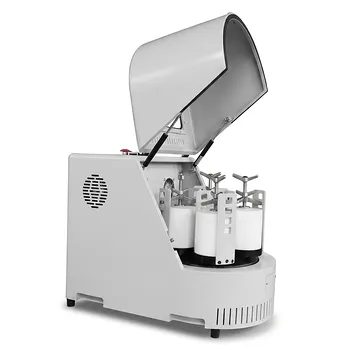
Vertical Semi Circular Planetary Ball Mill for Laboratory Precision Grinding
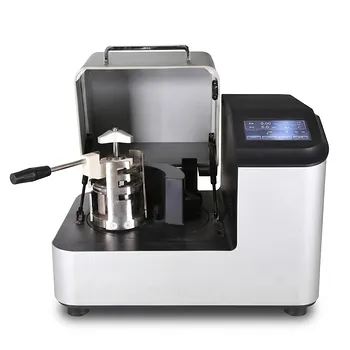
High Energy Laboratory Planetary Ball Mill for Nano Grinding and Material Science Sample Preparation
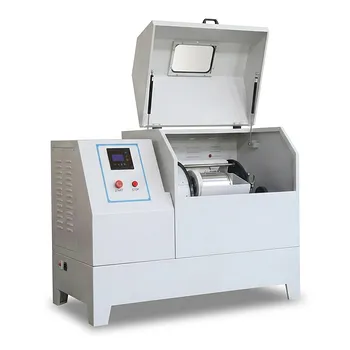
Heavy Duty Horizontal Planetary Ball Mill for Efficient Industrial Grinding and Sample Preparation
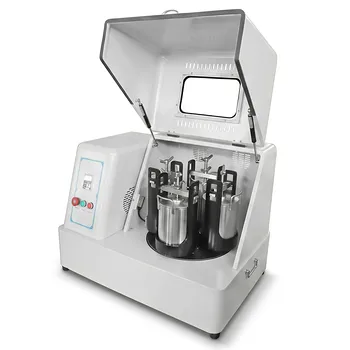
Vertical Square Planetary Ball Mill for Laboratory Sample Preparation and Nanoscale Grinding
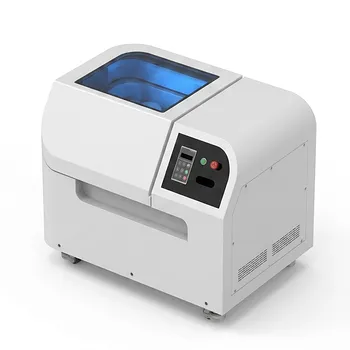
8L Planetary Ball Mill for Laboratory Grinding and Sample Preparation
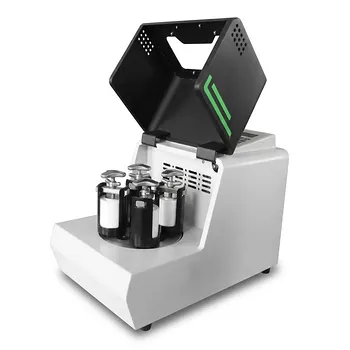
Miniature Planetary Ball Mill with Vacuum Grinding and High Efficiency for Laboratory Sample Preparation
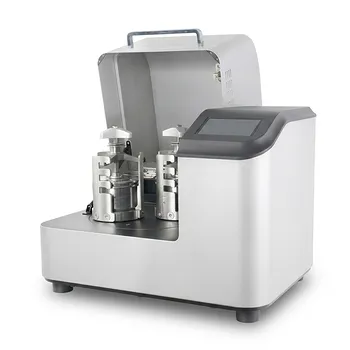
High Energy Planetary Ball Mill for Nano Scale Grinding and Mechanical Alloying
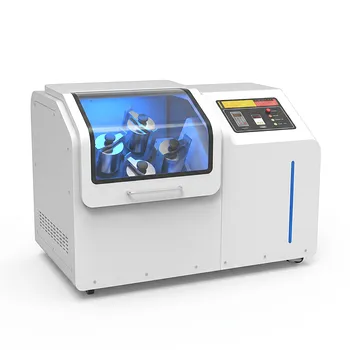
High Energy Omnidirectional Planetary Ball Mill 16L
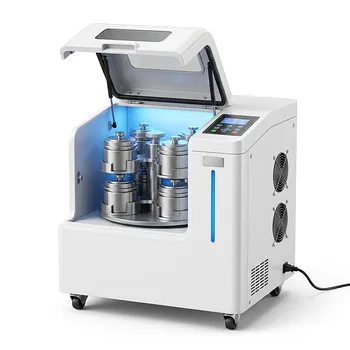
High Energy Omnidirectional Planetary Ball Mill 20L
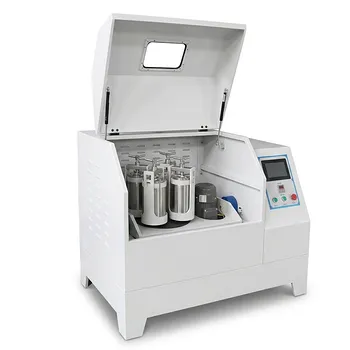
360° Rotating Omnidirectional Laboratory Planetary Ball Mill for Homogeneous Ultra-Fine Grinding and Mixing