Why is isostatic pressing typically used after uniaxial pressing for forsterite ceramics? Achieve Peak Homogeneity.
Updated 4 months ago
Isostatic pressing serves as a critical secondary compaction step to ensure structural homogeneity and eliminate defects introduced during initial forming. In the production of forsterite ceramics, it follows uniaxial pressing to apply uniform, omnidirectional pressure to the "green body." This process effectively removes internal density gradients and micro-cracks, ensuring the material can withstand high-temperature calcination without warping or failure.
Core Takeaway: Isostatic pressing corrects the inherent non-uniformity of uniaxial pressing by applying isotropic pressure, which leads to a defect-free, high-density forsterite ceramic capable of uniform shrinkage during sintering.
The Limitations of Initial Uniaxial Pressing
Overcoming Mold Wall Friction
During initial uniaxial pressing, friction between the powder and the mold walls prevents pressure from distributing evenly throughout the material. This creates density gradients, where some areas of the forsterite green body are more compacted than others.
Addressing Internal Stress Concentrations
Uniaxial pressing applies force along a single axis, which can leave microscopic pores and internal stress concentrations. If left unaddressed, these localized stresses act as failure points during the subsequent heating phases.
Mechanisms of Isostatic Improvement
Achieving Omnidirectional Compaction
By using a fluid medium to apply pressure from all directions, isostatic pressing ensures the ceramic body is compressed equally. This isotropic pressure forces the granulated particles into a more stable, uniform arrangement that uniaxial pressing cannot achieve.
Pore Size Reduction and Particle Bonding
High-pressure isostatic processing narrows the internal pore size distribution and promotes better bonding between particles. This increased particle-to-particle contact is essential for achieving a relative density that can exceed 95% in the final product.
Impact on High-Temperature Sintering
Facilitating Uniform Shrinkage
Forsterite ceramics require high-temperature calcination, often at 1600°C, where significant volume changes occur. A green body with uniform density will shrink isotropically, whereas a body with density gradients will warp, distort, or crack as different sections contract at different rates.
Ensuring Phase Stability and Mechanical Strength
The homogeneity provided by isostatic pressing directly influences the phase stability of the forsterite. By eliminating microscopic defects before sintering, the final material gains higher mechanical strength and a more consistent internal structure.
Understanding the Technical Trade-offs
Process Complexity and Cycle Time
Adding an isostatic pressing step increases the production cycle time and requires more complex equipment than uniaxial pressing alone. It involves sealing the pre-formed part in a flexible membrane and managing a hydraulic system, which raises the cost per unit.
Dimensional Precision and Tooling
While isostatic pressing improves internal density, it is generally less precise for achieving complex external geometries than hard-tool uniaxial pressing. This is why the two methods are used in sequence: uniaxial pressing defines the initial shape, and isostatic pressing refines the internal structure.
How to Apply This to Your Production Goal
- If your primary focus is maximum structural integrity: Always utilize Cold Isostatic Pressing (CIP) after uniaxial forming to eliminate the micro-cracks that cause catastrophic failure during sintering.
- If your primary focus is achieving high-density electrolytes: Prioritize high isostatic pressures (typically 150–200 MPa) to narrow pore sizes and ensure the material reaches a relative density above 95%.
- If your primary focus is minimizing post-sintering machining: Ensure the initial uniaxial compaction is as uniform as possible to provide a consistent "pre-form" for the isostatic press, which reduces final warping.
By integrating isostatic pressing as a secondary refinement, you transform a vulnerable powder compact into a robust, high-performance ceramic capable of surviving extreme thermal processing.
Summary Table:
| Feature | Uniaxial Pressing | Isostatic Pressing (CIP) | Combined Result |
|---|---|---|---|
| Pressure Direction | Single-axis (Vertical) | Omnidirectional (Fluid) | Uniform compaction |
| Density Consistency | High gradients (friction) | Homogeneous density | Minimal internal stress |
| Structural Defects | Potential micro-cracks | Defects eliminated | High structural integrity |
| Sintering Outcome | Risk of warping/cracking | Uniform shrinkage | >95% Relative density |
Elevate Your Ceramic Research with Precision Compaction
Achieving defect-free forsterite ceramics requires the right equipment at every stage. We provide complete laboratory sample preparation solutions for material science, specializing in high-performance powder processing and compaction technology.
Whether you need to refine raw materials with our crushers and planetary ball mills or eliminate density gradients using our advanced Cold/Warm Isostatic Presses (CIP/WIP) and hydraulic lab presses, our equipment ensures your "green bodies" are ready for high-temperature success.
Maximize your material density and structural integrity today. Contact our experts for a tailored solution!
References
- Hamza Milles, Khaled Toualbia. Hot corrosion behavior of Mg\(_{2}\)SiO\(_{4}\) ceramic exposed to molten Na\(_{2}\)SO\(_{4}\) at 900℃ to 1100℃. DOI: 10.55713/jmmm.v34i1.1777
Mentioned Products
- 6-Ton Small Single-Punch Tablet Press — Laboratory Powder & Granule Tableting Equipment / Tablet Forming Machine
- Manual Tablet Press with Dual Scale Pressure Gauge for Pharmaceutical Food Chemical Laboratory Sample Preparation
- 5 Ton Single Punch Tablet Press Laboratory Small Batch Production
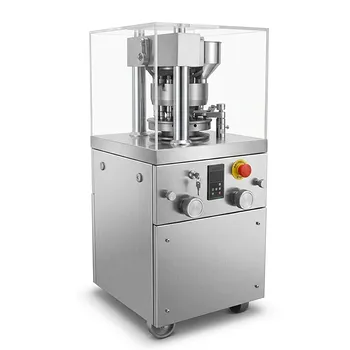
- Ordinary Type Rotary Tablet Press for Pharmaceutical Chemical Food Electronic Industries
People Also Ask
- What is the function of a laboratory press in Cr-Ti alloy evaluation? Quantify Fracture Stress & Strength
- What is the function of a laboratory press in assessing the hydrophobic performance of modified vermiculite fillers?
- What is the core function of a laboratory press in the forming of ceramic filter element green bodies? Maximize Density.
- What is the function of a laboratory press in the preparation of ceramic feed rods? Master Density and Precision
- Why is vacuum sealing and flexible packaging necessary for Aluminum Titanate powders during CIP? Ensure Peak Density

Tech Team · PowderPreparation
Last updated on May 14, 2026
Related Products
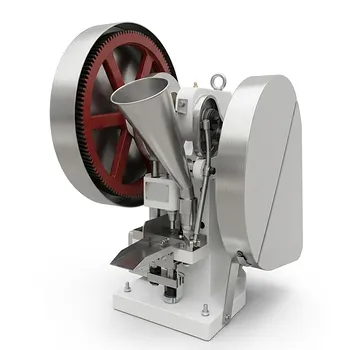
6-Ton Small Single-Punch Tablet Press — Laboratory Powder & Granule Tableting Equipment / Tablet Forming Machine
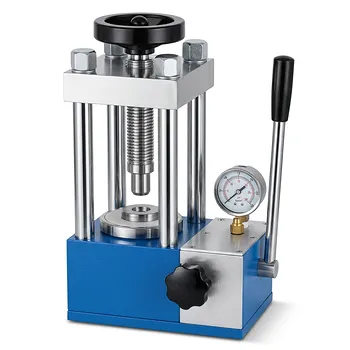
Manual Tablet Press with Dual Scale Pressure Gauge for Pharmaceutical Food Chemical Laboratory Sample Preparation
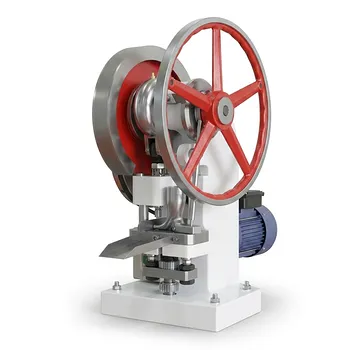
5 Ton Single Punch Tablet Press Laboratory Small Batch Production