Why is Cold Isostatic Pressing (CIP) necessary? Achieve 99%+ Density and Prevent Cracks in High-Entropy Ceramics
Updated 4 months ago
Cold Isostatic Pressing (CIP) is essential for achieving the density and structural uniformity required for high-entropy ceramics. While a standard lab press provides the initial shape, it leaves behind internal stress imbalances and density gradients. CIP applies high, multi-directional pressure through a fluid medium to eliminate these flaws, ensuring the ceramic does not crack or deform during the final high-temperature sintering process.
The central role of CIP is to transform a non-uniform "green body" into a homogenous, high-density structure. By applying isotropic pressure, it removes the physical inconsistencies that cause structural failure during sintering, allowing the material to reach near-theoretical density.
The Limitation of Uniaxial Lab Pressing
Unidirectional Force and Mold Friction
A standard lab press typically uses uniaxial (one-direction) force to compress powder into a mold. This method is efficient for shaping but suffers from internal friction between the powder and the mold walls.
This friction prevents the pressure from reaching the center of the green body equally. As a result, the powder is packed tightly near the plunger but remains relatively loose in other areas.
The Problem of Density Gradients
These variations in packing lead to density gradients, where different parts of the same ceramic piece have different weights and porosities.
If these gradients are not corrected, the ceramic will shrink unevenly during sintering. This "anisotropic shrinkage" is the primary cause of warping, internal cracking, and structural failure in high-entropy materials.
The Mechanics of Cold Isostatic Pressing
Isotropic Pressure Application
Unlike a lab press, a CIP system submerges the sample in a liquid medium to apply isotropic (omnidirectional) pressure. Typically ranging from 200 MPa to 300 MPa, this force is exerted equally on all surfaces of the green body.
This uniform application of force ensures that every part of the component experiences the same level of compaction. It effectively "squeezes" the entire body inward at once, neutralizing the stresses left by the initial molding.
Particle Rearrangement and Pore Compression
The high pressure forces powder particles to rearrange and undergo plastic deformation. This fills the microscopic gaps between particles that a standard lab press cannot reach.
By eliminating these internal pores, CIP increases the relative density of the green body (often reaching approximately 62%). This high starting density is a prerequisite for achieving a final sintered density exceeding 99%.
Understanding the Trade-offs
Process Complexity and Cost
While CIP is technically superior, it adds a distinct layer of complexity to the fabrication workflow. It requires specialized high-pressure equipment, fluid maintenance, and vacuum-sealing the samples in flexible molds to prevent fluid contamination.
Geometry and Surface Finish
CIP is highly effective for uniform densification, but it may not maintain the razor-sharp edges or intricate surface details as well as a rigid metal die. The flexible molds used in CIP can lead to slight rounding of corners that may require post-sintering machining.
Maximizing Results in High-Entropy Ceramic Fabrication
How to Apply This to Your Project
To ensure the integrity of high-performance ceramics, the choice to use CIP should be dictated by your final density and durability requirements.
- If your primary focus is reaching near-theoretical density (>99%): CIP is mandatory to eliminate the microscopic voids that limit densification during sintering.
- If your primary focus is preventing structural cracks in complex shapes: CIP is the most reliable way to neutralize the internal stress gradients that lead to fracture during heating.
- If your primary focus is rapid prototyping of non-structural parts: You may be able to rely on uniaxial pressing alone, provided the sintering temperatures are lower and density is not a critical performance metric.
By integrating Cold Isostatic Pressing into your workflow, you provide the necessary physical foundation for producing high-performance, dense ceramics with minimal risk of deformation.
Summary Table:
| Feature | Uniaxial Lab Pressing | Cold Isostatic Pressing (CIP) |
|---|---|---|
| Pressure Direction | Single axis (Unidirectional) | All directions (Isotropic) |
| Density Distribution | Gradients (uneven packing) | Uniform (high homogeneity) |
| Sintering Risk | High risk of warping/cracking | Minimal risk; uniform shrinkage |
| Green Body Density | Lower (~40-50%) | Higher (~60%+) |
| Primary Use | Initial shaping | Final densification & structural integrity |
Elevate Your Material Research with Professional Compaction Solutions
Are you struggling with structural defects or inconsistent density in your high-entropy materials? Our laboratory sample preparation solutions are designed to bridge the gap between initial molding and flawless sintering. We specialize in high-performance powder processing and compaction equipment tailored for advanced material science.
Our extensive product line includes:
- Advanced Compaction: Cold/Warm Isostatic Presses (CIP/WIP), standard lab presses, XRF pellet presses, and vacuum hot presses.
- Powder Processing: Planetary ball mills, jet mills, cryogenic grinders, and high-efficiency powder mixers.
- Analysis & Grading: Sieve shakers (vibratory/air-jet) and a full range of test sieves.
Don't let density gradients compromise your research. Contact our technical experts today to find the perfect CIP system or sample prep workflow for your specific application!
References
- Jiahang Liu, Honglin Guo. A novel high-entropy (Sc0.2La0.2Sm0.2Er0.2Yb0.2)2Zr2O7 ceramics with excellent thermophysical properties designed by thermal properties tailoring theory. DOI: 10.2298/pac2504334l
Mentioned Products
- 6-Ton Small Single-Punch Tablet Press — Laboratory Powder & Granule Tableting Equipment / Tablet Forming Machine
- Manual Tablet Press with Dual Scale Pressure Gauge for Pharmaceutical Food Chemical Laboratory Sample Preparation
- 5 Ton Single Punch Tablet Press Laboratory Small Batch Production
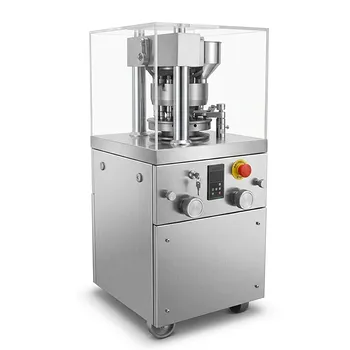
- Ordinary Type Rotary Tablet Press for Pharmaceutical Chemical Food Electronic Industries
People Also Ask
- What is the function of a laboratory press in Cr-Ti alloy evaluation? Quantify Fracture Stress & Strength
- What is the function of a laboratory press in assessing the hydrophobic performance of modified vermiculite fillers?
- What is the core function of a laboratory press in the forming of ceramic filter element green bodies? Maximize Density.
- What is the function of a laboratory press in the preparation of ceramic feed rods? Master Density and Precision
- Why is vacuum sealing and flexible packaging necessary for Aluminum Titanate powders during CIP? Ensure Peak Density

Tech Team · PowderPreparation
Last updated on Jun 03, 2026
Related Products
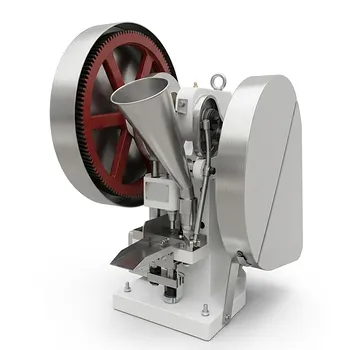
6-Ton Small Single-Punch Tablet Press — Laboratory Powder & Granule Tableting Equipment / Tablet Forming Machine
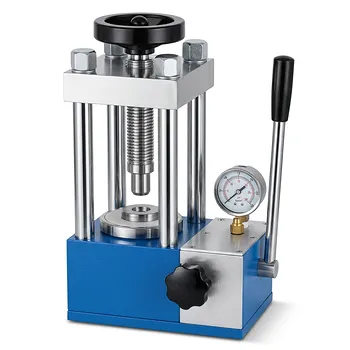
Manual Tablet Press with Dual Scale Pressure Gauge for Pharmaceutical Food Chemical Laboratory Sample Preparation
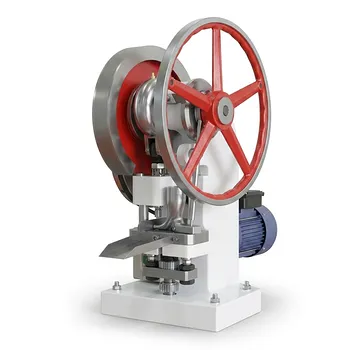
5 Ton Single Punch Tablet Press Laboratory Small Batch Production