Why is CIP equipment necessary for ceramic green bodies? Achieve uniform density and high-performance sintering.
Updated 5 months ago
Cold Isostatic Pressing (CIP) is the essential bridge between initial powder shaping and final sintering. It is necessary because traditional mechanical pressing creates uneven internal stresses and density gradients that often lead to cracking or warping during the firing process. By applying equal pressure from all directions, CIP ensures the green body has the structural integrity required for high-performance applications.
CIP equipment uses a high-pressure liquid medium to apply uniform, omnidirectional force to ceramic powders, eliminating internal voids and density gradients. This process is critical for achieving the high green density and dimensional stability necessary to prevent failure during high-temperature sintering.
Achieving Structural Uniformity Through Isotropic Pressure
Eliminating Internal Density Gradients
Traditional uniaxial or "die" pressing applies force in a single direction, which creates friction against the mold walls. This friction leads to uneven pressure distribution, resulting in "density gradients" where some parts of the ceramic are more compact than others.
CIP solves this by submerging the powder (sealed in a flexible mold) into a liquid medium. The liquid transmits equal pressure from all directions, ensuring every cubic millimeter of the green body experiences the same compressive force.
Maximizing Green Body Density
At pressures ranging from 200 MPa to 300 MPa, CIP forces ceramic particles to rearrange and bond more tightly than mechanical pressing alone. This high-pressure environment eliminates "bridging voids" and residual pores that often remain after initial shaping.
By reaching a higher relative density (often around 62% or higher), the ceramic green body becomes much stronger. This improved density provides a robust physical foundation for the subsequent densification process in the kiln.
Enhancing Sintering Performance and Integrity
Minimizing Deformation and Shrinkage
During high-temperature sintering (often between 1030°C and 1080°C), ceramic materials shrink as they densify. If the green body has uneven density, it will shrink at different rates, leading to warping, twisting, or dimensional inaccuracy.
Because CIP ensures uniform density throughout the part, the material shrinks evenly in all directions. This leads to high dimensional accuracy and significantly reduces the risk of the part deforming under its own weight during firing.
Preventing Micro-structural Failure
Internal pores and micro-cracks act as stress concentrators that can cause a ceramic component to fail prematurely. CIP effectively crushes these internal defects before the sintering stage begins.
For high-performance materials like Silicon Carbide (SiC) or Alumina, this secondary compaction is vital. It ensures the final product achieves the mechanical strength and hardness required for industrial cutting tools or structural components.
Understanding the Trade-offs
Process Complexity and Speed
While CIP produces superior parts, it is generally slower than high-speed mechanical pressing. The need to seal parts in flexible molds and cycle a high-pressure vessel adds time and labor to the manufacturing workflow.
Geometric Constraints
CIP relies on flexible molds (usually rubber or polyurethane), which can make it difficult to maintain extremely sharp corners or complex external features compared to rigid steel dies. The resulting surfaces may require secondary machining to meet tight tolerances.
Equipment and Maintenance Costs
Operating at pressures up to 300 MPa requires specialized, heavy-duty vessels and sophisticated pumping systems. The initial capital investment and the ongoing maintenance of high-pressure seals make it a more expensive forming route than simple dry pressing.
How to Apply CIP to Your Production Goal
Making the Right Choice for Your Goal
- If your primary focus is high mechanical strength: Use CIP to eliminate internal pores and ensure the maximum possible density before sintering.
- If your primary focus is dimensional precision: Implement CIP to provide uniform shrinkage rates, which prevents warping and reduces the need for expensive post-sintering grinding.
- If your primary focus is complex, low-density preforms (like SLS): Utilize CIP as a secondary compaction step to stabilize the structure and prepare it for full densification.
- If your primary focus is high-volume, low-cost production: Consider if the benefits of CIP outweigh the slower cycle times compared to traditional uniaxial dry pressing.
Integrating Cold Isostatic Pressing into your workflow is the most effective way to transform loose ceramic powders into high-performance, defect-free technical components.
Summary Table:
| Feature | Cold Isostatic Pressing (CIP) | Traditional Uniaxial Pressing |
|---|---|---|
| Pressure Direction | Omnidirectional (Equal from all sides) | Unidirectional (Single axis) |
| Density Distribution | Highly uniform; no internal gradients | Uneven due to mold wall friction |
| Sintering Outcome | Minimal warping; predictable shrinkage | Prone to cracking and deformation |
| Product Integrity | High mechanical strength; defect-free | Risk of internal voids and failure |
| Application | High-performance technical ceramics | High-volume, simple geometries |
Elevate Your Material Performance with Precision Compaction Solutions
Achieving the perfect green body is critical to the success of your final sintered product. At [Insert Brand Name], we provide complete laboratory sample preparation solutions specifically designed for material science and advanced powder processing.
From high-performance Cold/Warm Isostatic Presses (CIP/WIP) to a full spectrum of hydraulic presses, hot presses, and vacuum hot presses, our equipment ensures maximum density and structural integrity. We also specialize in the entire preparation workflow, offering:
- Size Reduction: Jaw/roll crushers and liquid nitrogen cryogenic grinders.
- Precision Milling: Planetary ball, jet, sand/bead, and rotor mills.
- Analysis & Mixing: Vibratory sieve shakers, powder mixers, and defoaming mixers.
Ready to eliminate sintering defects and optimize your production? Contact us today to consult with our technical experts and find the ideal equipment for your specific material requirements.
References
- Wenjun Li, Zhengyi Fu. Preparation and Property of Mg<sub>0.9</sub>Al<sub>2.08</sub>O<sub>3.73</sub>N<sub>0.03</sub> Transparent Ceramic with Broad Optical Transmission Range. DOI: 10.15541/jim20210771
Mentioned Products
- 6-Ton Small Single-Punch Tablet Press — Laboratory Powder & Granule Tableting Equipment / Tablet Forming Machine
- Manual Tablet Press with Dual Scale Pressure Gauge for Pharmaceutical Food Chemical Laboratory Sample Preparation
- 5 Ton Single Punch Tablet Press Laboratory Small Batch Production
- Ordinary Type Rotary Tablet Press for Pharmaceutical Chemical Food Electronic Industries
People Also Ask
- What is the function of a laboratory press in Cr-Ti alloy evaluation? Quantify Fracture Stress & Strength
- What is the function of a laboratory press in assessing the hydrophobic performance of modified vermiculite fillers?
- What is the core function of a laboratory press in the forming of ceramic filter element green bodies? Maximize Density.
- What is the function of a laboratory press in the preparation of ceramic feed rods? Master Density and Precision
- Why is vacuum sealing and flexible packaging necessary for Aluminum Titanate powders during CIP? Ensure Peak Density

Tech Team · PowderPreparation
Last updated on May 14, 2026
Related Products
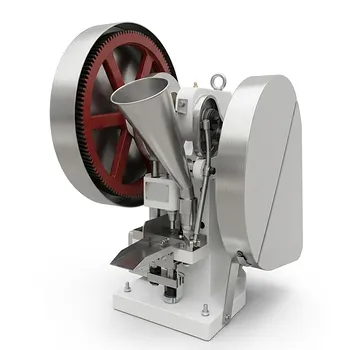
6-Ton Small Single-Punch Tablet Press — Laboratory Powder & Granule Tableting Equipment / Tablet Forming Machine
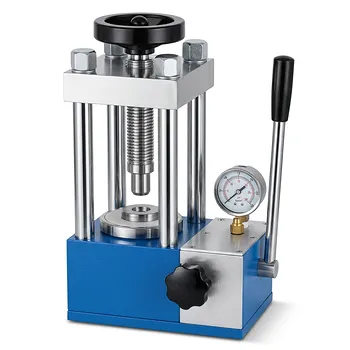
Manual Tablet Press with Dual Scale Pressure Gauge for Pharmaceutical Food Chemical Laboratory Sample Preparation
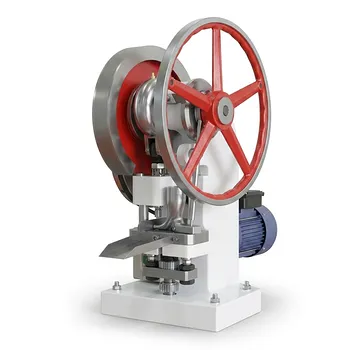
5 Ton Single Punch Tablet Press Laboratory Small Batch Production