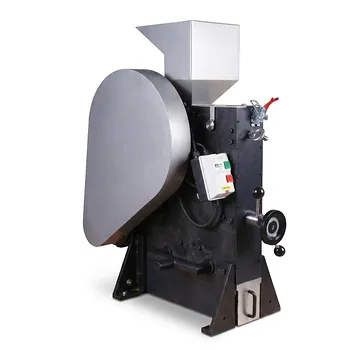
Why is an industrial cutting crusher utilized for red algae fiber? Essential for Uniform Mixing and Stable Extrusion
Updated 4 months ago
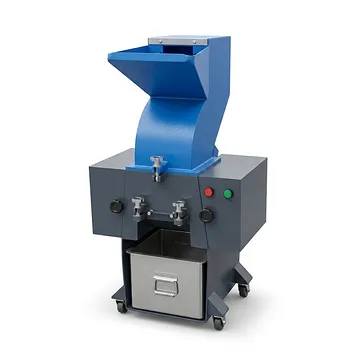
The industrial cutting crusher is the critical mechanical bridge between raw biomass and a processable technical additive. It uses high-speed shearing forces to reduce bulky, dried red algae into fine powders or standardized granules. This physical transformation is mandatory to ensure a homogenous blend with polymer matrices and to maintain stable material flow during downstream extrusion.
An industrial cutting crusher standardizes the morphology of red algae to ensure uniform mixing with polymers like PLA and to prevent feeding fluctuations in extrusion equipment. This stage is fundamental for achieving consistent material properties and dimensional accuracy in the final product.
Achieving Micro-Scale Uniformity
High-Speed Shearing of Fibrous Biomass
Industrial cutting crushers utilize high-speed rotating blades to apply intense shearing and crushing forces directly to the cellular structure of dried red algae. Unlike simple grinding, this shearing action efficiently breaks down the tough, fibrous tissues of the algae into a fine, manageable powder.
Enhancing Matrix Integration
Reducing red algae to a fine powder is essential for creating a uniform distribution when combined with polylactic acid (PLA) matrices. Maximizing the surface area of the algae particles ensures that the biological filler is thoroughly encapsulated by the polymer, preventing structural weak points in the composite.
Standardizing Material Flow for Extrusion
Precise Granular Morphology
Beyond fine powders, industrial crushers are often used to process kneaded bulk composites into uniform granules, typically sized at approximately 4 x 4 mm. This "cold-cutting" process transforms irregular masses into a standardized feedstock that is compatible with industrial manufacturing standards.
Preventing Extruder Fluctuations
Standardized granules are a prerequisite for stable feeding into single-screw extruders. Consistent particle size prevents "bridging" in the hopper and ensures a steady volumetric flow, which is directly responsible for the diameter uniformity of 3D printing filaments and other extruded profiles.
Understanding the Trade-offs
Thermal Management During Crushing
The high-speed mechanical action of the blades generates significant frictional heat, which can potentially degrade the organic compounds within the red algae. High-quality industrial crushers must often incorporate cooling mechanisms or "cold-cutting" techniques to preserve the chemical integrity of the biomass.
Blade Wear and Contamination
Processing fibrous materials like red algae can lead to progressive blade dulling, which reduces the efficiency of the shearing force and can lead to inconsistent particle sizes. Furthermore, the abrasive nature of some biomasses requires the use of hardened tool steels to prevent metal micro-contaminants from entering the powder batch.
How to Apply This to Your Process
When integrating an industrial cutting crusher into your production line, the configuration should be dictated by your specific manufacturing goals.
- If your primary focus is material strength: Prioritize a finer powder output to maximize surface area and ensure a defect-free interface between the algae fiber and the PLA matrix.
- If your primary focus is dimensional accuracy in 3D printing: Focus on the "cold-cutting" granular stage to produce uniform 4 x 4 mm pellets that guarantee a stable, surge-free extrusion flow.
- If your primary focus is high-throughput production: Implement a multi-stage crushing approach where the algae is first pre-crushed before entering the high-speed shearing stage to reduce machine strain and energy consumption.
Proper mechanical preparation is the foundation upon which the entire performance of a bio-composite material is built.
Summary Table:
| Feature | Process Benefit | Impact on Final Product |
|---|---|---|
| High-Speed Shearing | Efficiently breaks down tough fibrous biomass | Creates fine, manageable powder particles |
| Morphology Control | Ensures uniform distribution in polymer matrices | Prevents structural weak points in composites |
| Granulation (4x4mm) | Standardizes feedstock for industrial equipment | Ensures stable extrusion and flow uniformity |
| Cold-Cutting Action | Manages frictional heat during processing | Preserves the chemical integrity of the biomass |
Optimize Your Material Preparation with Professional Lab Solutions
Achieving consistent results in bio-composite research requires precision at the powder preparation stage. We provide complete laboratory sample preparation solutions for material science, specializing in high-performance powder processing and compaction equipment.
Whether you are refining red algae fiber or developing advanced polymers, our extensive line includes:
- Crushing & Milling: Industrial cutting crushers, jaw/roll crushers, planetary ball mills, jet mills, and liquid nitrogen cryogenic grinders.
- Sieving & Mixing: Vibratory/air-jet sieve shakers, powder mixers, and defoaming mixers.
- Advanced Compaction: A full spectrum of hydraulic presses, including Cold/Warm Isostatic Presses (CIP/WIP), XRF pellet presses, and vacuum hot presses.
From raw biomass to standardized technical additives, we help you ensure micro-scale uniformity and stable material flow. Contact our experts today to find the ideal equipment for your specific research and production needs.
References
- Farah Nurasyikin Md Rosdi, Siti Noorbaini Sarmin. Potential Red Algae Fibre Waste as a Raw Material for Biocomposite. DOI: 10.37934/araset.30.1.303310
Mentioned Products
- Industrial Cutting Mill for Tough Fibrous and Soft Materials
- Versatile Industrial Crusher for Laboratory Crushing and Material Processing
- Heavy Duty Industrial Jaw Crusher for Primary Ore Crushing and High Capacity Mineral Material Size Reduction
- Heavy-Duty Crusher for Laboratory and Industrial Material Size Reduction
- Heavy Duty Industrial Laboratory Jaw Crusher for Primary Sample Preparation and Hard Material Size Reduction
People Also Ask
- Why is a cutting mill utilized for processing fibrous Agarwood distillation waste? Efficient Shearing Solutions
- What role does an industrial cutting mill play in sea buckthorn waste processing? Efficient Biomass Pretreatment
- What is the role of a cutting mill equipped with a 1 mm screen in the preliminary preparation of Maguey fibers?
- What is the purpose of using a laboratory cutting mill for two-stage grinding? Optimize WPC Particles for 3D Printing
- How is a universal cutting mill used to achieve precise size control of hop fibers for material reinforcement? Guide

Tech Team · PowderPreparation
Last updated on Jun 03, 2026
Related Products
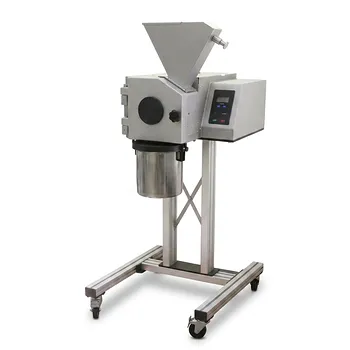
Industrial Cutting Mill for Tough Fibrous and Soft Materials
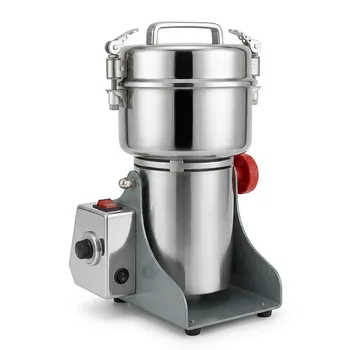
Versatile Industrial Crusher for Laboratory Crushing and Material Processing
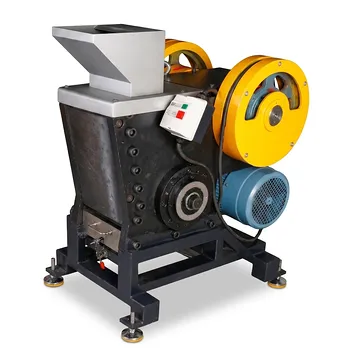
Heavy Duty Industrial Jaw Crusher for Primary Ore Crushing and High Capacity Mineral Material Size Reduction
Heavy-Duty Crusher for Laboratory and Industrial Material Size Reduction