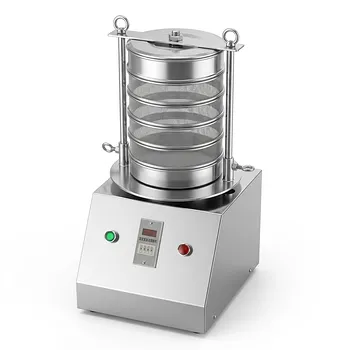
Why is a No. 200 standard test sieve required for ash additives? Maximize Reactivity for Soil Stabilization
Updated 4 months ago
Maximum chemical reactivity in soil stabilization depends entirely on particle fineness.
Using a No. 200 standard test sieve ensures that volcanic and rice husk ash additives reach the required fineness to maximize their high silica (SiO2) reactivity. By removing coarse impurities and oversized particles, the sieve allows these materials to react fully with clay particles, effectively reducing the soil's plasticity index and significantly enhancing its long-term structural stability.
Core Takeaway: The No. 200 sieve acts as a quality-control gatekeeper that ensures ash additives possess the high specific surface area necessary for pozzolanic reactions. This precise particle sizing is what converts raw agricultural or volcanic waste into a reactive chemical agent capable of hardening unstable soils.
Maximizing Chemical and Pozzolanic Reactivity
Unlocking Silica (SiO2) Potential
Volcanic ash and rice husk ash are valued for their high amorphous silica content, which is the primary driver of soil stabilization. The No. 200 sieve ensures particles are small enough (0.075mm or less) to expose maximum surface area for chemical interaction.
Facilitating the Clay-Ash Reaction
For chemical stabilization to occur, the additive must react intimately with the clay minerals in the soil. Fine particles passing through a No. 200 sieve can distribute uniformly, ensuring that the calcium-silicate-hydrate (CSH) bonds form consistently throughout the soil matrix.
Reducing the Plasticity Index
High-plasticity clays are prone to swelling and shrinking, which can destroy infrastructure. The fine ash particles produced by No. 200 sieving react with the clay to neutralize its expansive properties, resulting in a more workable and predictable material.
Ensuring Physical Homogeneity and Density
Removing Coarse Impurities
Raw volcanic ash and rice husk ash often contain unburned carbon, stones, or oversized organic debris. Using a No. 200 sieve filters out these non-reactive impurities, which would otherwise weaken the stabilized soil structure.
Preventing Stress Concentration
Oversized particles can act as "weak points" within a soil-cement or soil-ash mixture. By ensuring all particles are below the 0.075mm threshold, the sieve prevents the localized stress concentrations that lead to premature cracking under heavy loads.
Optimizing Void Filling
Ultra-fine ash particles act as physical fillers that occupy the microscopic voids between larger soil grains. This "micro-filler effect" increases the overall density of the soil, making it less permeable to water and more resistant to erosion.
Understanding the Trade-offs and Constraints
The Cost of Over-Processing
While finer particles generally lead to higher reactivity, grinding ash to pass through even finer sieves (like No. 325) increases energy costs and production time. The No. 200 sieve represents the "sweet spot" where high reactivity is achieved without the diminishing returns of extreme pulverization.
Limitations of Dry Sieving
In some environments, fine ash can become electrostatic or clump due to moisture, making dry sieving difficult. In these cases, wet sieving through the No. 200 mesh is often required to ensure that fine particles adhering to larger grains are not accidentally discarded.
Reactivity vs. Ash Quality
The No. 200 sieve ensures fineness, but it cannot fix poor chemical quality. If the rice husk ash was burned at too high a temperature (crystalline silica), even the finest particles will fail to react effectively with the soil.
How to Apply This to Your Project
When incorporating ash additives into your soil stabilization strategy, consider your specific performance requirements:
- If your primary focus is Maximum Strength Gain: Ensure the ash is ground until 100% passes the No. 200 sieve to maximize the pozzolanic reaction and CSH bond formation.
- If your primary focus is Cost-Effective Modification: Use the No. 200 sieve primarily to remove large impurities and organic matter, as even partial fineness will improve the workability of heavy clays.
- If your primary focus is Durability in Wet Conditions: Prioritize the "micro-filler" aspect by using a No. 200 sieve to ensure the ash can effectively plug soil voids and reduce hydraulic conductivity.
By strictly adhering to the No. 200 sieve standard, you transform inconsistent raw waste into a precision engineering material for stable foundations.
Summary Table:
| Key Requirement | Role of No. 200 Sieve (0.075mm) | Impact on Soil Stabilization |
|---|---|---|
| Chemical Reactivity | Increases specific surface area | Maximizes pozzolanic reaction and CSH bonding |
| Physical Purity | Filters out coarse debris/impurities | Prevents localized stress and premature cracking |
| Structural Density | Produces ultra-fine "micro-fillers" | Occupies voids to reduce water permeability |
| Plasticity Control | Ensures uniform particle distribution | Neutralizes expansive properties of heavy clays |
Elevate Your Material Research with Precision Sample Preparation
Precision in particle size is the foundation of effective soil stabilization. Achieving consistent No. 200 mesh fineness is critical to transforming raw volcanic or rice husk ash into high-performance chemical agents.
At [Company Name], we provide complete laboratory sample preparation solutions for material science, specializing in powder processing and compaction equipment. Our extensive range is designed to help researchers and engineers achieve perfect results every time:
- Sieving & Particle Analysis: Advanced vibratory and air-jet sieve shakers with high-precision test sieves and meshes.
- Milling & Grinding: Planetary ball mills, jet mills, and cryogenic grinders to achieve the specific surface area needed for maximum reactivity.
- Compaction & Pressing: A full spectrum of hydraulic presses, including Cold/Warm Isostatic Presses (CIP/WIP), standard lab presses, and vacuum hot presses for material characterization.
Ready to optimize your stabilization formulas? Contact us today to find the right equipment for your lab!
References
- Ika Puji Hastuty, Muhammad Iqbal Abidin. The Utilization of Volcanic Ash and High Rusk Ash as Material Stabilization in Clay by Unconfined Compression Test (UCT) and California Bearing Ratio (CBR). DOI: 10.1088/1757-899x/180/1/012141
Mentioned Products
- Stainless Steel Laboratory Vibratory Test Sieve Shaker
- Laboratory Vibratory Test Sieve Shaker for Precision Particle Size Analysis and Powder Grading
- Small Laboratory Vibrating Sieve Shaker for Precise Particle Size Analysis
People Also Ask
- What function does a laboratory vibratory sieve shaker serve in the production process of metakaolin? Optimize Reactivity
- Why is a precision laboratory vibratory sieve shaker necessary for particle size control? Optimize Biomass Carbonization
- What is the function of a laboratory vibratory sieve shaker? Enhance Coal Particle Size Distribution (PSD) Analysis
- What role do laboratory vibratory sieve shakers and test sieves play before the molding of Nb-Cu composite powders?
- What is the primary function of a laboratory vibratory sieve shaker in the evaluation of sand liquefaction potential?

Tech Team · PowderPreparation
Last updated on May 14, 2026