Why combine a Lab Hydraulic Press & CIP for ZrC Green Body Prep? Achieve Superior Density & Structural Uniformity
Updated 5 months ago
The combination of a hydraulic press and a Cold Isostatic Press (CIP) is essential for Zirconium Carbide (ZrC) because it decouples geometric shaping from high-pressure densification. While the hydraulic press establishes the basic dimensions of the green body, the CIP provides the uniform, omnidirectional pressure required to eliminate internal density gradients and micro-pores, which are critical for successful pressureless sintering.
This two-stage forming process ensures that ZrC powders achieve the maximum possible green density and structural uniformity. By using a hydraulic press for initial shaping and a CIP for isotropic compaction, manufacturers can prevent deformation, cracking, and incomplete densification during the high-temperature sintering phase.
The Role of the Laboratory Hydraulic Press: Establishing the Foundation
Precision Geometric Shaping
The process begins with a standard laboratory hydraulic press using high-strength steel molds to apply uniaxial (axial) force.
This stage, typically performed at pressures around 30 MPa, is designed to compress loose powder into a specific geometric "green body."
Without this initial step, the powder would lack the structural integrity needed to be handled or placed into the flexible molds required for the next phase.
Initial Particle Rearrangement
Applying a controlled mechanical force ensures that powder particles achieve initial close contact and expel trapped air.
This foundation reduces macroscopic defects and provides a stable physical framework for subsequent high-pressure processing.
Precise control of the pressing force at this stage is vital to avoid "capping" or laminations caused by excessive air entrapment or uneven pressure distribution in the mold.
The Role of the Cold Isostatic Press (CIP): Achieving Uniformity
Elimination of Density Gradients
Standard axial pressing suffers from friction between the powder and the mold walls, which leads to uneven density throughout the sample.
A CIP solves this by using a liquid medium to transmit a high omnidirectional pressure (up to 300 MPa) to the green body.
This isotropic pressure ensures that the material is compressed equally from all sides, effectively eliminating density gradients and stress imbalances.
Maximizing Green Density for Sintering
Zirconium Carbide is notoriously difficult to sinter to full density without the application of external pressure.
The high-pressure environment of the CIP (ten times that of the initial axial press) significantly increases the relative density of the green body.
By removing micro-pores and maximizing particle packing, the CIP creates a green body that can achieve complete densification during the final pressureless sintering process.
Understanding the Trade-offs
The Limitations of Single-Stage Pressing
Relying solely on a hydraulic press often results in internal micro-cracks and non-uniform shrinkage during sintering due to the "die-wall effect."
Conversely, attempting to use a CIP without a pre-formed green body makes it extremely difficult to achieve precise geometric dimensions or complex shapes.
Structural Risks During Sintering
Green bodies that have not undergone isostatic pressing are highly susceptible to warping or cracking at high temperatures.
The lack of uniform internal pressure leads to differential shrinkage rates, where different parts of the ceramic component contract at different speeds.
This composite approach—axial pressing followed by CIP—is the industry standard for producing high-performance, defect-free ZrC ceramics.
How to Apply This to Your Project
Recommendations for Material Preparation
Success in ZrC fabrication depends on matching your pressing parameters to your final density requirements.
- If your primary focus is high geometric precision: Prioritize the use of precision-ground steel molds in the hydraulic press stage to define sharp edges and exact dimensions.
- If your primary focus is achieving full transparency or zero porosity: Ensure the CIP stage reaches at least 300 MPa to eliminate the smallest micro-pores before sintering.
- If your primary focus is preventing deformation in large parts: Increase the holding time during the CIP process to allow the isotropic pressure to equalize fully throughout the volume.
By mastering this two-step forming sequence, you provide the necessary physical foundation for high-temperature solid-phase reactions and optimal grain growth.
Summary Table:
| Pressing Stage | Equipment Type | Typical Pressure | Primary Objective |
|---|---|---|---|
| Stage 1: Shaping | Standard Hydraulic Press | ~30 MPa | Geometric definition & initial particle rearrangement. |
| Stage 2: Compaction | Cold Isostatic Press (CIP) | Up to 300 MPa | Eliminating density gradients & maximizing green density. |
| Outcome | Combined Process | Synergistic | Defect-free sintering with zero warping or micro-cracks. |
Elevate Your Material Research with Precision Sample Preparation
Achieving the perfect green body for Zirconium Carbide requires the right tools for both shaping and densification. At our facility, we provide complete laboratory sample preparation solutions tailored for material science professionals.
Whether you are processing advanced ceramics or metal powders, our extensive equipment line supports your entire workflow:
- Size Reduction: Jaw/roll crushers, liquid nitrogen cryogenic grinders, and high-energy mills (planetary ball, jet, sand/bead, disc, and rotor).
- Classification & Mixing: Vibratory/air-jet sieve shakers and advanced powder/defoaming mixers.
- Compaction Excellence: A full spectrum of hydraulic presses, including Cold/Warm Isostatic Presses (CIP/WIP), standard lab presses, XRF pellet presses, and vacuum hot presses.
Don't let internal density gradients compromise your sintering results. Contact our expert team today to find the ideal pressing and milling configuration for your specific material requirements!
References
- Katrin Schönfeld, A. Michaelis. Pressureless sintering of ZrC with variable stoichiometry. DOI: 10.1007/s40145-017-0229-1
Mentioned Products
- 6-Ton Small Single-Punch Tablet Press — Laboratory Powder & Granule Tableting Equipment / Tablet Forming Machine
- Manual Tablet Press with Dual Scale Pressure Gauge for Pharmaceutical Food Chemical Laboratory Sample Preparation
- 5 Ton Single Punch Tablet Press Laboratory Small Batch Production
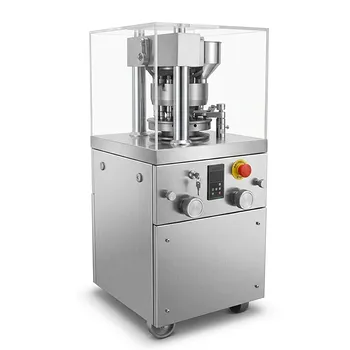
- Ordinary Type Rotary Tablet Press for Pharmaceutical Chemical Food Electronic Industries
People Also Ask
- What is the function of a laboratory press in Cr-Ti alloy evaluation? Quantify Fracture Stress & Strength
- What is the function of a laboratory press in assessing the hydrophobic performance of modified vermiculite fillers?
- What is the core function of a laboratory press in the forming of ceramic filter element green bodies? Maximize Density.
- What is the function of a laboratory press in the preparation of ceramic feed rods? Master Density and Precision
- Why is vacuum sealing and flexible packaging necessary for Aluminum Titanate powders during CIP? Ensure Peak Density

Tech Team · PowderPreparation
Last updated on May 14, 2026
Related Products
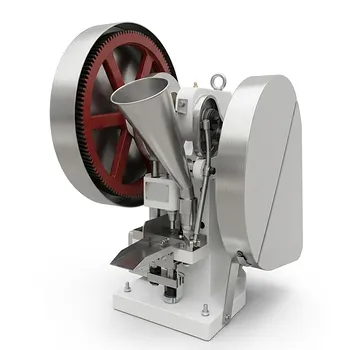
6-Ton Small Single-Punch Tablet Press — Laboratory Powder & Granule Tableting Equipment / Tablet Forming Machine
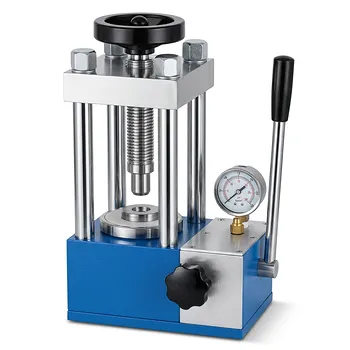
Manual Tablet Press with Dual Scale Pressure Gauge for Pharmaceutical Food Chemical Laboratory Sample Preparation
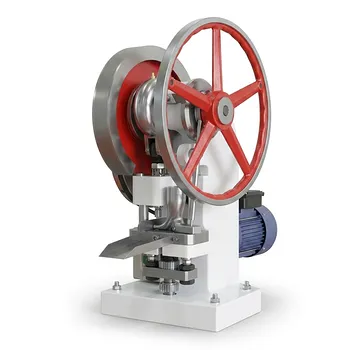
5 Ton Single Punch Tablet Press Laboratory Small Batch Production