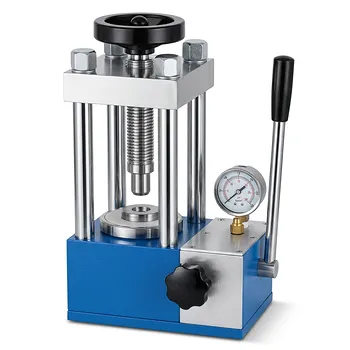
Why is a Cold Isostatic Press (CIP) preferred for Mo2N? Ensure Maximum Density & Prevent Sintering Cracks
Updated 5 months ago
Cold Isostatic Pressing (CIP) is the preferred method for anti-rutile $Mo_2N$ because it addresses the material's unique high compressibility and susceptibility to internal stress. While a standard uniaxial press applies force along a single axis, a CIP applies equal, omnidirectional pressure that ensures a uniform density distribution. This uniformity is critical for preventing the deformation, cracking, and structural failure that typically occur during the high-temperature sintering of molybdenum nitride.
Core Takeaway: A Cold Isostatic Press is essential for $Mo_2N$ green bodies because it eliminates the density gradients and internal stresses inherent in uniaxial pressing. By providing isotropic compaction, CIP ensures the green body remains structurally intact and dimensionally stable throughout subsequent thermal processing.
Managing High Compressibility in Anti-Rutile $Mo_2N$
The Impact of Material Structure on Compaction
The anti-rutile phase of $Mo_2N$ exhibits higher compressibility than traditional ceramic or metallic phases. This means the powder particles require a highly controlled environment to rearrange efficiently without creating structural imbalances.
Achieving Maximum Green Density
By applying fluid pressure from all directions, a CIP forces $Mo_2N$ particles to bond more tightly and uniformly. This omnidirectional high pressure (often exceeding 100-300 MPa) results in the highest possible green density, which is necessary for achieving full densification later.
Eliminating Internal Stress Gradients
Standard pressing often leaves "stress pockets" where some areas are more compacted than others. CIP effectively eliminates these internal gradients, ensuring that the mechanical properties of the green body are consistent throughout its entire volume.
Limitations of Uniaxial Pressing for Molybdenum Nitride
The Problem of Friction and Anisotropy
In a uniaxial press, friction between the powder and the die walls prevents pressure from reaching the center of the part evenly. This creates anisotropy, where the material properties vary depending on the direction of the original pressing force.
Bridging Voids and Micro-cracks
Uniaxial pressing can lead to bridging voids, where particles "arch" over empty spaces rather than filling them. These voids become sites for micro-cracks and stress concentrations that compromise the integrity of the $Mo_2N$ body.
Deformation During Heat Treatment
Because anti-rutile $Mo_2N$ undergoes significant volume changes during sintering, any uneven density distribution will cause the part to warp or crack. A uniaxial green body is far more likely to fail during high-temperature conversion than a CIP-compacted body.
Understanding the Trade-offs
Process Complexity and Cycle Time
CIP is generally a slower, batch-oriented process compared to the high-speed automation possible with uniaxial pressing. It requires the powder to be hermetically sealed in flexible molds, which adds steps to the production workflow.
Geometric Precision vs. Material Integrity
While uniaxial pressing can produce parts with very precise "near-net" shapes due to rigid tooling, CIP provides superior internal structural integrity. For advanced materials like $Mo_2N$, the risk of structural failure usually outweighs the benefit of immediate dimensional precision.
Equipment and Operational Costs
The initial capital investment for a Cold Isostatic Press is typically higher than for a standard hydraulic press. However, this cost is often offset by the reduced scrap rates and the ability to produce high-performance materials that are impossible to manufacture otherwise.
Making the Right Choice for Your Project
Recommendations for Material Processing
- If your primary focus is maximum density and structural reliability: Utilize a Cold Isostatic Press to ensure the $Mo_2N$ particles are fully rearranged and free of internal voids.
- If your primary focus is preventing sintering cracks: Prioritize the isotropic pressure of a CIP to eliminate the density gradients that lead to warping during heat treatment.
- If your primary focus is high-volume production of simple shapes: You may use uniaxial pressing for initial shaping, but it should be followed by a secondary CIP step to "heal" internal defects before sintering.
By choosing Cold Isostatic Pressing, you ensure that the complex compressibility of anti-rutile $Mo_2N$ is managed scientifically, resulting in a robust, high-performance ceramic.
Summary Table:
| Feature | Uniaxial Pressing | Cold Isostatic Pressing (CIP) |
|---|---|---|
| Pressure Direction | Single axis (top/bottom) | Omnidirectional (360° fluid pressure) |
| Density Uniformity | Low (gradients present) | High (uniform throughout) |
| Internal Stress | Significant (die friction) | Minimized (isotropic compaction) |
| Sintering Result | High risk of warping/cracking | Dimensional stability & integrity |
| Material Suitability | Simple shapes/low complexity | High compressibility materials (Mo2N) |
Elevate Your Material Research with Precision Sample Prep
At [Your Brand Name], we provide complete laboratory sample preparation solutions tailored for material science. Achieving defect-free green bodies like anti-rutile $Mo_2N$ requires the right equipment. Our specialized Cold Isostatic Presses (CIP) and Warm Isostatic Presses (WIP) are designed to eliminate density gradients and ensure the structural integrity of your high-performance materials.
Beyond isostatic pressing, our extensive lineup includes:
- Powder Processing: Crushers (jaw/roll), liquid nitrogen cryogenic grinders, and advanced mills (planetary ball, jet, sand, rotor).
- Sieving & Mixing: Vibratory/air-jet sieve shakers and high-efficiency powder or defoaming mixers.
- Hydraulic Solutions: Standard lab presses, XRF pellet presses, and vacuum hot presses.
Don't let internal stress compromise your sintering results. Contact our technical team today to find the perfect compaction solution for your laboratory needs!
References
- Lauren N. Walters, James M. Rondinelli. Metallicity and chemical bonding in anti-anatase Mo<sub>2</sub>N. DOI: 10.1039/d3cp05054h
Mentioned Products
- Ordinary Type Rotary Tablet Press for Pharmaceutical Chemical Food Electronic Industries
- 6-Ton Small Single-Punch Tablet Press — Laboratory Powder & Granule Tableting Equipment / Tablet Forming Machine
- Manual Tablet Press with Dual Scale Pressure Gauge for Pharmaceutical Food Chemical Laboratory Sample Preparation
People Also Ask
- Why is a laboratory hydraulic press required for FT-IR KBr pellets? Achieve Precise Sample Clarity for ZrC–SiC Analysis
- Why is a laboratory hydraulic press required to compress oyster shell powder before XRF analysis? Improve Data Accuracy.
- Why is vacuum sealing and flexible packaging necessary for Aluminum Titanate powders during CIP? Ensure Peak Density
- What are the advantages of using hardened steel molds and graphite spray for titanium powder? Ensure structural integrity
- What role does a high-strength stainless steel mold kit play in the uniaxial die compaction process? Ensuring Precision

Tech Team · PowderPreparation
Last updated on May 14, 2026
Related Products
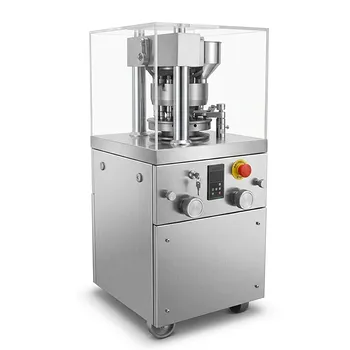
Ordinary Type Rotary Tablet Press for Pharmaceutical Chemical Food Electronic Industries
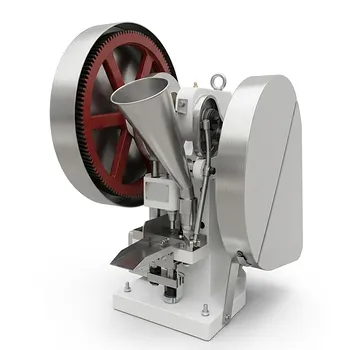
6-Ton Small Single-Punch Tablet Press — Laboratory Powder & Granule Tableting Equipment / Tablet Forming Machine