Why is a Cold Isostatic Press (CIP) often used after die pressing during the ceramic green body forming process?
Updated 5 months ago
Cold Isostatic Pressing (CIP) is used after die pressing to achieve a level of density uniformity and structural integrity that uniaxial pressing cannot provide. By applying high, omnidirectional pressure through a liquid medium, CIP eliminates the internal density gradients and "bridging voids" caused by the friction inherent in die pressing. This secondary processing step ensures the ceramic green body is sufficiently compacted to prevent cracking, warping, and non-uniform shrinkage during the high-temperature sintering process.
Core Takeaway: While die pressing provides the initial shape, Cold Isostatic Pressing uses isotropic pressure to homogenize the internal structure of the green body. This eliminates the residual stresses and density variations that lead to mechanical failure or deformation during sintering.
Overcoming the Limitations of Die Pressing
The Failure of Unidirectional Force
In traditional die pressing, pressure is applied along a single axis, which creates significant internal friction between the powder particles and the die walls. This friction prevents pressure from distributing evenly, leading to a "density gradient" where the center or bottom of the part is less dense than the surface.
Eliminating Bridging Voids
Granulated ceramic particles often form "bridges" during initial pressing, creating microscopic voids that resist further compression from one direction. Cold Isostatic Pressing applies pressure from all directions simultaneously, effectively crushing these bridges and forcing particles to rearrange into a more stable, high-density configuration.
Reducing Internal Stress
The non-uniform pressure of die pressing leaves behind internal residual stresses within the green body. If these stresses are not relieved via CIP, they often manifest as cracks or structural "spring-back" once the part is removed from the die or heated in the kiln.
The Mechanics of Isostatic Homogenization
Pascal’s Law in Practice
CIP utilizes a high-pressure liquid medium to transmit force equally across every square millimeter of the green body’s surface. Because the pressure is omnidirectional (isotropic), the powder is compacted with the same intensity regardless of the part's geometry or thickness.
Achieving Higher Relative Density
While initial pressing provides a basic shape, secondary CIP treatment at pressures often exceeding 200 MPa to 500 MPa significantly increases the relative density of the compact. In many technical ceramic applications, this step is what allows the green body to reach the critical density threshold—sometimes as high as 62%—required for high-performance results.
Promoting Uniform Sintering Shrinkage
Ceramics shrink significantly during sintering; if the green body density is uneven, the part will shrink at different rates, leading to warping or "potato-chipping." By ensuring a uniform starting density through CIP, manufacturers can achieve predictable, linear shrinkage and maintain tight dimensional tolerances.
Understanding the Trade-offs
Process Complexity and Cost
Implementing CIP adds an extra step to the manufacturing flow, requiring specialized equipment and flexible tooling (elastomeric molds). This increase in cycle time and capital expenditure must be weighed against the performance requirements of the final component.
Post-Processing Requirements
Unlike die pressing, which can produce high-precision "near-net" shapes, CIP often results in a green body that requires green machining or grinding. Because the pressure is applied through a flexible membrane, the outer dimensions may not be as precise as those formed in a rigid steel die.
Risk of "Soft" Surface Defects
If the flexible mold or "bag" used in CIP is not properly sealed or designed, it can cause surface irregularities or contamination from the hydraulic fluid. Proper evacuation of air from the powder before sealing is also critical to prevent air pockets from expanding and rupturing the part when pressure is released.
How to Apply This to Your Project
Integrating CIP into the Production Workflow
To decide if CIP is necessary for your ceramic forming process, evaluate the final application's tolerance for internal porosity and dimensional variance.
- If your primary focus is high mechanical strength or transparency: You must use CIP after die pressing to eliminate residual internal pores and ensure a completely dense, pore-free microstructure after sintering.
- If your primary focus is complex geometries with tight tolerances: Use die pressing for the initial shape and follow with CIP at pressures above 100 MPa to ensure the density is uniform enough to prevent warping during the kiln cycle.
- If your primary focus is low-cost mass production of simple shapes: Die pressing alone may be sufficient if the material's final properties are not compromised by slight density gradients and if the sintering shrinkage is manageable.
Cold Isostatic Pressing serves as the critical bridge between a roughly formed powder compact and a high-performance ceramic component capable of withstanding extreme thermal and mechanical stress.
Summary Table:
| Feature | Uniaxial Die Pressing | CIP (Secondary Processing) |
|---|---|---|
| Pressure Direction | Single axis (unidirectional) | Omnidirectional (isotropic) |
| Density Uniformity | Low (creates gradients/voids) | High (homogenized structure) |
| Internal Stress | Significant residual stress | Relieved/Minimized |
| Sintering Result | Risk of warping/cracking | Uniform, predictable shrinkage |
| Shape Precision | High (near-net shape) | Requires green machining |
Elevate Your Material Integrity with Kindle Tech
Achieving the perfect ceramic green body requires precision at every stage. At Kindle Tech, we provide comprehensive laboratory sample preparation solutions tailored for material science. Whether you are looking to eliminate internal defects with our advanced Cold Isostatic Presses (CIP) or need high-performance hydraulic lab presses and planetary ball mills, our equipment is designed for maximum reliability and density uniformity.
Our product range includes:
- Compaction: CIP, WIP, vacuum hot presses, and standard lab presses.
- Processing: Jaw/roll crushers, cryogenic grinders, and jet mills.
- Mixing: Powder and defoaming mixers, plus vibratory sieve shakers.
Ready to optimize your sintering outcomes and prevent structural failure? Contact our technical experts today to find the ideal equipment for your laboratory or production line!
References
- Naoki Kondo, Mikinori Hotta. Preparation and characterization of alumina granules via tumbling and agitation granulation. DOI: 10.2109/jcersj2.25139
Mentioned Products
- Ordinary Type Rotary Tablet Press for Pharmaceutical Chemical Food Electronic Industries
- 6-Ton Small Single-Punch Tablet Press — Laboratory Powder & Granule Tableting Equipment / Tablet Forming Machine
- Manual Tablet Press with Dual Scale Pressure Gauge for Pharmaceutical Food Chemical Laboratory Sample Preparation
People Also Ask
- Why is a laboratory hydraulic press required for FT-IR KBr pellets? Achieve Precise Sample Clarity for ZrC–SiC Analysis
- Why is a laboratory hydraulic press required to compress oyster shell powder before XRF analysis? Improve Data Accuracy.
- Why is vacuum sealing and flexible packaging necessary for Aluminum Titanate powders during CIP? Ensure Peak Density
- What are the advantages of using hardened steel molds and graphite spray for titanium powder? Ensure structural integrity
- What role does a high-strength stainless steel mold kit play in the uniaxial die compaction process? Ensuring Precision

Tech Team · PowderPreparation
Last updated on May 14, 2026
Related Products
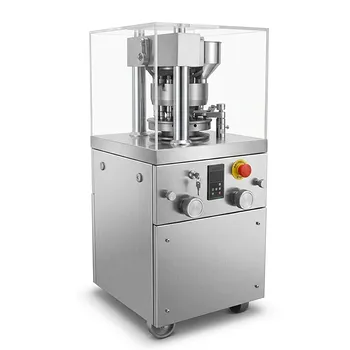
Ordinary Type Rotary Tablet Press for Pharmaceutical Chemical Food Electronic Industries
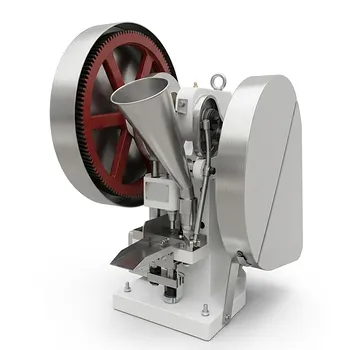
6-Ton Small Single-Punch Tablet Press — Laboratory Powder & Granule Tableting Equipment / Tablet Forming Machine