Why is a Cold Isostatic Press (CIP) considered key equipment for zirconia? Eliminate defects and maximize density.
Updated 5 months ago
Cold Isostatic Pressing (CIP) is the definitive solution for eliminating internal density gradients that plague traditional ceramic forming. By using a liquid medium to apply equal, omnidirectional pressure to zirconia powder, CIP overcomes the friction-induced limitations of mechanical dry pressing. This uniform compression forces particles into an extremely tight, homogeneous arrangement, ensuring the material achieves the structural integrity required to reach near-theoretical density during sintering.
A Cold Isostatic Press ensures that zirconia powder is compacted with perfect uniformity from every direction, eliminating the microscopic defects and density variations that lead to warping or structural failure. This process is the critical foundation for producing high-strength, dense ceramics with a relative density exceeding 99%.
Overcoming the Limitations of Mechanical Pressing
The Problem of Mold Wall Friction
In traditional uniaxial or biaxial dry pressing, the friction between the powder and the rigid mold walls prevents pressure from distributing evenly. This creates "dead zones" and density gradients where some parts of the ceramic are more compacted than others.
The Advantage of Isotropic Pressure
A CIP uses a hydraulic medium—typically a liquid—to transmit high pressure (often between 100 MPa and 250 MPa) to a flexible mold. Because the pressure is isotropic (equal from all directions), it bypasses the friction issues of rigid molds and ensures every millimeter of the zirconia body receives the same compressive force.
Eliminating Internal Gradients
By removing these pressure imbalances, CIP produces a green body with a consistent density distribution throughout its entire volume. This uniformity is the primary reason CIP is considered essential for high-performance zirconia components that must withstand extreme stress.
Enhancing Microstructural Integrity
Particle Rearrangement and Bonding
High-pressure environments force zirconia particles, including nanopowders, to rearrange and bond more tightly than mechanical pressing allows. This tight packing eliminates large pores and micro-cracks that would otherwise act as failure points in the finished product.
Achieving Near-Theoretical Density
The densification achieved during the CIP stage provides a critical foundation for subsequent high-temperature sintering. Because the green body is already highly compact and uniform, it can reach a relative density exceeding 99%, approaching the material's theoretical maximum.
Preventing Deformation and Warping
Since the density is uniform, the zirconia ceramic undergoes consistent shrinkage during the sintering process. This prevents the internal stresses that cause warping, delamination, or cracking, ensuring the final part maintains its precise dimensional requirements.
Understanding the Trade-offs
Process Complexity and Cost
While CIP delivers superior material properties, it is more complex and expensive than simple uniaxial pressing. The need for high-pressure vessels, flexible tooling, and a liquid medium increases the initial capital investment and operational costs.
Geometric Limitations and Cycle Times
CIP is highly effective for simple shapes or pre-formed bodies, but achieving complex geometries can be difficult with flexible molds compared to precision-machined rigid dies. Additionally, the process is generally slower than dry pressing, as it requires sealing, pressurizing, and depressurizing cycles.
Tooling Considerations
Flexible molds used in CIP do not provide the same "near-net-shape" precision as rigid molds. Users must often account for additional post-processing or machining to reach the final desired dimensions of the zirconia part.
How to Apply This to Your Project
Optimizing Your Zirconia Forming Strategy
The decision to implement Cold Isostatic Pressing should be based on the performance requirements of your final ceramic component.
- If your primary focus is maximum mechanical strength: Utilize CIP to ensure the elimination of micro-defects and to achieve a density near 100%.
- If your primary focus is dimensional stability in large parts: Use CIP to prevent the uneven shrinkage and warping that occurs in non-isostatic forming methods.
- If your primary focus is high-volume, low-cost production of simple shapes: Traditional uniaxial pressing may be sufficient, provided the density gradients do not compromise the part's function.
- If your primary focus is handling nanopowders: Implement CIP to overcome the natural resistance of fine powders to uniform compaction under standard mechanical pressure.
By utilizing Cold Isostatic Pressing, you transition from basic ceramic shaping to precision material engineering, ensuring your zirconia components meet the highest standards of durability and density.
Summary Table:
| Feature | Cold Isostatic Pressing (CIP) | Traditional Uniaxial Pressing |
|---|---|---|
| Pressure Distribution | Isotropic (equal from all directions) | Directional (limited by mold friction) |
| Density Gradient | Eliminated; uniform green body | High; prone to "dead zones" |
| Relative Density | Exceeds 99% (near-theoretical) | Lower and inconsistent |
| Sintering Result | Consistent shrinkage; no warping | High risk of deformation and cracks |
| Best Used For | High-strength, high-performance parts | Simple shapes, low-cost production |
Elevate Your Material Performance with Precision CIP Solutions
Achieving near-theoretical density in zirconia requires more than just pressure—it requires the right engineering. At [Your Brand Name], we provide complete laboratory sample preparation solutions for material science, specializing in advanced powder processing and compaction equipment.
Whether you are handling nanopowders or scaling up production, our extensive line includes everything you need to succeed:
- Compaction Excellence: Cold/Warm Isostatic Presses (CIP/WIP), standard lab presses, XRF pellet presses, and vacuum hot presses.
- Powder Preparation: Crushers (jaw/roll), planetary ball mills, jet mills, and liquid nitrogen cryogenic grinders.
- Analysis & Mixing: Sieve shakers, powder mixers, and defoaming mixers.
Ready to eliminate structural defects and optimize your ceramic forming process? Contact our experts today to find the perfect equipment for your material science applications.
References
- Arife Yurdakul, Hilmi Yurdakul. Highly tough and hard zirconia-based composites derived from 3Y-TZP and 12ce-tzp powders by co-doping approach. DOI: 10.2298/sos250129012y
Mentioned Products
- Ordinary Type Rotary Tablet Press for Pharmaceutical Chemical Food Electronic Industries
- 6-Ton Small Single-Punch Tablet Press — Laboratory Powder & Granule Tableting Equipment / Tablet Forming Machine
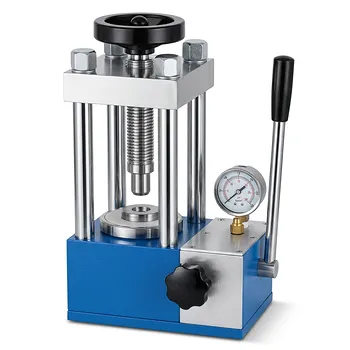
- Manual Tablet Press with Dual Scale Pressure Gauge for Pharmaceutical Food Chemical Laboratory Sample Preparation
People Also Ask
- Why is a laboratory hydraulic press required for FT-IR KBr pellets? Achieve Precise Sample Clarity for ZrC–SiC Analysis
- Why is a laboratory hydraulic press required to compress oyster shell powder before XRF analysis? Improve Data Accuracy.
- Why is vacuum sealing and flexible packaging necessary for Aluminum Titanate powders during CIP? Ensure Peak Density
- What are the advantages of using hardened steel molds and graphite spray for titanium powder? Ensure structural integrity
- What role does a high-strength stainless steel mold kit play in the uniaxial die compaction process? Ensuring Precision

Tech Team · PowderPreparation
Last updated on May 14, 2026
Related Products
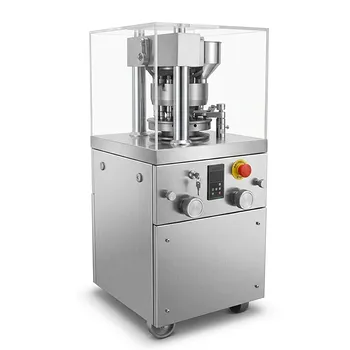
Ordinary Type Rotary Tablet Press for Pharmaceutical Chemical Food Electronic Industries
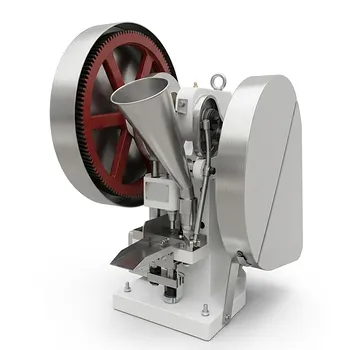
6-Ton Small Single-Punch Tablet Press — Laboratory Powder & Granule Tableting Equipment / Tablet Forming Machine