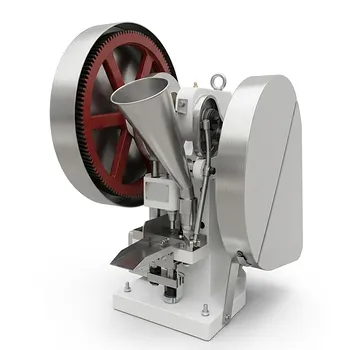
Why is a 20-ton laboratory hydraulic press required for preparing sediment pellets for XRF testing? Optimize Accuracy
Updated 3 months ago
A 20-ton laboratory hydraulic press is essential because it transforms loose sediment powder into a solid, high-density pellet with a perfectly flat surface. This high-pressure compaction is required to eliminate internal voids and ensure the structural integrity of the sample. By creating a uniform geometry, the press allows X-ray Fluorescence (XRF) spectrometers to achieve the sensitivity and repeatability necessary for precise quantitative analysis.
High-pressure pelletization is the critical bridge between raw powdered sediment and accurate XRF data. By applying significant tonnage, the press removes physical inconsistencies that would otherwise distort X-ray signals, ensuring that the resulting data reflects the sample's true chemistry rather than its physical state.
Eliminating Physical Interferences
Removing Voids and Porosity
Loose sediment powder contains significant air gaps and internal pores that interfere with X-ray signals. A 20-ton press applies high-intensity axial pressure to force these particles together, effectively eliminating voids.
Removing these gaps minimizes "matrix effects," which occur when the physical structure of the sample causes unpredictable X-ray absorption. This results in a much higher signal-to-noise ratio during spectral analysis.
Standardizing Sample Geometry
XRF spectrometers require a constant geometric relationship between the X-ray source and the sample surface. The press uses specialized dies, often 25 mm in diameter, to produce pellets with fixed thickness and diameter.
This standardized shape ensures that every sample is positioned identically within the machine. By maintaining this constant light path, you minimize measurement errors caused by varying distances or angles.
Enhancing Spectral Accuracy
Reducing X-ray Scattering
Surface roughness and internal pores cause X-rays to scatter in multiple directions, leading to background noise. The high-pressure molding process provides a flat and compact surface for X-ray excitation.
This reduction in scattering is particularly vital for detecting trace elements and heavy metals like Chromium (Cr) and Lead (Pb). A dense, smooth surface ensures that the detector receives a stable and clear element signal.
Ensuring Chemical Uniformity
High-pressure consolidation ensures a consistent internal density throughout the pellet. This prevents certain elements from being over-represented or under-represented during analysis.
Uniform element distribution is fundamental for obtaining repeatable quantitative data. Without the 20-ton compression, the XRF may yield different results from different spots on the same sample.
Understanding the Trade-offs and Pitfalls
The Risk of Sample Delamination
While high pressure is necessary, exceeding the material's limits can cause "capping" or delamination. This occurs when the pellet layers separate or crack upon being released from the die.
Properly balancing the pressure with the dwell time (how long the pressure is held) is critical. Some sediment types may also require a binder (like wax or cellulose) to maintain their structure even under 20 tons of force.
Equipment Maintenance and Wear
Operating at 20 tons puts significant stress on both the hydraulic press and the precision-ground dies. Using high-tonnage equipment requires a strict maintenance schedule to ensure the pressure gauge remains accurate.
Worn or scratched dies will transfer surface imperfections to the pellet, which can reintroduce the scattering effects the process is meant to eliminate.
Optimizing Your Sample Preparation
How to Apply This to Your Project
- If your primary focus is Trace Element Analysis: Ensure you use a full 20 tons of pressure to maximize density and minimize background noise for low-concentration elements.
- If your primary focus is High-Throughput Testing: Invest in automated hydraulic presses to ensure that the pressure and dwell time remain identical across hundreds of samples.
- If your primary focus is Fragile or Sandy Sediments: Consider incorporating a chemical binder before pressing to ensure the pellet survives the transition from the press to the XRF spectrometer.
Consistent, high-pressure pelletization is the most effective way to guarantee the integrity of your XRF analytical results.
Summary Table:
| Feature | Impact on XRF Analysis | Key Benefit |
|---|---|---|
| 20-Ton Pressure | Eliminates internal voids and porosity | Maximizes signal-to-noise ratio |
| Specialized Dies | Standardizes sample geometry (e.g., 25mm) | Ensures constant light path and repeatability |
| High-Density Molding | Creates a perfectly flat, smooth surface | Reduces X-ray scattering and background noise |
| Uniform Consolidation | Ensures consistent internal element distribution | Guarantees stable and accurate quantitative data |
Elevate Your Analytical Precision with Expert Sample Preparation
Achieving reliable XRF data starts with the perfect pellet. Our professional laboratory solutions provide the structural integrity and uniformity required for high-stakes material science research.
We specialize in powder processing and compaction equipment, offering a full spectrum of hydraulic presses, including specialized XRF pellet presses, standard lab presses, and Cold/Warm Isostatic Presses (CIP/WIP). Our complete sample prep line also includes:
- Size Reduction: Jaw/roll crushers, planetary ball mills, jet mills, and cryogenic grinders.
- Sieving & Mixing: Vibratory sieve shakers, powder mixers, and vacuum defoaming mixers.
- Thermal Processing: Hot presses and vacuum hot presses for advanced material synthesis.
Whether you are analyzing trace elements in sediment or scaling high-throughput testing, our equipment is designed to meet the most rigorous standards of density and precision.
Contact our technical team today to find the ideal solution for your lab!
References
- R. Ravisankar, Atef El‐Taher. Effects of physicochemical properties on heavy metal, magnetic susceptibility and natural radionuclides with statistical approach in the Chennai coastal sediment of east coast of Tamilnadu, India. DOI: 10.1007/s13201-019-1031-8
Mentioned Products
People Also Ask
- What is the function of a laboratory press in Cr-Ti alloy evaluation? Quantify Fracture Stress & Strength
- What is the function of a laboratory press in assessing the hydrophobic performance of modified vermiculite fillers?
- What is the core function of a laboratory press in the forming of ceramic filter element green bodies? Maximize Density.
- What is the function of a laboratory press in the preparation of ceramic feed rods? Master Density and Precision
- Why is vacuum sealing and flexible packaging necessary for Aluminum Titanate powders during CIP? Ensure Peak Density

Tech Team · PowderPreparation
Last updated on Jun 03, 2026