Why are zirconia grinding jars and balls selected for milling nickel powder mixed with ceramic particles? Ensure Purity
Updated 3 months ago
Zirconia (ZrO2) grinding media are the industry standard for high-purity milling due to their unique combination of mechanical toughness and chemical inertness. When processing nickel powder mixed with abrasive ceramic particles, zirconia is selected because its extreme hardness and high density allow it to efficiently pulverize hard materials while resisting erosion. This ensures that the final composite powder maintains its precise chemical composition without being compromised by metallic or atmospheric contaminants.
Zirconia media provide the high kinetic energy necessary for rapid particle refinement and alloying while ensuring the final powder remains free from foreign metal contamination through superior wear resistance and chemical stability.
The Mechanical Advantage: Hardness and Density
Resisting Abrasive Wear from Ceramic Particles
Ceramic particles, such as alumina (Al2O3), are inherently abrasive and can quickly erode softer grinding media. Zirconia's high hardness allows it to withstand this friction, significantly minimizing the introduction of impurities caused by media wear during the deformation process.
Maximizing Kinetic Energy for Nickel Refinement
The high density of zirconia is critical for providing the kinetic energy required for the rapid pulverization and refinement of nickel powders. This energy is essential for achieving a uniform distribution of ceramic particles within the nickel matrix, which is a prerequisite for high-performance composite materials.
Durability During High-Frequency Impact
Zirconia media can endure prolonged, high-frequency impacts without significant spalling or cracking. This structural integrity ensures consistent milling performance over cycles that often last between 10 to 24 hours, maintaining a stable particle size distribution.
Chemical Purity and Contamination Control
Avoiding Metallic Cross-Contamination
Unlike steel or other alloy media, zirconia does not introduce foreign metallic impurities like iron or chrome into the nickel-ceramic system. This is vital for maintaining the precision of the primary components, especially in electronic or magnetic applications where trace metals can degrade performance.
Superior Chemical Stability
Zirconia exhibits exceptional chemical stability, meaning it does not react with the nickel or the ceramic phases during high-energy milling. Even if trace amounts of wear debris are produced, they are often chemically compatible with the system or act as a neutral secondary phase rather than a reactive contaminant.
Preserving Material Characteristics
By minimizing contamination, zirconia helps preserve specific material properties such as microwave dielectric characteristics or magnetic permeability. This level of control is necessary for synthesizing advanced materials like BaTi1-xZrxO3 or other zirconium-doped ceramics where chemical precision is paramount.
Understanding the Trade-offs
The Risk of Micro-Spalling
Despite its hardness, high-energy milling can result in trace amounts of zirconia spalling over time. While these particles are generally less harmful than metallic contaminants, they can still alter the stoichiometry of the mix if not accounted for in the initial formulation.
Cost and Weight Considerations
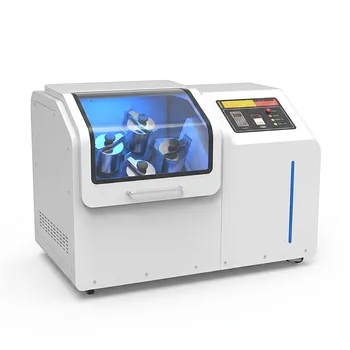
Zirconia is a premium material with a higher acquisition cost compared to alumina or stainless steel media. Additionally, its high density requires more powerful milling equipment (like planetary ball mills) to effectively move the heavy media and achieve the desired impact force.
Thermal Management
The high-energy impacts generated by dense zirconia media can lead to significant heat buildup within the grinding jar. If the nickel powder is sensitive to oxidation or phase changes at elevated temperatures, external cooling or intermittent milling cycles may be required.
How to Apply This to Your Project
Making the Right Choice for Your Goal
To achieve the best results when milling nickel-ceramic composites, consider the specific requirements of your end product:
- If your primary focus is maximum chemical purity: Utilize high-purity zirconia jars and balls to eliminate the risk of foreign metal introduction.
- If your primary focus is rapid particle size reduction: Leverage the high density of zirconia to maximize kinetic energy and reduce total milling time.
- If your primary focus is zirconium-based alloying: Use zirconia media as it ensures that any inevitable wear debris is chemically compatible with your matrix material.
- If your primary focus is cost-sensitive bulk production: Monitor media wear rates closely to determine if the longevity of zirconia offsets its higher initial price point compared to cheaper alternatives.
By matching the superior mechanical properties of zirconia to the specific abrasive nature of your ceramic additives, you ensure a high-quality, uncontaminated composite powder.
Summary Table:
| Key Property | Benefit for Nickel-Ceramic Milling | Advantage over Other Media |
|---|---|---|
| High Hardness | Resists abrasion from hard ceramic particles | Minimal media wear & impurity introduction |
| High Density | Maximizes kinetic energy for rapid refinement | Faster particle size reduction than alumina |
| Chemical Inertness | Prevents iron/chrome contamination | Maintains precise chemical & magnetic specs |
| Toughness | Resists spalling during 10-24h cycles | Consistent performance & stable particle size |
Elevate Your Material Research with Precision Engineering
Achieving perfect homogeneity in nickel-ceramic composites requires equipment that balances power with purity. At [Company Name], we provide complete laboratory sample preparation solutions tailored for material science. Whether you are refining advanced powders or preparing samples for XRF, our equipment ensures uncompromised results.
Our Specialist Equipment Lines Include:
- Milling & Grinding: High-performance planetary ball mills, jet mills, and cryogenic grinders designed for zirconia media compatibility.
- Powder Processing: Sieve shakers (vibratory/air-jet), powder mixers, and defoaming mixers for uniform blending.
- Sample Compaction: A full spectrum of hydraulic presses, including Cold/Warm Isostatic Presses (CIP/WIP), vacuum hot presses, and standard lab presses.
- Primary Crushing: Durable jaw and roll crushers for initial material reduction.
Ready to optimize your milling process? Contact our technical team today to find the ideal zirconia media and milling solution for your specific application. Let us help you achieve superior purity and performance in your laboratory.
References
- A. K. Deb, P. Chatterjee. Study of deformation microstructure of nickel samples at very short milling times: effects of addition of α-Al2O3 particles. DOI: 10.1007/s40094-019-0319-2
Mentioned Products
People Also Ask
- What role does an omni-directional planetary ball mill play in brass/cobalt antimonide pretreatment? Achieve Nano-Scale Homogeneity.
- What is the role of a high-energy planetary ball mill in Li2ZrO3 and LBS prep? Achieve Superior Electrolyte Density
- What role does a high-energy planetary ball mill play in processing quenched bioactive glass? Achieve Nano-Scale Precision
- What role does a planetary ball mill play in nano-mineral filler prep? Achieve Sub-100nm Precision & Performance
- What role does a high-energy planetary ball mill play in magnesium-based hydrogen storage alloy preparation?

Tech Team · PowderPreparation
Last updated on Jun 03, 2026