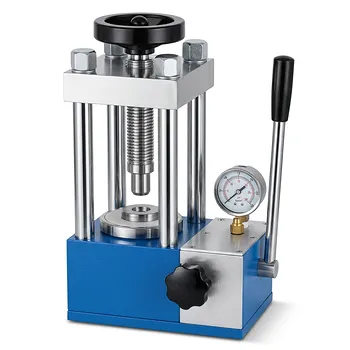
What role does a laboratory hydraulic press play in the performance evaluation of Y-type hexagonal ferrite samples?
Updated 4 months ago
The laboratory hydraulic press is the foundational tool for transforming Y-type hexagonal ferrite powder into precise, high-density "green bodies" suitable for rigorous analysis. It applies constant, high-pressure loads to ensure uniform particle arrangement and consistent initial density across all specimens. This standardization is essential for isolating the effects of chemical variables, such as doping ratios, from physical inconsistencies in the molding process.
Core Takeaway: By providing precise pressure control, a laboratory hydraulic press eliminates experimental "noise" caused by geometric defects or density fluctuations, ensuring that subsequent measurements of electromagnetic and mechanical properties are both accurate and repeatable.
Achieving Structural Integrity and Precise Density
The primary role of the hydraulic press is to consolidate loose ferrite powders into a solid, manageable form known as a green body.
High-Pressure Compaction
The press applies stable axial pressure—often reaching levels such as 1.9 Ton/cm² or 35 MPa—to force powder particles to rearrange and bond. This high-pressure environment overcomes internal friction, significantly increasing packing density and reducing the internal porosity that could otherwise compromise the sample.
Uniformity of the Green Body
Consistency in particle arrangement is vital for establishing a standardized baseline. By ensuring the initial green density is uniform across all samples, researchers can confidently attribute changes in material behavior to the sintering process or chemical composition rather than molding variations.
Eliminating Interference in Property Testing
Y-type hexagonal ferrites are frequently evaluated for their electromagnetic performance, which is highly sensitive to the physical state of the sample.
Precision Geometric Specifications
The press uses specialized molds to produce specimens with exact dimensions, such as standardized disks or rings. These precise geometries are critical for eliminating measurement errors that arise from geometric defects during electromagnetic physical property testing.
Standardizing the Volume Fraction
High-pressure compaction eliminates internal air voids and ensures the volume fraction of the active ferrite material meets predefined standards. This step is non-negotiable for obtaining repeatable electromagnetic parameter measurements and ensuring the reliability of experimental data.
Facilitating Sintering and Phase Transformation
The physical state of the green body directly influences how the ferrite reacts when subjected to high-temperature heat treatments.
Enhancing Atomic Diffusion
The tight bonding of powder particles achieved during pressing provides the necessary physical foundation for atomic diffusion. This close contact is required for uniform phase transformation and the development of the desired microstructure during the sintering stage.
Providing Structural Support
A well-pressed green body possesses the structural strength required to withstand the stresses of the sintering furnace. Without sufficient initial compaction, samples are prone to deforming, cracking, or failing to reach their theoretical bulk density during heat treatment.
Understanding the Trade-offs
While high pressure is beneficial, it must be managed with precision to avoid introducing new experimental errors.
The Risk of Density Gradients
Applying excessive or uneven pressure can lead to internal density gradients within the green body. These gradients can cause uneven shrinkage during sintering, leading to warped samples or internal micro-cracks that skew mechanical testing results like Young’s modulus.
Pressure Limits and Material Deformation
Every ferrite composition has an optimal pressure threshold; exceeding this can lead to die-sticking or mechanical failure of the green body upon ejection. Finding the balance between high density and structural integrity is a critical step in the experimental design.
How to Apply This to Your Research
To maximize the accuracy of your Y-type hexagonal ferrite evaluation, tailor your pressing strategy to your primary research objective.
- If your primary focus is Electromagnetic Accuracy: Use high-precision molds and integrated gauges to ensure perfect geometric dimensions and zero air voids, as even minor defects will distort permeability and permittivity data.
- If your primary focus is Sintering Kinetics: Prioritize achieving a consistent initial green density across all samples to ensure that observed shrinkage and grain growth are strictly a result of temperature and time.
- If your primary focus is Mechanical Strength: Focus on the pressure-holding duration to eliminate internal pores, which serves to prevent cracking and ensures a reliable measurement of radial compression strength.
The laboratory hydraulic press is not merely a shaping tool, but a precision instrument that dictates the integrity and validity of the entire material characterization process.
Summary Table:
| Key Role | Technical Benefit | Impact on Performance Evaluation |
|---|---|---|
| Compaction | High-pressure (35 MPa) particle bonding | Increases packing density and reduces porosity |
| Geometric Precision | Standardized disk/ring molds | Eliminates errors in electromagnetic property testing |
| Density Uniformity | Consistent axial pressure | Removes "experimental noise" from physical variations |
| Sintering Prep | Enhanced atomic diffusion | Prevents cracking and ensures uniform phase transformation |
Elevate Your Material Research with Precision Sample Preparation
Achieving accurate and repeatable results in material science starts with superior sample integrity. We provide complete laboratory sample preparation solutions specifically designed to meet the rigorous demands of powder processing and material characterization.
Our extensive equipment line includes:
- High-Precision Compaction: Standard lab presses, XRF pellet presses, Cold/Warm Isostatic Presses (CIP/WIP), and Vacuum Hot Presses.
- Advanced Powder Processing: Planetary ball mills, jet mills, and cryogenic grinders to ensure perfect particle size distribution.
- Material Handling: Specialized sieve shakers, powder mixers, and defoaming mixers for consistent material homogeneity.
Whether you are evaluating Y-type hexagonal ferrites or developing advanced ceramics, our equipment eliminates experimental noise caused by geometric defects and density fluctuations.
Ready to optimize your lab’s efficiency? Contact our experts today to find the perfect compaction solution for your research goals.
References
- Yang Bai, Ji Zhou. Low-fired Y-type hexagonal ferrite for hyper frequency applications. DOI: 10.1007/s40145-012-0015-z
Mentioned Products
- 6-Ton Small Single-Punch Tablet Press — Laboratory Powder & Granule Tableting Equipment / Tablet Forming Machine
- 5 Ton Single Punch Tablet Press Laboratory Small Batch Production
- 6 Ton Variable Frequency Single Punch Tablet Press
- Manual Tablet Press with Dual Scale Pressure Gauge for Pharmaceutical Food Chemical Laboratory Sample Preparation
People Also Ask
- What is the function of a laboratory press in Cr-Ti alloy evaluation? Quantify Fracture Stress & Strength
- What is the function of a laboratory press in assessing the hydrophobic performance of modified vermiculite fillers?
- What is the core function of a laboratory press in the forming of ceramic filter element green bodies? Maximize Density.
- What is the function of a laboratory press in the preparation of ceramic feed rods? Master Density and Precision
- Why is vacuum sealing and flexible packaging necessary for Aluminum Titanate powders during CIP? Ensure Peak Density

Tech Team · PowderPreparation
Last updated on Jun 03, 2026
Related Products
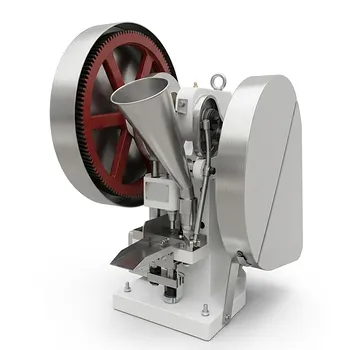
6-Ton Small Single-Punch Tablet Press — Laboratory Powder & Granule Tableting Equipment / Tablet Forming Machine
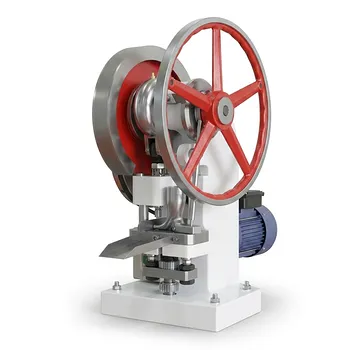
5 Ton Single Punch Tablet Press Laboratory Small Batch Production
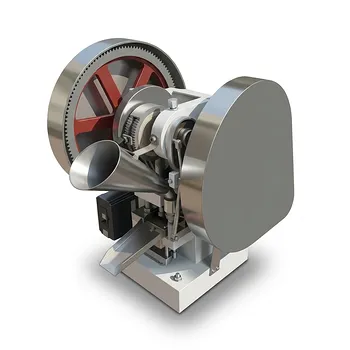
6 Ton Variable Frequency Single Punch Tablet Press