What role do laboratory hydraulic presses and stainless steel molds play in alumina ceramic green body preparation? Achieve Superior Density.
Updated 4 months ago
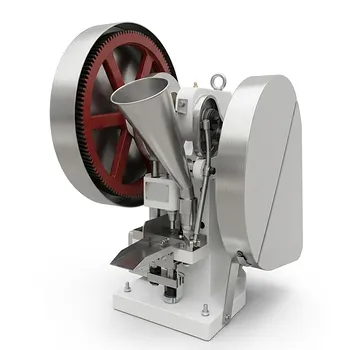
The laboratory hydraulic press and stainless steel mold function as the primary mechanical system for transforming loose alumina powder into a cohesive "green body." By applying controlled uniaxial pressure—typically ranging from 30 MPa to 295 MPa—the press forces particles to rearrange, overcome internal friction, and interlock within the precision-machined confines of the mold. This stage is critical because it establishes the material's initial density and geometric shape, directly determining the shrinkage behavior and structural integrity of the ceramic during subsequent high-temperature sintering.
The synergy between the hydraulic press and the mold provides the mechanical energy necessary to eliminate air and maximize particle-to-particle contact. This high-density consolidation is the technical prerequisite for achieving a final ceramic with high mechanical strength and minimal defects.
The Mechanics of Powder Compaction
Achieving Particle Rearrangement and Interlocking
The hydraulic press provides precise axial loading that forces alumina particles to slide past one another. This movement overcomes inter-particle friction, allowing the powder to transition from a loose state into a close-packed arrangement.
Under the applied force, particles undergo mechanical interlocking and, in some cases, plastic deformation. This creates a green body with sufficient "green strength" to be handled or machined before it ever enters a furnace.
Maximizing Initial Relative Density
A primary goal of the pressing stage is to maximize the relative density of the green body. By applying pressures up to 100 MPa or more, the press reduces the volume of internal voids and expels trapped air.
A high initial density is vital because it creates the superior conditions for atomic diffusion required during sintering. Without this high-pressure compaction, the final ceramic would suffer from excessive porosity and reduced structural performance.
The Role of Precision Molds in Shaping
Defining Geometric Consistency
The stainless steel mold acts as the high-strength boundary that defines the specific geometric dimensions of the alumina component. Because alumina ceramics are difficult to machine after firing, the mold ensures the green body is formed as close to the final net-shape as possible.
High-precision steel is used to withstand the extreme pressures without deforming. This ensures that every green body produced maintains consistent diameters and masses, which is essential for repeatable manufacturing.
Facilitating Uniform Pressure Distribution
The design of the mold allows for the uniform application of pressure across the powder bed. When used with a precision press, the mold helps minimize density gradients that can lead to warping.
Uniform density is the foundation for controlled volume shrinkage. If the density is consistent in the green state, the material will shrink predictably during sintering, preventing the internal stresses that cause cracking.
Understanding the Trade-offs and Pitfalls
The Impact of Wall Friction
Despite the precision of stainless steel molds, friction between the powder and the mold walls remains a significant challenge. This friction can lead to "pressure lag," where the center of the green body receives less force than the areas near the punch.
This discrepancy results in internal density gradients. During sintering, these gradients cause uneven shrinkage, which is the leading cause of deformation and micro-cracking in technical ceramics.
Limitations of Uniaxial Pressing
Laboratory hydraulic presses typically utilize uniaxial pressing, meaning force is applied from one direction (or two opposing directions). This method is highly efficient for simple shapes like discs or cylinders but is less effective for complex geometries.
For parts with high aspect ratios (very tall or thin parts), the pressure may not reach the center of the powder column effectively. In these cases, the limits of the mold and press system must be managed by using lubricants or binders to aid particle flow.
How to Optimize Your Preparation Strategy
Applying This to Your Project
To achieve the best results with alumina green bodies, your pressing parameters should be tailored to the specific requirements of your final application.
- If your primary focus is maximizing final density: Utilize higher compaction pressures (approaching 200-295 MPa) and ensure your powder contains a suitable binder to facilitate plastic deformation.
- If your primary focus is dimensional accuracy: Use high-precision stainless steel molds and prioritize the elimination of density gradients by using external lubricants to reduce mold-wall friction.
- If your primary focus is preventing sintering cracks: Implement a slow pressure-release cycle on the hydraulic press to prevent "spring-back" effects that can create laminations or micro-cracks in the green body.
By mastering the control of axial pressure and mold containment, you establish the physical foundation necessary for high-performance alumina ceramics.
Summary Table:
| Component | Primary Function | Key Technical Benefit |
|---|---|---|
| Hydraulic Press | Axial Pressure Application | Maximizes relative density & ensures particle interlocking. |
| Stainless Steel Mold | Geometric Containment | Defines net-shape dimensions & facilitates uniform pressure. |
| Uniaxial Force | Particle Rearrangement | Overcomes internal friction to create a cohesive green body. |
| Lubricants/Binders | Friction Management | Reduces density gradients and prevents sintering cracks. |
Elevate Your Material Research with High-Precision Compaction Solutions
Achieving the perfect green body is the foundation of high-performance technical ceramics. We provide complete laboratory sample preparation solutions for material science, specializing in advanced powder processing and compaction equipment designed to meet the most rigorous research standards.
Why Choose Our Solutions?
- Comprehensive Compaction Range: From standard laboratory presses and XRF pellet presses to advanced Cold/Warm Isostatic Presses (CIP/WIP), hot presses, and vacuum hot presses, we offer the tools to achieve maximum material density.
- Precision Powder Processing: Optimize your raw materials with our extensive line of crushers, liquid nitrogen cryogenic grinders, and high-energy mills (planetary ball, jet, and disc mills).
- Workflow Integration: We support your entire process with vibratory sieve shakers, powder mixers, and defoaming mixers to ensure material homogeneity before pressing.
Ready to eliminate density gradients and enhance your structural integrity? Contact our experts today to discuss your specific alumina processing requirements and discover how our equipment can streamline your laboratory workflow.
References
- Kai Li, Lucun Guo. Normalized evaluation of thermal shock resistance for ceramic materials. DOI: 10.1007/s40145-014-0118-9
Mentioned Products
People Also Ask
- What is the function of a laboratory press in Cr-Ti alloy evaluation? Quantify Fracture Stress & Strength
- What is the function of a laboratory press in assessing the hydrophobic performance of modified vermiculite fillers?
- What is the core function of a laboratory press in the forming of ceramic filter element green bodies? Maximize Density.
- What is the function of a laboratory press in the preparation of ceramic feed rods? Master Density and Precision
- Why is vacuum sealing and flexible packaging necessary for Aluminum Titanate powders during CIP? Ensure Peak Density

Tech Team · PowderPreparation
Last updated on May 14, 2026