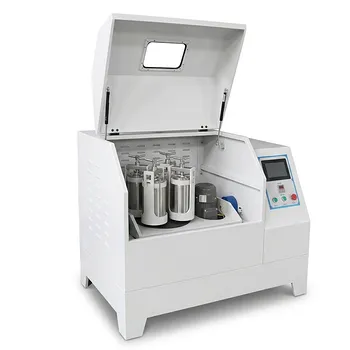
What is the primary purpose of selecting a rotary closed mixing container? Ensure Pure, Uniform Material Distribution
Updated 4 months ago
The primary purpose of selecting a rotary closed mixing container is to ensure a uniform distribution of sub-micron alumina powders across the surface of magnesium chips while maintaining material purity. This method utilizes mechanical tumbling and diffusion to create a consistent coating of the reinforcement phase on the matrix. The closed design is critical for preventing the loss of ultrafine particles and protecting the reactive magnesium from atmospheric contamination.
By leveraging tumbling mechanics in a sealed environment, rotary mixing achieves a preliminary uniform distribution that is essential for the structural integrity of the final composite material, preventing reinforcement clustering and oxidation.
Achieving Micro-Scale Uniformity
The Role of Tumbling and Diffusion
The rotary motion of the container facilitates a continuous tumbling and diffusion process. As the magnesium chips and alumina powders move within the vessel, the sub-micron particles are mechanically forced to coat the larger magnesium surfaces.
This dry mixing approach ensures that the reinforcement phase is not merely present but is initially uniformly distributed across the matrix chips. Without this controlled motion, ultrafine powders tend to agglomerate, leading to weak spots in the final alloy structure.
Establishing a Continuous Matrix Structure
A uniform initial distribution is a prerequisite for successful downstream processing, such as extrusion or sintering. By coating the chips evenly at the start, the process ensures a continuous matrix structure where the reinforcement phase is dispersed rather than clustered.
This consistency is vital for the mechanical properties of the finished component. It allows the alumina to effectively reinforce the magnesium matrix without causing structural discontinuities.
Material Integrity and Containment
Preventing the Loss of Ultrafine Powders
Sub-micron alumina powders are incredibly light and prone to becoming airborne during agitation. The closed nature of the container acts as a physical barrier that prevents the loss of these expensive and critical reinforcements.
Retaining the exact mass of the powder is essential for maintaining the intended volume fraction of the composite. Even a small loss of reinforcement phase can significantly alter the performance characteristics of the final material.
Protection Against Environmental Contamination
Magnesium and its alloys are highly sensitive to the environment and can easily suffer from secondary contamination or oxidation. A sealed container isolates the raw materials from atmospheric moisture and oxygen during the mixing phase.
Preventing oxidation is critical because oxide layers on the chips can interfere with the bonding between the matrix and the reinforcement. This containment ensures that the chemical purity of the materials is preserved throughout the preparation process.
Understanding the Trade-offs
Limitations of Dry Mixing
While rotary mixing is excellent for surface coating, it is a low-energy process compared to high-energy ball milling. It may not be sufficient if the goal is to achieve true mechanical alloying or to break down large agglomerates within the powder.
Saturation and Coating Thickness
There is a physical limit to how much sub-micron powder can adhere to a magnesium chip surface through tumbling alone. If the reinforcement ratio is too high, the "excess" powder will not find a surface to bond to, leading to segregation within the container.
Processing Time vs. Uniformity
Achieving a truly uniform coating requires a specific balance of rotation speed and duration. Rotating the container too quickly can lead to centrifugal pinning, where materials stick to the walls, while too slow a speed fails to generate the necessary diffusion motion.
Applying This to Your Material Preparation
To maximize the effectiveness of your mixing process, consider the specific requirements of your matrix and reinforcement phases.
- If your primary focus is preventing oxidation: Ensure the container is not only closed but vacuum-sealed or purged with an inert gas like Argon before the rotary process begins.
- If your primary focus is reinforcement uniformity: Optimize the rotation speed to ensure a tumbling motion rather than a sliding motion, allowing for maximum surface contact between the chips and the powder.
- If your primary focus is high-volume production: Use internal baffles or lifters within the rotary container to increase the diffusion rate and reduce the total time required for a uniform coating.
Choosing a rotary closed container is a strategic decision that balances material distribution with the stringent containment needs of reactive and ultrafine particles.
Summary Table:
| Feature | Primary Function | Benefit for Magnesium-Alumina Composites |
|---|---|---|
| Rotary Motion | Tumbling & Diffusion | Ensures sub-micron alumina uniformly coats magnesium chips. |
| Sealed Design | Atmosphere Isolation | Prevents reactive magnesium oxidation and secondary contamination. |
| Closed Vessel | Particle Containment | Eliminates the loss of ultrafine powders to maintain volume fraction. |
| Low-Energy Process | Surface Adhesion | Creates a continuous matrix structure without premature alloying. |
Elevate Your Material Synthesis with Precision Lab Solutions
Achieving the perfect composite requires more than just mixing; it requires the right equipment to maintain purity and uniformity. [Brand Name] provides complete laboratory sample preparation solutions tailored for material science.
We specialize in high-performance powder processing and compaction equipment, including:
- Advanced Mixing: Powder mixers and defoaming mixers for uniform dispersion.
- Precision Milling: Planetary ball, jet, and cryogenic grinders to achieve sub-micron scales.
- Superior Compaction: A full spectrum of hydraulic presses, including Cold/Warm Isostatic Presses (CIP/WIP), standard lab presses, and vacuum hot presses.
Whether you are working with reactive magnesium alloys or advanced ceramics, our equipment ensures structural integrity and chemical purity.
Ready to optimize your lab's efficiency? Contact our experts today for a custom solution!
References
- Moara M. Castro, Terence G. Langdon. Development of a magnesium-alumina composite through cold consolidation of machining chips by high-pressure torsion. DOI: 10.1016/j.jallcom.2018.11.357
Mentioned Products
People Also Ask
- What role does an omni-directional planetary ball mill play in brass/cobalt antimonide pretreatment? Achieve Nano-Scale Homogeneity.
- What is the function of an omni-directional planetary ball mill? Achieve Streak-Free Glass Homogenization
- Why is an intermittent grinding process required for perovskites in a planetary ball mill? Ensure Stability & Purity
- Why is a planetary ball mill essential for SiBCN-rGO wet-spinning? Achieve Superior Dispersion and Spinnability
- What role does a planetary ball mill play in the synthesis of Li6PS5Cl (LPSCl)? Unlock High Ionic Conductivity

Tech Team · PowderPreparation
Last updated on Jun 03, 2026