What is the necessity of using a laboratory hydraulic press for forming hydroxyapatite green bodies? Optimize Sintering
Updated 5 months ago
The laboratory hydraulic press is the critical bridge between loose powder and a structural ceramic.
A hydraulic press is necessary to apply specific, high-intensity uniaxial pressure—often ranging from 1000 psi to over 98 MPa—to compact loose hydroxyapatite powder into a dense, handleable "green body." This process eliminates trapped air, reduces internal porosity, and creates the essential mechanical interlocking required for the material to maintain its shape and undergo successful high-temperature sintering.
Core Takeaway: By providing precise and uniform compaction, a laboratory hydraulic press creates a high-density foundation that lowers required sintering temperatures and prevents structural failure in the final hydroxyapatite product.
The Mechanics of Powder Compaction
Overcoming Inter-particle Friction
Loose hydroxyapatite powder consists of individual particles separated by significant air gaps. The hydraulic press applies uniaxial pressure to force these particles to overcome friction, allowing them to rearrange into a more efficient, closely packed configuration.
Expelling Internal Air
As the press compacts the powder within a precision steel mold, it expels air trapped between particles. This removal of macroscopic voids is vital for creating a homogenous green body and preventing "bloating" or internal ruptures during the heating phase.
Establishing Mechanical Interlocking
High-pressure compaction facilitates mechanical interlocking and increases the contact area between sub-micron particles. This gives the "green body" sufficient green strength to be handled, measured, and moved into a furnace without crumbling or deforming.
Impact on the Sintering Process
Increasing Mass Transfer Driving Force
Sintering relies on the diffusion of atoms across particle boundaries. By using a press to maximize initial contact points, you provide the necessary physical foundation for solid-phase reactions and grain growth to occur efficiently.
Reducing Sintering Temperature
A well-compacted green body requires less thermal energy to reach high density. The increased contact area and reduced gap size effectively lower the required sintering temperature, saving energy and preventing unwanted chemical phases from forming.
Controlling Shrinkage and Density
Precise compaction ensures that the shrinkage occurring during sintering is uniform. This is critical for achieving a final relative density of over 90%, which is the standard requirement for high-strength bioceramics like bone implants.
Precision and Consistency in Formation
Achieving Specific Geometries
Laboratory presses allow for the creation of green bodies with exact dimensions, such as 20 mm discs or 60 mm bars. This geometric precision is essential for standardized testing and ensuring the final component fits its intended application.
Maintaining Density Uniformity
High-precision pressure control ensures that the density is consistent throughout the entire sample. Without this uniformity, the hydroxyapatite may experience density gradients, leading to warping, cracking, or abnormal grain growth during the final firing.
Understanding the Trade-offs and Pitfalls
Pressure Limits and Cracking
While high pressure is necessary, exceeding the material's limits can lead to "capping" or laminations, where the green body cracks into layers upon release from the mold. It is vital to find the optimal pressure balance for your specific powder morphology.
Mold Friction and Lubrication
Friction between the powder and the mold walls can cause uneven pressure distribution. To achieve a truly uniform green body, researchers must often use high-strength steel molds and occasionally incorporate lubricants to ensure the pressure reaches the center of the compact.
Making the Right Choice for Your Goal
To ensure your hydroxyapatite green bodies are of the highest quality, tailor your pressing strategy to your final objective:
- If your primary focus is maximum final density: Utilize higher pressures (up to 98 MPa) and sub-micron powders to minimize initial porosity before sintering.
- If your primary focus is geometric precision: Use high-precision steel molds and controlled axial pressure to prevent deformation and ensure "near-net-shape" results.
- If your primary focus is preventing structural defects: Implement a slow pressure release (decompression) cycle to avoid internal stress cracks and laminations in the green body.
Mastering the compaction of hydroxyapatite green bodies is the foundational step in producing reliable, high-performance bioceramic materials.
Summary Table:
| Feature | Benefit for Hydroxyapatite | Impact on Final Product |
|---|---|---|
| Uniaxial Compaction | Expels air and eliminates macroscopic voids | Prevents internal ruptures and bloating |
| Mechanical Interlocking | Increases particle contact and green strength | Allows for safe handling and measurement |
| High-Pressure Density | Maximizes atomic diffusion driving force | Lowers required sintering temperatures |
| Precision Control | Ensures uniform density gradients | Prevents warping, cracking, and shrinkage |
| Geometric Accuracy | Creates exact disc or bar dimensions | Facilitates standardized testing and fit |
Achieve Superior Bioceramic Precision with Kintek
Ready to elevate your hydroxyapatite research? Kintek provides complete laboratory sample preparation solutions for material science, specializing in advanced powder processing and compaction equipment. Our technology ensures your green bodies achieve the density and uniformity required for high-performance bioceramics.
Our extensive range includes:
- Advanced Hydraulic Presses: Manual/automatic lab presses, Cold/Warm Isostatic Presses (CIP/WIP), XRF pellet presses, and vacuum hot presses.
- Powder Processing: Planetary ball mills, jet mills, cryogenic grinders, and high-efficiency powder mixers.
- Sizing & Finishing: Sieve shakers, crushers, and precision steel molds.
Don't let inconsistent compaction compromise your sintering results. Contact our specialists today to find the perfect equipment for your material science lab!
References
- C.K. Ng, U. Sutharsini. Characterization and Sintering Properties of Hydroxyapatite Bioceramics Synthesized From Clamshell Biowaste. DOI: 10.31436/iiumej.v23i2.2143
Mentioned Products
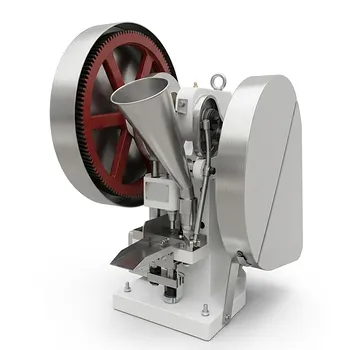
- 6-Ton Small Single-Punch Tablet Press — Laboratory Powder & Granule Tableting Equipment / Tablet Forming Machine
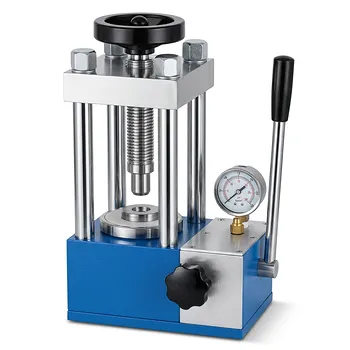
- Manual Tablet Press with Dual Scale Pressure Gauge for Pharmaceutical Food Chemical Laboratory Sample Preparation
People Also Ask
- What is the function of a laboratory press in Cr-Ti alloy evaluation? Quantify Fracture Stress & Strength
- What is the function of a laboratory press in assessing the hydrophobic performance of modified vermiculite fillers?
- What is the core function of a laboratory press in the forming of ceramic filter element green bodies? Maximize Density.
- What is the function of a laboratory press in the preparation of ceramic feed rods? Master Density and Precision
- Why is vacuum sealing and flexible packaging necessary for Aluminum Titanate powders during CIP? Ensure Peak Density

Tech Team · PowderPreparation
Last updated on May 14, 2026