What are the process advantages of Cold Isostatic Pressing (CIP)? Achieve Uniform Density and Material Integrity
Updated 4 months ago
Cold Isostatic Pressing (CIP) offers a transformative approach to material compaction. By utilizing a liquid medium to apply equal, omnidirectional pressure, CIP eliminates the friction-induced density gradients inherent in standard dry pressing. This process results in "green bodies" with exceptional microstructural uniformity, significantly reducing the risk of warping, cracking, or performance variability during the critical sintering stage.
The central takeaway: While standard dry pressing relies on uniaxial force constrained by rigid molds, CIP employs isotropic compression to ensure uniform density throughout the component. This uniformity is the fundamental requirement for manufacturing advanced ceramics and powder metals that must maintain precise dimensions and high mechanical integrity under extreme conditions.
Elimination of Density Gradients
Standard dry pressing creates internal friction between powder particles and the rigid walls of the mold. This leads to uneven pressure distribution, where the center or edges of a part may be less dense than the surface.
Overcoming Mold Wall Friction
In CIP, the powder is contained in a flexible membrane and submerged in a pressurized fluid. Because the fluid exerts equal pressure from all directions, the friction constraints found in metal dies are removed.
Achieving Uniform Microstructure
The absence of friction gradients ensures that particles pack together with consistent density across the entire volume of the part. This uniform microstructure is essential for ensuring that the final material properties—such as thermal conductivity or hardness—remain stable throughout the component.
Impact on Sintering and Structural Integrity
The way a part is pressed directly dictates how it will behave in the furnace. Most manufacturing failures in advanced ceramics occur during sintering due to internal stresses created during the initial forming stage.
Controlling Shrinkage and Distortion
Green bodies produced via CIP experience uniform shrinkage during high-temperature sintering. Because the density is consistent, the part pulls inward equally from all sides, preventing the "hourglassing" or warping common in uniaxially pressed parts.
Mitigation of Cracking and Internal Stress
Standard dry pressing often leaves residual "anisotropic" stresses within the material. By using isotropic compression, CIP minimizes these internal stresses, effectively preventing the formation of cracks caused by uneven shrinkage rates or thermal shock.
Improving Mechanical Properties
High-pressure CIP (often ranging from 176 MPa to 250 MPa) promotes better deformation and bonding of granulated particles. This process narrows the internal pore size, which directly correlates to higher fracture toughness and overall mechanical strength in the finished product.
Capabilities for Complex and Large-Scale Geometries
Standard dry pressing is generally limited to simple, shallow shapes due to the way pressure dissipates through a powder bed in a rigid die.
Forming Complex Structures
CIP is uniquely suited for components with high surface-area-to-volume ratios, such as Zirconium Diboride micro-channel plates. It allows for the compression of intricate features without creating localized stress concentrations that would fail during cooling.
Scaling to Large Components
For large-scale industrial parts, such as pistons or components exceeding 56 mm in diameter, CIP ensures that the core of the part is as dense as the surface. This capability is vital for refractories and heavy-duty industrial ceramics that operate in harsh environments.
Understanding the Trade-offs
While CIP provides superior material quality, it is not always the most efficient choice for every application. It is important to weigh the technical benefits against the operational requirements.
- Production Speed: CIP is generally a slower, batch-oriented process compared to the high-speed, automated cycling of mechanical dry presses.
- Dimensional Tolerances: Because the powder is contained in a flexible membrane rather than a rigid steel die, the "as-pressed" dimensions of a CIP part are less precise and often require post-process machining.
- Operational Complexity: Managing high-pressure fluid systems and flexible tooling requires more specialized maintenance and handling than traditional uniaxial tooling.
How to Apply CIP to Your Production Goal
Choosing between CIP and dry pressing depends on the performance requirements of your final component and your volume needs.
- If your primary focus is structural reliability in extreme environments: Utilize CIP to ensure a uniform microstructure that can withstand thermal shock and rapid cooling without internal failure.
- If your primary focus is geometric stability of complex or large parts: Apply CIP to eliminate the uneven shrinkage rates that cause warping in large-scale or intricate ceramic preforms.
- If your primary focus is maximizing mechanical strength: Use CIP as a secondary compaction step for pre-formed parts to further narrow pore sizes and enhance particle bonding.
By prioritizing isotropic pressure over uniaxial force, CIP provides the foundational material consistency required for high-performance engineering.
Summary Table:
| Feature | Cold Isostatic Pressing (CIP) | Standard Dry Pressing |
|---|---|---|
| Pressure Direction | Isotropic (Equal from all sides) | Uniaxial (One or two directions) |
| Density Uniformity | High (No mold wall friction) | Low (Significant gradients) |
| Sintering Result | Minimal warping and distortion | High risk of 'hourglassing' |
| Shape Capability | Complex and large-scale parts | Simple, shallow geometries |
| Mechanical Strength | Superior (Reduced pore size) | Standard |
Master Your Material Compaction with Our Advanced Solutions
Achieving structural perfection in advanced ceramics and powder metallurgy starts with the right equipment. At [Insert Brand Name], we provide complete laboratory sample preparation solutions for material science, specializing in high-performance powder processing and compaction systems.
Our extensive product lines are designed to help you eliminate density gradients and maximize mechanical integrity:
- Compaction Excellence: Cold/Warm Isostatic Presses (CIP/WIP), standard lab presses, XRF pellet presses, and vacuum hot presses.
- Sample Preparation: Crushers (jaw/roll), liquid nitrogen cryogenic grinders, and high-efficiency mills (planetary ball, jet, sand, disc, rotor).
- Processing & Analysis: Powder mixers, defoaming mixers, and vibratory/air-jet sieve shakers.
Whether you are scaling up production or conducting precise lab research, our specialized equipment ensures consistent, high-quality results. Contact our technical experts today to discuss your specific application and find the ideal solution for your workflow!
References
- Albin Conde Reis, Mohammadhosein Safari. Revisiting the Importance of Sulfur Electrode‐Current‐Collector Interface in Lithium‐Sulfur Batteries. DOI: 10.1002/batt.202300286
Mentioned Products
- Ordinary Type Rotary Tablet Press for Pharmaceutical Chemical Food Electronic Industries
- 6-Ton Small Single-Punch Tablet Press — Laboratory Powder & Granule Tableting Equipment / Tablet Forming Machine
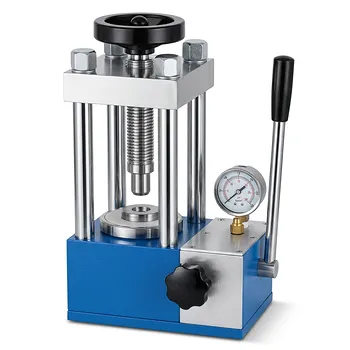
- Manual Tablet Press with Dual Scale Pressure Gauge for Pharmaceutical Food Chemical Laboratory Sample Preparation
People Also Ask
- Why is a laboratory hydraulic press required for FT-IR KBr pellets? Achieve Precise Sample Clarity for ZrC–SiC Analysis
- Why is a laboratory hydraulic press required to compress oyster shell powder before XRF analysis? Improve Data Accuracy.
- Why is vacuum sealing and flexible packaging necessary for Aluminum Titanate powders during CIP? Ensure Peak Density
- What are the advantages of using hardened steel molds and graphite spray for titanium powder? Ensure structural integrity
- What role does a high-strength stainless steel mold kit play in the uniaxial die compaction process? Ensuring Precision

Tech Team · PowderPreparation
Last updated on May 14, 2026
Related Products
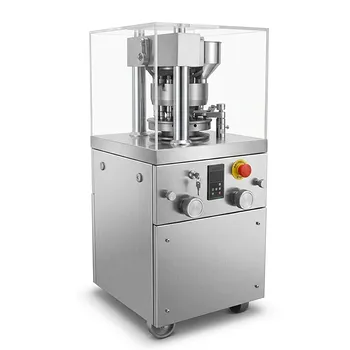
Ordinary Type Rotary Tablet Press for Pharmaceutical Chemical Food Electronic Industries
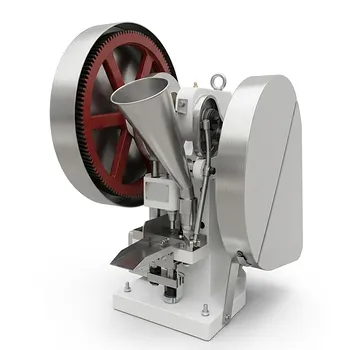
6-Ton Small Single-Punch Tablet Press — Laboratory Powder & Granule Tableting Equipment / Tablet Forming Machine