What are the advantages of using CIP over dry pressing for composite ceramics? Achieve Uniform Density & No Cracks
Updated 4 months ago
Cold isostatic pressing (CIP) provides a significant advantage over dry pressing by applying uniform, omnidirectional pressure through a liquid medium, which eliminates the internal friction and pressure gradients inherent in rigid-mold dry pressing. This process results in a green body with exceptionally consistent density and a uniform microstructure, effectively preventing the warping, cracking, and structural defects that often occur during high-temperature sintering.
Central Takeaway: CIP overcomes the physical limitations of uniaxial dry pressing by using isotropic liquid pressure to ensure uniform compaction. This results in superior mechanical properties, higher bulk density, and the structural integrity required for complex or high-performance composite ceramics.
Eliminating the Friction Gradient
Overcoming Mold Wall Friction
Standard dry pressing relies on mechanical pistons that create friction between the powder and the rigid mold walls. This friction prevents pressure from distributing evenly, leading to "dead zones" or areas of lower density within the ceramic preform.
Achieving Isotropic Compaction
In contrast, a CIP system submerges the powder-filled flexible mold in a liquid medium, applying balanced ultra-high pressure (often 200 MPa to 500 MPa) from every direction simultaneously. This isotropic compression ensures that every part of the composite structure receives the same force, regardless of its shape or size.
Reducing Internal Stress
By removing localized stress concentrations, CIP creates a homogeneous green body. This uniformity is critical for preventing the internal stresses that typically lead to "spring-back" or laminations when the part is removed from a standard dry press.
Enhancing Material Performance and Stability
Preventing Sintering Deformation
Because CIP produces a body with highly uniform density, the material undergoes equal shrinkage rates during the sintering process. This precision prevents the common issues of bending, twisting, or cracking that plague dry-pressed parts during high-temperature densification.
Improving Mechanical and Dielectric Properties
Uniform compaction significantly reduces internal porosity and increases the final bulk density of the ceramic. For composite ceramics, this leads to improved mechanical strength and can enhance specialized characteristics like the dielectric constant.
Strengthening Thermal Shock Resistance
For high-performance refractories, the uniform density distribution provided by CIP is vital for structural integrity. Ceramics produced this way are better equipped to survive harsh thermal shock or rapid cooling environments without failing.
Precision for Complex and Large-Scale Geometries
Stability for Complex Micro-structures
CIP is essential for advanced materials like Zirconium Diboride (ZrB2) used in micro-heat exchangers. It maintains the geometric stability of structures with high surface-area-to-volume ratios, ensuring that intricate micro-channels do not collapse or distort during production.
Scalability for Large Components
While dry pressing is often limited by the size of the mechanical die, CIP can effectively process large-scale components (such as those exceeding 56 mm in diameter). The liquid medium ensures that even large volumes reach the required density without molding defects.
Foundation for Near-Full Densification
CIP serves as an ideal precursor to Hot Isostatic Pressing (HIP). By establishing a crack-free, uniform foundation, it allows the subsequent HIP stage to achieve near-theoretical density in the final ceramic product.
Understanding the Trade-offs
Process Speed and Complexity
Standard dry pressing is generally much faster and more suitable for high-volume, automated production of simple shapes. CIP requires a multi-step process involving vacuum sealing powder in flexible bags and a longer pressurization cycle, which increases the time per part.
Dimensional Precision of the Green Body
Dry pressing in a steel mold produces parts with very high dimensional tolerances in their "green" (unfired) state. Because CIP uses flexible rubber or silicone molds, the outer dimensions of the green body are less precise and often require additional machining after pressing.
Tooling and Equipment Costs
While dry pressing requires expensive precision-machined steel dies, CIP requires high-pressure vessels and fluid handling systems. The choice between the two often depends on whether the performance benefits of isotropic density outweigh the higher operational overhead of isostatic equipment.
How to Apply This to Your Project
Recommendations Based on Goals
- If your primary focus is high-volume production of simple shapes: Standard dry pressing remains the most cost-effective choice for rapid throughput and decent dimensional accuracy.
- If your primary focus is eliminating cracks in complex or large parts: Utilize CIP to ensure uniform density and prevent deformation during the sintering phase.
- If your primary focus is maximum material performance: CIP is the superior choice for achieving the high density and uniform microstructure required for aerospace or high-thermal environments.
- If your primary focus is preparing for HIP sintering: Use CIP to create a defect-free green body, which is essential for reaching near-full densification in the final stage.
By choosing Cold Isostatic Pressing, you ensure the structural reliability and performance consistency required for the most demanding composite ceramic applications.
Summary Table:
| Feature | Standard Dry Pressing | Cold Isostatic Pressing (CIP) |
|---|---|---|
| Pressure Direction | Uniaxial (One or two directions) | Isotropic (Uniform from all sides) |
| Density Uniformity | Low (Friction creates density gradients) | High (Homogeneous green body) |
| Shape Capability | Simple, shallow geometries | Complex, large, or high aspect-ratio |
| Internal Stress | Higher (Risk of laminations/spring-back) | Minimal (Reduced internal porosity) |
| Sintering Result | Prone to warping or cracking | Consistent shrinkage; high stability |
| Production Speed | High (Ideal for automation) | Moderate (Multi-step batch process) |
Elevate Your Material Research with Precision Compaction
Ready to eliminate structural defects and achieve superior mechanical properties in your composite ceramics? At [Brand Name], we provide complete laboratory sample preparation solutions for material science, specializing in advanced powder processing and high-pressure compaction equipment.
Our extensive product lines are designed to support every stage of your workflow:
- Powder Processing: High-efficiency crushers (jaw/roll), liquid nitrogen cryogenic grinders, and a variety of mills (planetary ball, jet, sand/bead, disc, rotor).
- Sieving & Mixing: Vibratory and air-jet sieve shakers with precision meshes, along with advanced powder and defoaming mixers.
- Advanced Pressing Solutions: A full spectrum of hydraulic presses including Cold/Warm Isostatic Presses (CIP/WIP), standard lab presses, XRF pellet presses, and vacuum hot presses.
Whether you are developing aerospace-grade refractories or intricate micro-heat exchangers, our equipment ensures the structural reliability and performance consistency your project demands.
Contact us today to find the perfect solution for your lab!
References
- Jun-feng GAO, Q Wang. Preparation and Performance Study of ZrO<sub>2</sub>/LaAl<sub>11-3</sub><italic><sub>x</sub></italic>Ni<sub>3</sub><italic><sub>x</sub></italic>O<sub>18</sub> Composite Ceramic Materials. DOI: 10.3724/s1004-0277.202402006
Mentioned Products
- 6-Ton Small Single-Punch Tablet Press — Laboratory Powder & Granule Tableting Equipment / Tablet Forming Machine
- Manual Tablet Press with Dual Scale Pressure Gauge for Pharmaceutical Food Chemical Laboratory Sample Preparation
- 5 Ton Single Punch Tablet Press Laboratory Small Batch Production
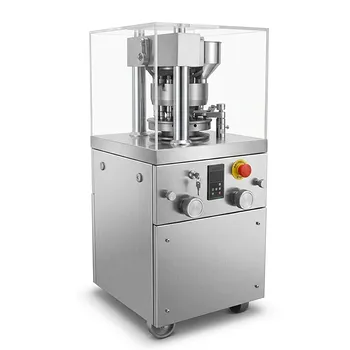
- Ordinary Type Rotary Tablet Press for Pharmaceutical Chemical Food Electronic Industries
People Also Ask
- What is the function of a laboratory press in Cr-Ti alloy evaluation? Quantify Fracture Stress & Strength
- What is the function of a laboratory press in assessing the hydrophobic performance of modified vermiculite fillers?
- What is the core function of a laboratory press in the forming of ceramic filter element green bodies? Maximize Density.
- What is the function of a laboratory press in the preparation of ceramic feed rods? Master Density and Precision
- Why is vacuum sealing and flexible packaging necessary for Aluminum Titanate powders during CIP? Ensure Peak Density

Tech Team · PowderPreparation
Last updated on Jun 03, 2026
Related Products
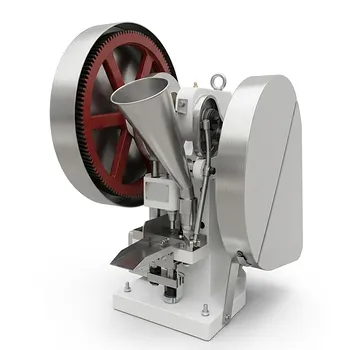
6-Ton Small Single-Punch Tablet Press — Laboratory Powder & Granule Tableting Equipment / Tablet Forming Machine
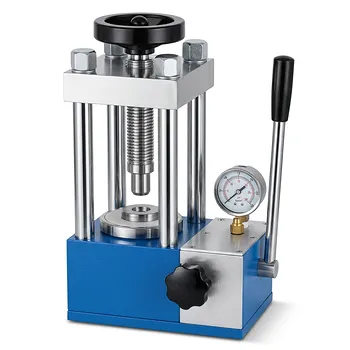
Manual Tablet Press with Dual Scale Pressure Gauge for Pharmaceutical Food Chemical Laboratory Sample Preparation
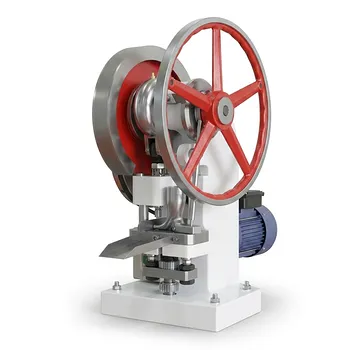
5 Ton Single Punch Tablet Press Laboratory Small Batch Production