How does mold wall friction affect the cold compaction of ceramic powders? Impact on Density & Structural Integrity
Updated 5 months ago
Mold wall friction acts as a parasitic force that prevents uniform pressure distribution during the cold compaction of ceramic powders. This friction creates a "pressure drop" along the depth of the mold, resulting in a green body with inconsistent density and complex internal stresses that can lead to structural failure.
Mold wall friction is a primary driver of structural defects in ceramic components, causing axial density variations and residual stresses that can lead to warping or cracking. Reducing this friction through surface engineering or lubrication is essential for achieving a homogenous green body with high mechanical integrity.
The Mechanics of Pressure Decay
Frictional Resistance and Axial Gradients
As the punch applies downward force, the ceramic particles rub against the inner walls of the mold. This interaction generates frictional resistance that opposes the applied load, causing the effective pressure to decay as it moves deeper into the powder bed.
Pressure Transmission Efficiency
The efficiency of pressure transmission is directly compromised by this wall interaction. Instead of the force reaching the bottom of the mold at full strength, a significant portion is "lost" to the walls, creating a stress gradient from the top to the bottom of the specimen.
Impact on Material Integrity
Non-Uniform Green Density
Because density is a function of applied pressure, the axial pressure decay leads to non-uniform density along the height of the green body. Typically, the regions closest to the moving punch are more densely packed than those at the base of the mold.
Complex Residual Stresses
After the compaction pressure is released and the part is ejected, the internal stress gradients remain as residual stresses. These localized pockets of energy can cause the ceramic part to distort, delaminate, or crack during subsequent handling or sintering processes.
Strategies for Friction Mitigation
Surface Roughness Optimization
The texture of the mold's inner wall plays a decisive role in the magnitude of the friction coefficient. Utilizing compaction cylinders with high surface finishes or specialized surface treatments can reduce the friction coefficient to values near 0.1, significantly improving pressure distribution.
The Role of Lubricants
Applying external lubricants to the mold walls or incorporating internal lubricants into the powder mix provides a low-shear interface. This lubrication allows the powder bed to slide more freely, ensuring the bottom of the specimen receives a higher percentage of the initial punch pressure.
Understanding the Trade-offs
The Pitfalls of Excessive Lubrication
While reducing friction is critical, over-lubrication can introduce contaminants that interfere with the purity of the ceramic. Additionally, excessive lubricant can occupy pore space, potentially leading to "spring-back" effects or gas-trapping during the sintering phase.
Surface Treatment Limitations
High-precision surface treatments and ultra-smooth finishes increase the cost of tooling significantly. Engineers must balance the required structural uniformity of the final part against the economic reality of maintaining highly polished mold surfaces in a production environment.
Applying These Principles to Your Process
Recommendations for Optimization
Depending on your production goals, the approach to managing mold friction will vary:
- If your primary focus is structural uniformity: Prioritize the use of high-finish mold materials and precise wall lubrication to ensure consistent density across the entire part height.
- If your primary focus is mechanical strength: Focus on minimizing axial pressure decay by optimizing the length-to-diameter ratio of the mold, which reduces the total wall contact area relative to volume.
- If your primary focus is minimizing post-process defects: Invest in friction-reducing coatings for the mold to lower residual stresses, which prevents warping during the critical sintering stage.
By systematically controlling the friction at the mold-powder interface, you can ensure that the initial compaction phase sets the foundation for a high-quality, defect-free ceramic product.
Summary Table:
| Impact Factor | Description of Effect | Potential Defect | Mitigation Strategy |
|---|---|---|---|
| Pressure Decay | Applied force is lost to mold walls | Axial stress gradients | Use of external/internal lubricants |
| Density Variation | Uneven particle packing density | Structural weak points | High-finish (smooth) mold surfaces |
| Residual Stress | Stored energy remains after ejection | Warping and cracking | Optimized mold L/D ratio |
| Wall Friction | Parasitic resistance during punch | Delamination | Specialized surface treatments/coatings |
Master Your Ceramic Compaction with KINTEK SOLUTION
Achieve unparalleled structural integrity and uniform density in your materials with our precision-engineered equipment. KINTEK SOLUTION specializes in providing complete laboratory sample preparation solutions for material science, focusing on advanced powder processing and compaction technology.
Our extensive product line is designed to overcome the challenges of mold wall friction and pressure decay:
- Advanced Hydraulic Presses: Cold/Warm Isostatic Presses (CIP/WIP), standard lab presses, vacuum hot presses, and XRF pellet presses.
- Precision Milling: Planetary ball mills, jet mills, and liquid nitrogen cryogenic grinders for optimal powder preparation.
- Sieving & Mixing: Vibratory sieve shakers and high-efficiency powder/defoaming mixers.
Don't let friction-induced defects compromise your research or production. Contact our technical experts today to find the perfect solution for your material processing needs!
References
- S. Stupkiewicz, Davide Bigoni. Elastoplastic coupling to model cold ceramic powder compaction. DOI: 10.1016/j.jeurceramsoc.2013.11.017
Mentioned Products
- 6-Ton Small Single-Punch Tablet Press — Laboratory Powder & Granule Tableting Equipment / Tablet Forming Machine
- Manual Tablet Press with Dual Scale Pressure Gauge for Pharmaceutical Food Chemical Laboratory Sample Preparation
- 5 Ton Single Punch Tablet Press Laboratory Small Batch Production
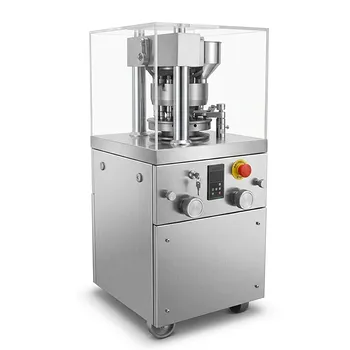
- Ordinary Type Rotary Tablet Press for Pharmaceutical Chemical Food Electronic Industries
People Also Ask
- What is the function of a laboratory press in Cr-Ti alloy evaluation? Quantify Fracture Stress & Strength
- What is the function of a laboratory press in assessing the hydrophobic performance of modified vermiculite fillers?
- What is the core function of a laboratory press in the forming of ceramic filter element green bodies? Maximize Density.
- What is the function of a laboratory press in the preparation of ceramic feed rods? Master Density and Precision
- Why is vacuum sealing and flexible packaging necessary for Aluminum Titanate powders during CIP? Ensure Peak Density

Tech Team · PowderPreparation
Last updated on May 14, 2026
Related Products
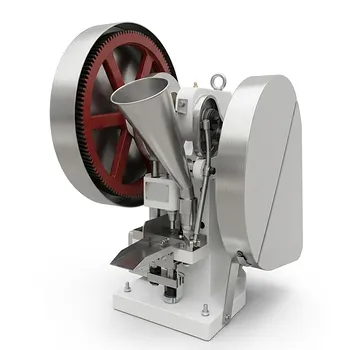
6-Ton Small Single-Punch Tablet Press — Laboratory Powder & Granule Tableting Equipment / Tablet Forming Machine
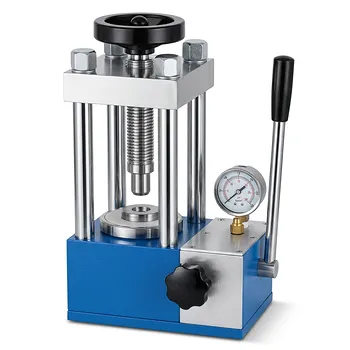
Manual Tablet Press with Dual Scale Pressure Gauge for Pharmaceutical Food Chemical Laboratory Sample Preparation
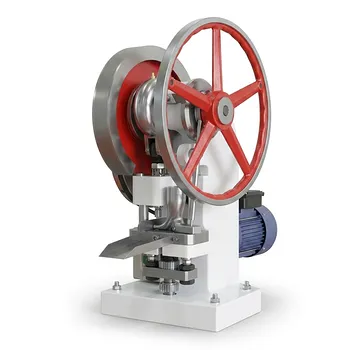
5 Ton Single Punch Tablet Press Laboratory Small Batch Production