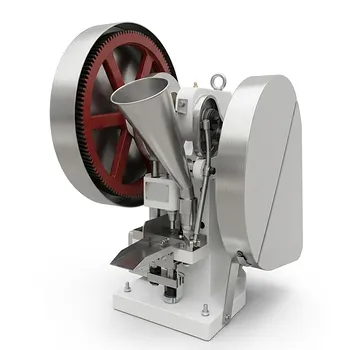
How does an electric laboratory press assist in zirconia-based ceramic green body preparation? Optimizing densification.
Updated 4 months ago
Electric laboratory presses are the essential first step in ceramic fabrication, transforming loose zirconia composite powders into structural "green bodies." By applying precise, unidirectional pressure through a mold, these machines initially compact the powder into defined geometric shapes with the mechanical strength required for handling and subsequent high-pressure densification or sintering.
Core Takeaway: The electric laboratory press serves as the foundation for ceramic performance by establishing uniform initial density, maximizing particle contact points, and eliminating internal voids through controlled uniaxial compaction.
The Role of Unidirectional Compaction
Transforming Loose Powder into Structural Preforms
An electric laboratory press utilizes a dry-press pre-forming technique to apply force to mixed zirconia composite powders. This process overcomes the natural resistance of the particles, forcing them into a mold to create a green body with specific dimensions.
Establishing Mechanical Integrity
The primary goal of this stage is to provide the material with enough mechanical strength to be handled or machined. Without this initial compaction, the zirconia powder remains a loose aggregate, incapable of maintaining a shape or surviving the transition to high-temperature kilns.
Precision Pressure Control
Electric and hydraulic systems allow for precise pressure-holding functions, which are critical for zirconia-based materials. Consistent pressure ensures that the green body reaches a predictable density, which is a prerequisite for achieving ultra-high-pressure densification in later stages.
Mechanisms of Particle Rearrangement
Eliminating Air and Reducing Voids
As the press applies axial pressure (often reaching several hundred bar), particles are forced to rearrange and fill voids. This effectively eliminates trapped air that would otherwise lead to structural defects or cracking during the sintering process.
Maximizing Inter-Particle Contact
The mechanical force induces particle deformation and mechanical interlocking, significantly increasing the number of contact points between the zirconia and composite additives. These contact points are vital for the efficient diffusion of atoms during thermal processing.
Minimizing Density Gradients
Precise control over the pressing cycle helps minimize internal density gradients. When density is uniform throughout the green body, the material experiences uniform shrinkage during sintering, preventing the warping or internal stresses common in poorly compacted ceramics.
Impact on Post-Processing and Sintering
Foundation for Field-Assisted Sintering
For advanced techniques like flash sintering or microwave hybrid sintering, a uniform green body is non-negotiable. The press ensures even current distribution and stable thermal runaway triggers by maintaining a consistent internal structure.
Ensuring Dimensional Accuracy
The consistency of the applied pressure directly influences the dimensional accuracy of the final component. Because zirconia-based ceramics undergo significant shrinkage, a high-quality green body produced by a laboratory press is the only way to ensure the final part meets strict tolerances.
Improving Breakdown Strength
By minimizing large pores and ensuring a dense particle packing, the press directly improves the dielectric and breakdown strength of the finished ceramic. This makes the laboratory press a critical tool for producing high-performance electronic or structural zirconia components.
Understanding the Trade-offs and Pitfalls
The Limitation of Uniaxial Pressure
Because pressure is applied from a single direction, friction between the powder and the mold walls can lead to non-uniform density distributions. The top of the green body may be denser than the bottom, which can cause "hourglassing" or bowing during the sintering phase.
Wall Friction and Lubrication
Zirconia powders are often abrasive, leading to significant mold wear and internal friction. If proper lubricants or binders are not used, the pressure may not reach the center of the powder mass effectively, resulting in a weak core.
Pressure-Induced Cracking
Applying pressure too rapidly or releasing it too quickly can cause delamination or "capping." This occurs when trapped air or elastic recovery causes the green body to crack into horizontal layers as it exits the mold.
How to Apply This to Your Project
Making the Right Choice for Your Goal
To maximize the effectiveness of your laboratory press when working with zirconia-based composites, consider your primary objective:
- If your primary focus is high-volume testing: Prioritize an electric press with programmable pressure cycles to ensure repeatability across hundreds of samples.
- If your primary focus is complex geometries: Use the press to create simple preforms, but plan for isostatic pressing or secondary machining to address density gradients.
- If your primary focus is advanced electronic properties: Focus on the pressure-holding duration to ensure maximum particle contact for stable field-assisted sintering.
A properly executed pressing stage is the single most important factor in determining the structural and functional integrity of the final sintered zirconia composite.
Summary Table:
| Key Aspect | Role in Zirconia Processing |
|---|---|
| Uniaxial Compaction | Transforms loose powders into handled structural green bodies. |
| Precision Control | Ensures repeatable density and stable thermal runaway triggers. |
| Void Elimination | Removes trapped air to prevent structural defects and cracking. |
| Particle Contact | Maximizes contact points for efficient atom diffusion during sintering. |
| Shrinkage Control | Minimizes density gradients to ensure dimensional accuracy. |
Elevate Your Ceramic Research with Precision Compaction Solutions
Achieving the perfect green body is critical for high-performance zirconia ceramics. We provide complete laboratory sample preparation solutions tailored for material science. Our expertise covers the entire powder processing workflow—from initial grinding with our planetary ball mills and jet mills to final compaction using our advanced electric laboratory presses.
Whether you require Cold Isostatic Presses (CIP) for uniform density or Vacuum Hot Presses for advanced sintering, our equipment is designed to meet the strictest research tolerances.
Our product range includes:
- Powder Processing: Jaw crushers, cryogenic grinders, and sieve shakers.
- Mixing: Powder mixers and vacuum defoaming mixers.
- Compaction & Sintering: Standard lab presses, XRF pellet presses, and Warm Isostatic Presses (WIP).
Ready to optimize your material properties? Contact our technical experts today to find the ideal solution for your laboratory's needs.
References
- Jun-feng GAO, Q Wang. Preparation and Performance Study of ZrO<sub>2</sub>/LaAl<sub>11-3</sub><italic><sub>x</sub></italic>Ni<sub>3</sub><italic><sub>x</sub></italic>O<sub>18</sub> Composite Ceramic Materials. DOI: 10.3724/s1004-0277.202402006
Mentioned Products
People Also Ask
- What is the function of a laboratory press in Cr-Ti alloy evaluation? Quantify Fracture Stress & Strength
- What is the function of a laboratory press in assessing the hydrophobic performance of modified vermiculite fillers?
- What is the core function of a laboratory press in the forming of ceramic filter element green bodies? Maximize Density.
- What is the function of a laboratory press in the preparation of ceramic feed rods? Master Density and Precision
- Why is vacuum sealing and flexible packaging necessary for Aluminum Titanate powders during CIP? Ensure Peak Density

Tech Team · PowderPreparation
Last updated on Jun 03, 2026