How does a Cold Isostatic Press (CIP) provide unique advantages? Achieve Uniform Density for Advanced Ceramics
Updated 5 months ago
Cold Isostatic Pressing (CIP) provides unique advantages by applying uniform, omnidirectional pressure to ceramic powders through a fluid medium, effectively eliminating the friction-induced density gradients found in traditional die pressing. This isotropic compression ensures that the resulting green bodies have an extremely uniform microstructure and minimal residual stress. Consequently, CIP-processed ceramics exhibit superior structural integrity, significantly reducing the risk of warping, cracking, or deformation during the high-temperature sintering process.
Core Takeaway: By replacing rigid mold walls with a pressurized liquid medium, CIP achieves a level of density consistency that is physically impossible in uniaxial pressing. This uniformity is the primary driver for producing high-performance ceramics that require high geometric stability and flaw-free microstructures.
The Physics of Density Uniformity
Eliminating Mold Wall Friction
In traditional die pressing, the interaction between the powder and the rigid steel walls creates internal friction. This friction prevents pressure from being distributed evenly, leading to "soft spots" or lower-density regions within the ceramic part.
Cold Isostatic Pressing (CIP) avoids this by using a flexible elastomer mold submerged in a fluid. Because the fluid exerts pressure equally on all surfaces, there are no rigid walls to cause friction gradients, ensuring the powder is packed with perfectly uniform density.
Achieving Isotropic Compression
Traditional pressing is typically unidirectional, meaning particles are primarily pushed from the top or bottom. This often results in anisotropic residual stresses, where the material's properties vary depending on the direction of the force.
CIP provides isotropic compression, meaning the pressure is identical from every angle. This creates a green body with a balanced internal structure, which is essential for advanced ceramics used in high-stress or high-purity applications.
Impact on Material Integrity and Sintering
Prevention of Internal Stress Concentrations
Uneven density in a green body leads to internal stress concentrations. During the molding stage, these concentrations can manifest as micro-cracks that are often invisible to the naked eye but catastrophic to the finished product.
By ensuring uniform densification, CIP eliminates these stress points. This results in high-purity targets and components that are free from the structural flaws that typically plague large or complex-shaped die-pressed parts.
Controlling Sintering Shrinkage and Deformation
Ceramics shrink significantly during high-temperature sintering. If the green body has density gradients, different areas will shrink at different rates, causing the part to warp, crack, or twist.
Because CIP-produced parts have extremely high density consistency, they shrink uniformly in all dimensions. This predictable shrinkage allows for better geometric consistency and prevents the formation of density voids in large-area components, such as piezoelectric ceramics.
Performance Gains in High-End Applications
Enhancing Purity and Sputtering Rates
For components like CuO/ZnO ceramic targets used in Physical Vapor Deposition (PVD), microstructural uniformity is critical. A uniform microstructure ensures consistent sputtering rates across the entire surface of the target.
CIP ensures that these powders achieve a high degree of densification without contamination. This leads to improved thin-film quality and more stable performance in sensitive electronic manufacturing processes.
Reliability in Harsh Environments
High-performance refractories must withstand thermal shock and rapid cooling. Any internal inconsistency in the ceramic structure acts as a failure point when the material expands or contracts.
The structural integrity provided by CIP strengthens the ceramic's resistance to these environments. This makes it the preferred method for manufacturing large piston components and other heavy-duty industrial ceramics.
Understanding the Trade-offs
Dimensional Precision and Near-Net Shapes
While CIP is superior for density, traditional die pressing often offers better initial dimensional tolerance. Because CIP uses flexible molds, the exterior dimensions of the green body may require more extensive machining after pressing to reach final specifications.
Process Complexity and Cycle Time
CIP is generally a slower, batch-oriented process compared to the high-speed, automated nature of dry die pressing. The need for a fluid medium, high-pressure vessels (often reaching 200 MPa to 230 MPa), and elastomer tooling increases the complexity of the production line.
How to Apply This to Your Project
Making the Right Choice for Your Goal
- If your primary focus is high-volume production of simple shapes: Traditional die pressing is likely the more cost-effective choice due to its speed and near-net-shape capabilities.
- If your primary focus is large or complex geometries: Use CIP to eliminate the pressure gradients that cause cracking and warping in large-scale parts.
- If your primary focus is maximum material performance and reliability: CIP is the definitive choice, as it ensures the microstructural uniformity required for high-stress and high-purity applications.
- If your primary focus is reducing post-sintering scrap rates: Transitioning to CIP can significantly lower losses caused by deformation and internal cracking during the sintering phase.
Ultimately, Cold Isostatic Pressing is the essential tool for engineers who cannot compromise on the internal structural integrity and density consistency of their ceramic components.
Summary Table:
| Feature | Traditional Die Pressing | Cold Isostatic Pressing (CIP) |
|---|---|---|
| Pressure Type | Unidirectional / Biaxial | Isotropic (360° Omnidirectional) |
| Density Uniformity | Low (Internal friction gradients) | High (Uniform microstructure) |
| Sintering Behavior | Risk of warping and cracking | Predictable, uniform shrinkage |
| Part Geometry | Simple shapes (cylinders, discs) | Large, complex, or long shapes |
| Internal Stress | High residual stress | Minimal internal stress |
Elevate Your Material Performance with Precision Compaction
Achieving flawless microstructures in high-performance ceramics requires more than just pressure—it requires precision. We provide complete laboratory sample preparation solutions for material science, specializing in advanced powder processing and compaction equipment.
From manufacturing Cold/Warm Isostatic Presses (CIP/WIP) and a full spectrum of hydraulic lab presses (XRF, hot, and vacuum hot presses) to providing high-efficiency mills (planetary, jet, and cryogenic) and sieve shakers, our tools are designed to eliminate structural flaws and maximize material integrity.
Ready to optimize your production and reduce post-sintering scrap?
Contact our technical experts today to find the perfect equipment for your material research and production needs.
References
- S. Stupkiewicz, Davide Bigoni. Elastoplastic coupling to model cold ceramic powder compaction. DOI: 10.1016/j.jeurceramsoc.2013.11.017
Mentioned Products
- 6-Ton Small Single-Punch Tablet Press — Laboratory Powder & Granule Tableting Equipment / Tablet Forming Machine
- Manual Tablet Press with Dual Scale Pressure Gauge for Pharmaceutical Food Chemical Laboratory Sample Preparation
- 5 Ton Single Punch Tablet Press Laboratory Small Batch Production
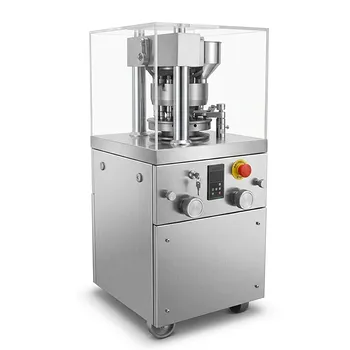
- Ordinary Type Rotary Tablet Press for Pharmaceutical Chemical Food Electronic Industries
People Also Ask
- What is the function of a laboratory press in Cr-Ti alloy evaluation? Quantify Fracture Stress & Strength
- What is the function of a laboratory press in assessing the hydrophobic performance of modified vermiculite fillers?
- What is the core function of a laboratory press in the forming of ceramic filter element green bodies? Maximize Density.
- What is the function of a laboratory press in the preparation of ceramic feed rods? Master Density and Precision
- Why is vacuum sealing and flexible packaging necessary for Aluminum Titanate powders during CIP? Ensure Peak Density

Tech Team · PowderPreparation
Last updated on May 14, 2026
Related Products
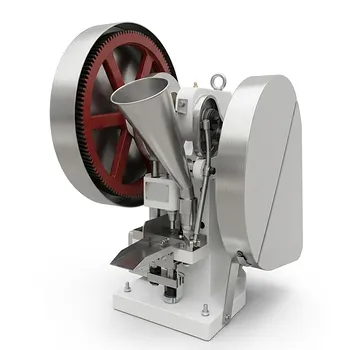
6-Ton Small Single-Punch Tablet Press — Laboratory Powder & Granule Tableting Equipment / Tablet Forming Machine
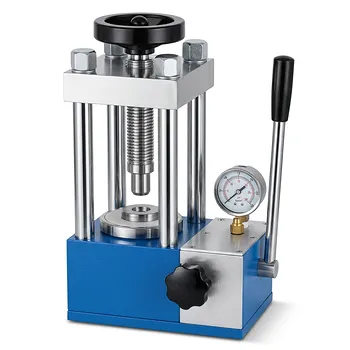
Manual Tablet Press with Dual Scale Pressure Gauge for Pharmaceutical Food Chemical Laboratory Sample Preparation
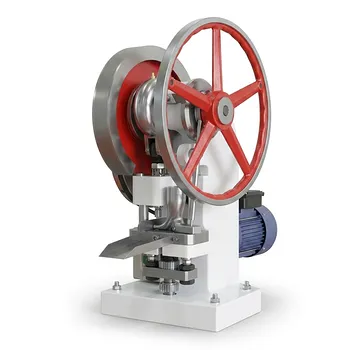
5 Ton Single Punch Tablet Press Laboratory Small Batch Production