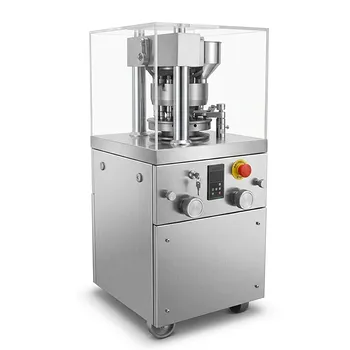
How do a precision uniaxial hydraulic press and carbide dies help ceramic membrane fabrication? Precision Green Bodies
Updated 5 months ago
The fabrication of high-performance ceramic membrane green bodies relies on the synergy between mechanical force and structural containment. A precision uniaxial hydraulic press applies consistent vertical pressure to consolidate loose ceramic powders, while carbide dies provide the specific geometric constraints and dimensional accuracy required. Together, they transform raw powder into a dense "green body" with the mechanical strength necessary for handling and the structural uniformity needed to survive high-temperature sintering.
Core Takeaway: Precision forming equipment eliminates internal density gradients and voids by forcing powder particles into a tightly interlocked state. This structural integrity is critical for preventing deformation, cracking, or fracturing during the subsequent sintering and operational phases.
The Role of the Uniaxial Hydraulic Press
Achieving Uniform Particle Rearrangement
The hydraulic press provides the axial pressure—often reaching up to 400 bar or 100 megapascals—required to force ceramic particles into a dense state. This high-pressure environment allows particles to overcome inter-particle friction, rearranging them into a tightly interlocked configuration.
This rearrangement effectively eliminates internal voids and trapped air within the powder bed. A high initial "green density" is essential because it determines the final density and mechanical strength of the ceramic membrane after firing.
Eliminating Internal Density Gradients
A precision press is designed to maintain a stable and highly controllable load throughout the pressing cycle. By regulating the pressure-holding time, the equipment ensures that the pressure field remains uniform across the entire volume of the powder.
Eliminating density gradients is vital for the survival of the component. If density varies across the green body, the material will shrink unevenly during sintering, leading to warping, micro-cracks, or catastrophic failure.
The Strategic Importance of Carbide Dies
Ensuring Tight Dimensional Tolerances
Carbide dies act as the precision mold that defines the geometric shape and dimensions of the ceramic membrane. The high hardness of carbide allows for a precision fit between the die wall and the punch, which is necessary to achieve exact tolerances.
These tight tolerances ensure that the green body meets the required specifications for industrial turnover and assembly. Precise dimensions in the green state lead to more predictable outcomes after the material undergoes thermal shrinkage.
Enhancing Surface Integrity and Longevity
Carbide is chosen for its exceptional wear resistance and ability to maintain a superior surface finish under extreme pressure. This minimizes the friction between the powder and the die wall during the compaction and ejection phases.
Reduced wall friction results in a more homogeneous pressure distribution within the powder. It also prevents surface defects on the green body, ensuring that the final ceramic membrane has a smooth, defect-free structure.
Understanding the Trade-offs and Pitfalls
The Challenge of Wall Friction
Even with high-precision dies, axial friction between the powder and the die walls can lead to pressure drop-off in thicker samples. This can result in a green body that is denser at the top than at the bottom, potentially causing "hourglassing" or bowing during sintering.
To mitigate this, manufacturers often use internal lubricants or binders. However, these additives must be carefully burned out before final sintering to avoid leaving carbon residues that could compromise the membrane's purity.
Material Cost vs. Precision Requirements
Carbide dies are significantly more expensive than standard steel molds. While they offer superior longevity and precision, the initial investment may be difficult to justify for low-volume laboratory testing or non-critical geometries.
Furthermore, because carbide is brittle, these dies are susceptible to chipping or cracking if the press is misaligned or if foreign contaminants enter the mold. Proper maintenance and alignment of the hydraulic press are non-negotiable for protecting these high-value tools.
Making the Right Choice for Your Project
To achieve the best results in ceramic membrane fabrication, your equipment strategy should align with your specific material requirements and production goals.
- If your primary focus is high-volume consistency: Invest in carbide dies and an automated hydraulic press with programmable pressure-holding cycles to minimize human error and tool wear.
- If your primary focus is avoiding sintering defects: Prioritize a press with high precision and stability to ensure the complete elimination of internal density gradients and micro-cracks.
- If your primary focus is complex geometries: Ensure your dies are engineered with highly polished surfaces to facilitate easy ejection of the green body without causing surface fractures.
By mastering the balance of pressure and precision, you create the stable structural foundation required for advanced ceramic filtration and separation technologies.
Summary Table:
| Component | Primary Function | Key Benefit |
|---|---|---|
| Uniaxial Hydraulic Press | Applies consistent axial pressure (up to 100 MPa) | Eliminates internal voids and density gradients |
| Carbide Dies | Provides high-hardness geometric constraints | Ensures tight tolerances and superior surface finish |
| The Synergy | Mechanical powder consolidation | Prevents warping, cracking, and failure during sintering |
Optimize Your Material Research with Precision Compaction Solutions
Achieving a flawless ceramic green body requires the perfect balance of pressure and precision. We provide complete laboratory sample preparation solutions tailored for material science, specializing in high-performance powder processing and compaction equipment.
Whether you are focusing on research or industrial turnover, our extensive product line supports every stage of your workflow:
- Advanced Compaction: A full spectrum of hydraulic presses, including Cold/Warm Isostatic Presses (CIP/WIP), standard lab presses, XRF pellet presses, and vacuum hot presses.
- Powder Processing: High-efficiency mills (planetary, jet, rotor), liquid nitrogen cryogenic grinders, and jaw/roll crushers.
- Refinement & Mixing: Sieve shakers (vibratory/air-jet) and specialized powder/defoaming mixers.
Ready to eliminate sintering defects and enhance your structural integrity? Contact our technical experts today to find the ideal equipment solution for your laboratory’s specific needs!
References
- Liudmila Fischer, Wilhelm A. Meulenberg. Impact of the sintering parameters on the microstructural and transport properties of 60 wt% Ce<sub>0.8</sub>Gd<sub>0.2</sub>O<sub>2−<i>δ</i></sub>–40 wt% FeCo<sub>2</sub>O<sub>4</sub> composites. DOI: 10.1039/d3ma01095c
Mentioned Products
People Also Ask
- Why is a laboratory hydraulic press required for FT-IR KBr pellets? Achieve Precise Sample Clarity for ZrC–SiC Analysis
- Why is a laboratory hydraulic press required to compress oyster shell powder before XRF analysis? Improve Data Accuracy.
- Why is vacuum sealing and flexible packaging necessary for Aluminum Titanate powders during CIP? Ensure Peak Density
- What are the advantages of using hardened steel molds and graphite spray for titanium powder? Ensure structural integrity
- What role does a high-strength stainless steel mold kit play in the uniaxial die compaction process? Ensuring Precision

Tech Team · PowderPreparation
Last updated on May 14, 2026