How are Uniaxial Presses & CIP Used for Gd2O2S:Tb Ceramic Forming? Achieving High-Density Green Bodies
Updated 4 months ago
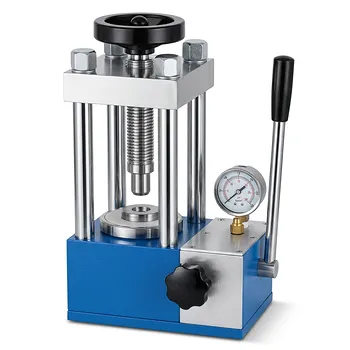
The production of high-performance $Gd_2O_2S:Tb$ ceramics relies on a precise two-stage forming process. A laboratory uniaxial hydraulic press is first used to achieve initial shaping and mechanical integrity, followed by Cold Isostatic Pressing (CIP) to ensure the high density and structural uniformity required for transparent sintering.
This dual-stage approach transitions the ceramic powder from a loose state to a high-density "green body." By combining uniaxial pre-pressing with omnidirectional CIP, manufacturers eliminate internal density gradients that would otherwise cause cracking or deformation during high-temperature sintering.
The Role of the Uniaxial Hydraulic Press: Initial Shaping
Pre-molding and Air Removal
The process begins by placing $Gd_2O_2S:Tb$ powder into a precision steel mold. The laboratory uniaxial hydraulic press applies an initial axial pressure—typically around 30 MPa—to force air out of the loose powder.
Establishing Mechanical Strength
This stage forces powder particles to rearrange, overcome friction, and increase their contact points. The result is a disc-shaped pellet with enough mechanical strength to be handled and moved to the next stage of production without crumbling.
Defining Dimensions
Uniaxial pressing is the primary method for defining the geometry and dimensions of the green body. It provides a stable, consistent foundation for the secondary densification process, ensuring the final ceramic block meets specific size requirements.
The Role of Cold Isostatic Pressing (CIP): Final Densification
Isotropic Pressure Application
After pre-molding, the green body undergoes secondary pressing in a Cold Isostatic Press at significantly higher pressures, often 250 MPa. The CIP uses a fluid medium to transmit pressure equally from all directions (omnidirectional).
Eliminating Density Gradients
Because the pressure is isotropic, the CIP eliminates the internal stress concentrations and density gradients inherent in uniaxial pressing. This ensures the compact is uniformly dense throughout its entire volume.
Preparing for Transparent Sintering
High-pressure CIP is critical for achieving successful transparent sintering. By removing micro-pores and maximizing packing density, the process ensures the ceramic will not undergo uneven shrinkage or cracking when exposed to temperatures as high as 1600 °C.
Understanding the Trade-offs and Limitations
Limitations of Uniaxial Pressing
While excellent for shaping, uniaxial pressing is limited by wall friction and internal particle friction. This often leads to "density gradients," where the center of the pellet is less dense than the edges, potentially causing warping during the furnace cycle.
The Necessity of the Two-Step Sequence
A Cold Isostatic Press cannot easily shape loose powder into a specific, sharp-edged geometry on its own. Attempting to skip the uniaxial stage often results in deformed or asymmetrical green bodies because the flexible CIP membranes do not provide rigid structural guidance.
Pressure Management Risks
Applying too much pressure during the initial uniaxial stage can lead to delamination or "capping" of the pellet. Conversely, insufficient pressure in the CIP stage will leave residual pores that prevent the ceramic from reaching its full theoretical density and optical transparency.
How to Apply This to Your Project
When forming $Gd_2O_2S:Tb$ ceramics, your equipment settings should align with the desired physical properties of the final scintillator.
- If your primary focus is optical transparency: Ensure the CIP stage reaches at least 250 MPa to eliminate the microscopic voids that scatter light.
- If your primary focus is dimensional precision: Prioritize the precision of your stainless steel molds during the uniaxial pre-pressing stage at 30 MPa.
- If your primary focus is preventing structural cracks: Do not bypass the CIP stage, as isotropic pressure is the only way to neutralize the internal stress gradients created during uniaxial molding.
By masterfully balancing initial uniaxial shaping with secondary isostatic densification, you create the high-quality green body necessary for advanced ceramic applications.
Summary Table:
| Stage | Equipment | Pressure | Key Purpose |
|---|---|---|---|
| Initial Shaping | Uniaxial Hydraulic Press | ~30 MPa | Pre-molding, air removal, & dimensional definition |
| Final Densification | Cold Isostatic Press (CIP) | ~250 MPa | Isotropic pressure to eliminate density gradients |
| Sintering Prep | High-Pressure Isostatic Press | Up to 250+ MPa | Voids removal for successful transparent sintering |
Elevate Your Material Science Research with Precision Compaction
Achieving the perfect green body for high-performance ceramics like $Gd_2O_2S:Tb$ requires equipment that delivers precision and reliability. We provide complete laboratory sample preparation solutions tailored for advanced material science.
Our extensive product line includes:
- Powder Processing: Crushers (jaw/roll), liquid nitrogen cryogenic grinders, and advanced mills (planetary ball, jet, sand/bead, disc, rotor).
- Sieving & Mixing: Sieve shakers (vibratory/air-jet), powder mixers, and defoaming mixers.
- Compaction Solutions: A full spectrum of hydraulic presses, including Cold/Warm Isostatic Presses (CIP/WIP), standard lab presses, XRF pellet presses, and vacuum hot presses.
Whether you are focusing on optical transparency or dimensional precision, our experts are here to help you select the right tools for your workflow. Contact us today to optimize your lab's performance!
References
- Junlin Wu, Jiang Li. Fabrication and Microstructure of Gd<sub>2</sub>O<sub>2</sub>S:Tb Scintillation Ceramics from Water-bath Synthesized Nano-powders: Influence of H<sub>2</sub>SO<sub>4</sub>/Gd<sub>2</sub>O<sub>3</sub> Molar Ratio. DOI: 10.15541/jim20220542
Mentioned Products
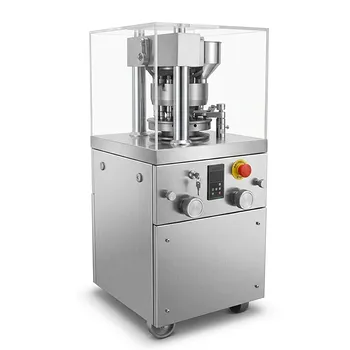
- Ordinary Type Rotary Tablet Press for Pharmaceutical Chemical Food Electronic Industries
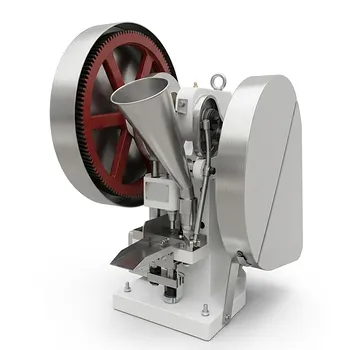
- 6-Ton Small Single-Punch Tablet Press — Laboratory Powder & Granule Tableting Equipment / Tablet Forming Machine
- Manual Tablet Press with Dual Scale Pressure Gauge for Pharmaceutical Food Chemical Laboratory Sample Preparation
People Also Ask
- Why is a laboratory hydraulic press required for FT-IR KBr pellets? Achieve Precise Sample Clarity for ZrC–SiC Analysis
- Why is a laboratory hydraulic press required to compress oyster shell powder before XRF analysis? Improve Data Accuracy.
- Why is vacuum sealing and flexible packaging necessary for Aluminum Titanate powders during CIP? Ensure Peak Density
- What are the advantages of using hardened steel molds and graphite spray for titanium powder? Ensure structural integrity
- What role does a high-strength stainless steel mold kit play in the uniaxial die compaction process? Ensuring Precision

Tech Team · PowderPreparation
Last updated on May 14, 2026
Related Products
Ordinary Type Rotary Tablet Press for Pharmaceutical Chemical Food Electronic Industries
6-Ton Small Single-Punch Tablet Press — Laboratory Powder & Granule Tableting Equipment / Tablet Forming Machine