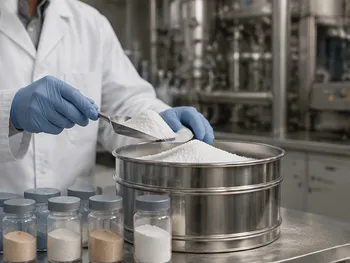
The Particle That Broke the Rocket: Why 325-Mesh Sieving Is the Unseen Foundation of Additive Manufacturing
Jul 07, 2026
The Invisible Defect
Inside a Selective Laser Melting (SLM) chamber, nothing is visible except a faint glow and a whisper-thin layer of metal powder. The recoater blade sweeps across the build plate. It should deposit a layer exactly 40 microns thick. But one grain of 18Ni300 maraging steel powder—70 microns wide, jagged, an outlier—catches the blade.
The blade hops. For a microsecond.
A streak appears in the bed. The laser scans over it anyway. That streak becomes a subsurface void. That void becomes a crack initiation point. And nine months later, a tooling insert or rocket bracket fails under load, and a failure analysis report traces it back to “lack of fusion porosity.”
All because of a single particle that should have been caught by a standard test sieve.
The System Is More Fragile Than You Think
We tend to believe robust machines protect us from small errors. An SLM printer costs half a million dollars. It’s tempting to assume it can handle a little variation in the powder. But additive manufacturing strips the process down to a terrifyingly precise physics experiment that repeats thousands of times per build.
Atul Gawande observed in medicine that “systems are designed to work, but they work only when everything is right.” An SLM system depends on a cascade of perfect inputs. The most critical input is the powder bed itself.
The Physics of a Single Layer
Every layer in SLM is a thin film of particles waiting to be fused.
- If the bed isn’t perfectly flat, laser focus shifts.
- If the packing is loose, the melt pool sinks into a gap and creates porosity.
- If an oversized particle protrudes from the bed, the next layer inherits that error, compounding it over hundreds of cycles.
The engineer’s romantic notion here is this: you are not printing a part. You are printing density. And density begins with the geometry of grains that are smaller than a human hair.
Why Standard Test Sieves Are Not Optional
Standard test sieves are a form of industrial discipline. They don’t just “filter” powder. They impose a statistical constraint on chaos.
The Problem of the Tail
Powder manufactured for SLM aims for a target size range, say 15–45 μm. But the distribution isn’t a perfect bell curve. There’s a long tail of coarse particles and agglomerates. Some are satellite droplets from the atomization process. Some are foreign debris.
A 325-mesh sieve (nominal 44 μm opening) catches the tail. It tells the operator: “Nothing larger than this enters the machine.”
Without it, you’re betting that the law of large numbers won’t punish you. It will. The probability that one bad grain ruins a critical part rises with bed area and layer count.
Packing Density and Flowability
When powder particles are uniform, they arrange themselves into a dense, stable lattice under gravity and recoater force. Flowability—measured in Hall flow seconds or Carr indexes—isn’t just a convenience metric. It’s a direct predictor of bed flatness.
A uniform particle size distribution (PSD) obtained through high-mesh sieving maximizes the coordination number in the powder bed. Every additional contact between neighboring grains conducts heat better during laser melting and reduces the shrinkage gap that creates voids.
The Psychology of False Economy
Morgan Housel often writes that the biggest risk is what you don’t see coming—the silent accumulation of minor compromises. Sieving is one of those steps that gets sacrificed on the altar of throughput.
“The Powder Looks Fine”
Operators will pour virgin powder from a new container and assume it’s ready. But even certified powders can suffer transportation-induced segregation, where fine particles settle to the bottom and coarse ones rise. A sieve re-homogenizes the lot.
The dangerous mental shortcut is: If the specification says 20–45 μm, I don’t need to verify. Standard test sieves transform trust into verification. They shift the mindset from “probably okay” to “certifiably within spec.”
The Yield Trap
A 270-mesh sieve may let 85% of the powder pass. A 325-mesh might drop yield to 70%. The rejected coarse fraction looks like waste. But consider the alternative: a scrapped build of 800 layers, each one a lottery ticket.
Balancing yield against precision isn’t a production compromise—it’s an engineering calculation. If your application requires near-100% theoretical density for high-cycle fatigue strength (as with 18Ni300 tooling), the tighter mesh pays for itself in reliability.
The Hidden Life of a Test Sieve
Standard test sieves look like simple brass or stainless steel frames with woven mesh. They are in fact delicate instruments.
Mesh Integrity Under Load
Vibratory sieving induces constant flexing. Wire strands fatigue. A local break in a 325-mesh cloth can let dozens of 60-μm particles through, completely unnoticed. An operator who doesn't inspect the mesh periodically is operating blind.
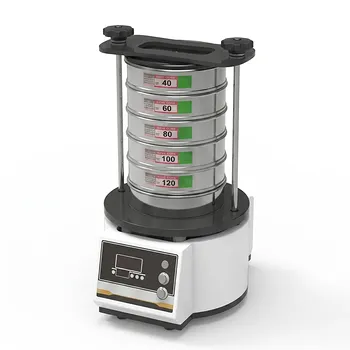
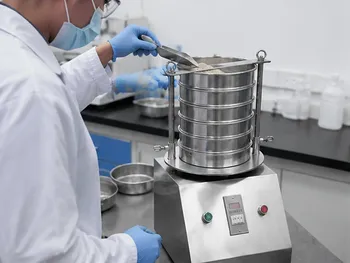
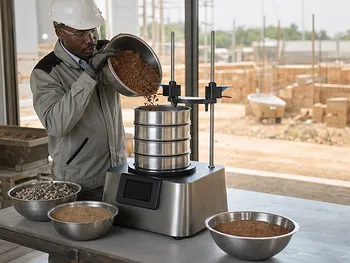
This is where industrial-grade sieve shakers with consistent amplitude and frequency matter. A calibrated vibratory sieve shaker or an air-jet sieving system reduces manual handling variability and preserves mesh life.
Contamination Cross-Over
Switching from one alloy to another without rigorous cleaning between batches introduces inclusion defects in maraging steel. These are high-performance parts. A few titanium aluminide particles from a previous job can nucleate brittle phases. Properly designed sieve shakers with quick-release clamps, easy-to-clean surfaces, and compatible test sieves make cleaning a protocol, not an afterthought.
Building a Sieving Protocol for 18Ni300 and Beyond
A systematic workflow turns powder screening from a bottleneck into a quality asset.
Step 1: Define Your Critical Defect Size
- For maximum mechanical strength (aerospace brackets, injection molds), aim for a 325-mesh cut (≤44 μm). This eliminates micro-voids.
- For production speed, use an automated ultrasonic deblinding system on your sieve shaker to maintain flow rates without clogging.
- For cost-sensitive runs, screen recycled powder through a standard 270-mesh sieve to remove agglomerates, then blend with virgin powder at a validated ratio.
Step 2: Choose the Right Sieving Technology
Not all sieving equipment preserves the fragile particle size distribution.
- Vibratory sieve shakers are the workhorse for routine quality control.
- Air-jet sieve shakers excel at deagglomerating cohesive metal powders. They use a rotating air jet to gently disperse particles and prevent mesh blinding, critical for fine meshes like 325.
- Standard test sieves must be certified to ASTM E11 or ISO 3310-1. Frame integrity and mesh tension maintenance are non-negotiable.
Step 3: Verify, Don’t Trust
After sieving, sample the powder and check the actual PSD with a master sieve stack. Documentation matters. A lot of one failed parts can be traced back to a single day when the sieve was worn.
Where the Real Solution Becomes Complete
Powder screening is a gate, but its effectiveness depends on the entire upstream preparation chain. If your 18Ni300 powder arrives with excessive fines, poor morphology, or moisture, sieving alone can’t fix it.
This is where holistic lab-scale powder processing turns a fragile SLM process into an industrial manufacturing line.
Our approach covers the full material lifecycle:
- Pre-processing: Planetary ball mills and jet mills for refining or homogenizing feedstock before classification.
- Classification: A full range of vibratory and air-jet sieve shakers, paired with precision ASTM/ISO test sieves down to 20 µm mesh openings, giving you absolute control over your PSD.
- Homogenization: Powder mixers and defoaming mixers that guarantee uniform lot-to-lot consistency, even when blending recycled and virgin material.
- Compaction & Quality Control: XRF pellet presses and Cold Isostatic Presses (CIP) that let you produce analysis samples or pre-forms from the same powder batch, closing the loop between powder validation and process performance.
When you control the powder, you control the part density. And when you control density, you prevent the invisible defect that turns a promising design into a fatigue statistic.
Sieving is not a compliance chore. It’s a declaration that you refuse to let chaos enter your build chamber.
Ready to turn your powder preparation into a competitive advantage? Contact our technical team to discuss tailored sieving and processing solutions for your additive manufacturing workflow.
Quick Links
Suggested Products
Stainless Steel Laboratory Vibratory Test Sieve Shaker Laboratory Vibratory Test Sieve Shaker for Precision Particle Size Analysis and Powder Grading Small Laboratory Vibrating Sieve Shaker for Precise Particle Size Analysis 三维电磁微量振动筛分仪 Laboratory Air Jet Sieving Machine for Fine Powder Particle Size Analysis and DeagglomerationFurther Reading
The Sieve Never Lies: How a Simple Stack of Mesh Became the Lab’s Ultimate Truth-Teller The Particle Whisperer: How a Vibratory Sieve Shaker Decodes Pine Bark into a Predictable Engineering Material The 75-Micron Mystery: How the Humble Sieve Decides Whether Your Brick Becomes a Wall or Returns to Dust The Hidden Geometry of Strength: Why 20 MPa Really Begins With a Sieve The Hidden Economics of Particle Size: Why the Most Overlooked Variable in Material Science Controls Everything
PowderPreparation
Last updated on May 14, 2026
Related Products
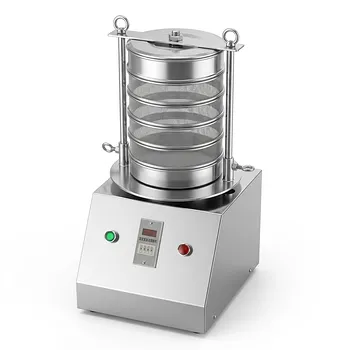
Stainless Steel Laboratory Vibratory Test Sieve Shaker
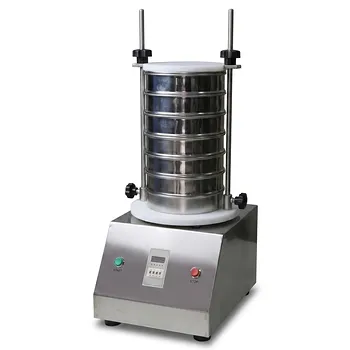
Laboratory Vibratory Test Sieve Shaker for Precision Particle Size Analysis and Powder Grading
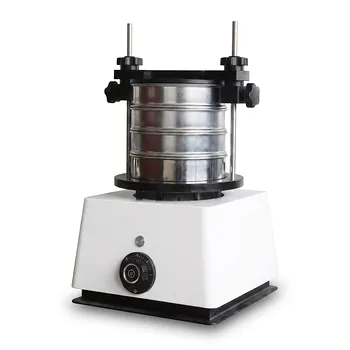
Small Laboratory Vibrating Sieve Shaker for Precise Particle Size Analysis
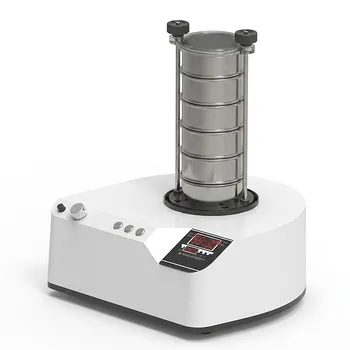
三维电磁微量振动筛分仪
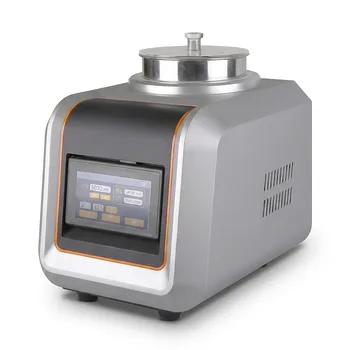
Laboratory Air Jet Sieving Machine for Fine Powder Particle Size Analysis and Deagglomeration
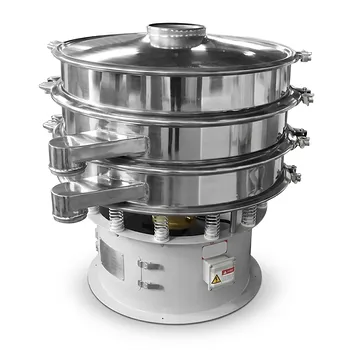
Three Dimensional Rotary Vibrating Sieve
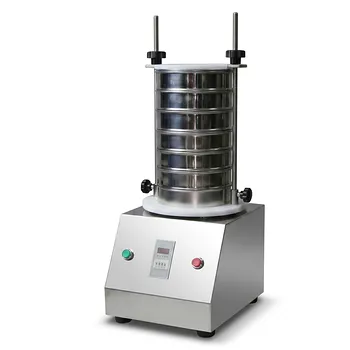
Small Laboratory Vibratory Sieve Shaker for Powder Gradation and Particle Size Analysis
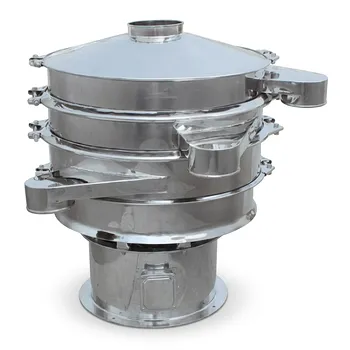
Stainless Steel Rotary Vibrating Sieve High Precision Circular Vibratory Separator Industrial Powder Grading Machine Multi Layer Sifting Equipment
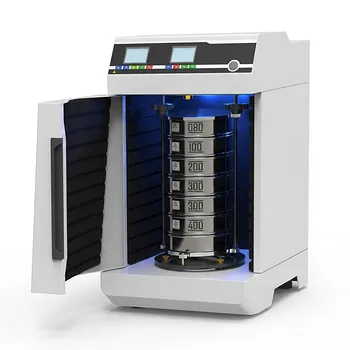
Laboratory Dry and Wet Three Dimensional Vibratory Sieve Shaker for Particle Analysis
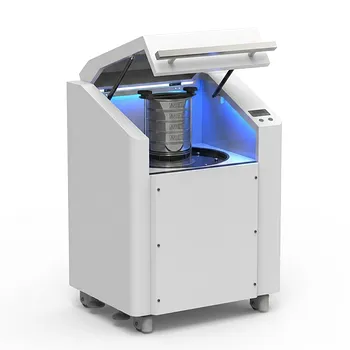
High Frequency Cabinet Type Three-Dimensional Rotary Vibrating Sieve Shaker for Dry Sieving and Particle Classification