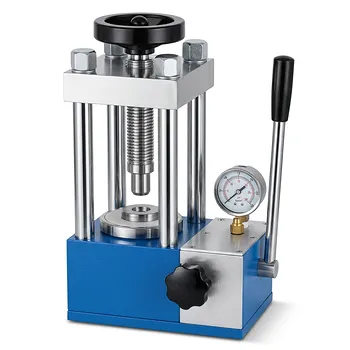
How does a uniaxial hydraulic system affect SiC-VC densification? Achieve Superior Material Density and Hardness
Updated 5 months ago
The integration of a uniaxial hydraulic system into the sintering process is the primary driver for achieving high-density SiC–VC composites. By applying a continuous axial pressure of approximately 45 MPa, the system provides a mechanical driving force that compels powder particles to rearrange and promotes the plastic flow of material at elevated temperatures. This process effectively collapses internal voids, reducing the porosity of composites with high vanadium carbide (VC) content to below 8.2% and significantly enhancing the material's final hardness.
Core Takeaway: A uniaxial hydraulic system transforms the sintering process from a purely thermal event into a thermo-mechanical operation, using precise pressure to eliminate internal pores and reach the density thresholds required for industrial-grade hardness and toughness.
Mechanisms of Densification under Axial Pressure
Particle Rearrangement and Initial Packing
The hydraulic system applies a constant force that overcomes the internal friction between SiC and VC particles. This force allows the particles to slide into a more compact configuration, filling micro-voids that would otherwise remain as structural defects.
Thermal-Mechanical Plastic Flow
As the temperature rises, the SiC–VC mixture enters a more pliable state where material can migrate more easily. The uniaxial pressure forces this softened material to flow into remaining gaps, a process known as plastic flow, which is essential for reaching near-theoretical density.
Pore Elimination and Porosity Control
In samples containing up to 40 wt.% VC, the hydraulic system is critical for driving porosity levels below the 8.2% threshold. By precisely controlling the timing and magnitude of the pressure, the system ensures that internal pores are closed before they can be "trapped" by grain growth.
The Impact on Mechanical Properties
Enhancing Hardness through Consolidation
Densification is directly correlated with the mechanical strength of the composite. The hydraulic system ensures a tight physical bond between the SiC matrix and VC reinforcements, which is the foundational requirement for high Vickers hardness.
Improving Fracture Toughness
A dense, low-porosity microstructure prevents the easy propagation of cracks through the material. By eliminating the voids that act as stress concentrators, the hydraulic system allows the VC particles to effectively deflect cracks and improve fracture toughness.
Achieving Uniform Internal Density
Unlike pressureless sintering, the uniaxial system applies force in a controlled direction to ensure structural uniformity. This minimizes internal gradients, which prevents the deformation or micro-cracking that often occurs during the cooling phase of ceramic production.
Understanding the Trade-offs
Risk of Non-Uniform Density
While uniaxial pressure is highly effective, it can occasionally lead to density gradients if the height-to-diameter ratio of the sample is too high. This happens because friction against the mold walls can dissipate the pressure before it reaches the center of the sample.
Material Deformation and Tooling Wear
Applying high pressure (such as 45-50 MPa) at high temperatures places extreme stress on the sintering molds. This requires specialized, high-strength materials for the plungers and dies to prevent deformation or contamination of the composite sample.
Complexity of Pressure Timing
Applying pressure too early or too late in the heating cycle can lead to suboptimal results. If pressure is applied before the material is sufficiently softened, it may cause particle fracturing rather than the desired rearrangement and flow.
How to Optimize Your Sintering Strategy
Recommendations for Material Goals
- If your primary focus is maximum hardness: Ensure the hydraulic system maintains a steady 45-50 MPa throughout the peak temperature dwell time to drive porosity to its absolute minimum.
- If your primary focus is preventing micro-cracks: Focus on the precision of the hydraulic release during the cooling phase to allow for uniform thermal contraction without internal stress.
- If your primary focus is high VC reinforcement (40 wt.%+): Use the hydraulic system to force mechanical interlocking, as the high carbide content requires more external work to achieve full densification than pure SiC.
By leveraging the mechanical force of a uniaxial hydraulic system, you move beyond the limits of thermal diffusion to create high-performance composites with superior structural integrity.
Summary Table:
| Densification Mechanism | Action of Hydraulic System | Impact on Composite Properties |
|---|---|---|
| Particle Rearrangement | Overcomes internal friction via axial force | Fills micro-voids; creates compact initial structure |
| Plastic Flow | Drives material migration at high temperatures | Eliminates internal pores; reaches near-theoretical density |
| Consolidation | Ensures tight bonding between SiC and VC | Maximizes Vickers hardness and mechanical strength |
| Pore Elimination | Reduces porosity to below 8.2% | Enhances fracture toughness and prevents crack propagation |
| Uniformity Control | Provides directional force application | Minimizes internal gradients and structural defects |
Elevate Your Material Research with Precision Engineering
Achieve industrial-grade density and superior structural integrity in your composite samples with our specialized equipment. [Company Name] provides complete laboratory sample preparation solutions for material science, specializing in advanced powder processing and compaction technology.
Whether you are focusing on SiC–VC composites or high-performance ceramics, our extensive product line supports your entire workflow:
- Compaction & Sintering: A full spectrum of hydraulic presses, including Hot Presses, Vacuum Hot Presses, Cold/Warm Isostatic Presses (CIP/WIP), and standard lab presses for precise pressure timing.
- Powder Preparation: High-efficiency crushers (jaw/roll), liquid nitrogen cryogenic grinders, and a variety of mills (planetary ball, jet, sand/bead, disc, rotor).
- Sizing & Mixing: Sieve shakers (vibratory/air-jet) with precision test sieves, alongside powder mixers and defoaming mixers for perfect homogeneity.
Ready to optimize your densification strategy? Contact us today to discuss how our laboratory solutions can enhance your material properties and research efficiency.
References
- V. V. Ivzhenko, Jacek Caban. Improvement of Microstructure and Mechanical Properties of SiC–VC System Obtained by Electroconsolidation. DOI: 10.3390/ma18184331
Mentioned Products
- Ordinary Type Rotary Tablet Press for Pharmaceutical Chemical Food Electronic Industries
- 6-Ton Small Single-Punch Tablet Press — Laboratory Powder & Granule Tableting Equipment / Tablet Forming Machine
- Enhanced 9 Punch Rotary Tablet Press for Powder Compaction
- 6 Ton Variable Frequency Single Punch Tablet Press
- Manual Tablet Press with Dual Scale Pressure Gauge for Pharmaceutical Food Chemical Laboratory Sample Preparation
People Also Ask
- Why is a laboratory hydraulic press required for FT-IR KBr pellets? Achieve Precise Sample Clarity for ZrC–SiC Analysis
- Why is a laboratory hydraulic press required to compress oyster shell powder before XRF analysis? Improve Data Accuracy.
- Why is vacuum sealing and flexible packaging necessary for Aluminum Titanate powders during CIP? Ensure Peak Density
- What are the advantages of using hardened steel molds and graphite spray for titanium powder? Ensure structural integrity
- What role does a high-strength stainless steel mold kit play in the uniaxial die compaction process? Ensuring Precision

Tech Team · PowderPreparation
Last updated on May 14, 2026
Related Products
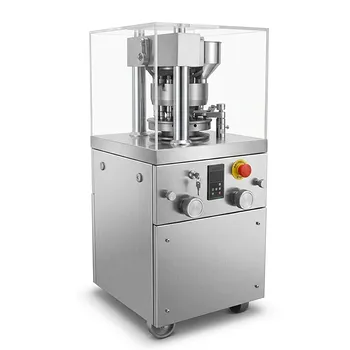
Ordinary Type Rotary Tablet Press for Pharmaceutical Chemical Food Electronic Industries
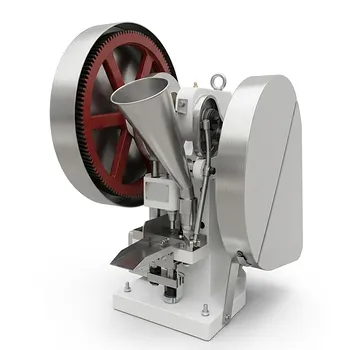
6-Ton Small Single-Punch Tablet Press — Laboratory Powder & Granule Tableting Equipment / Tablet Forming Machine
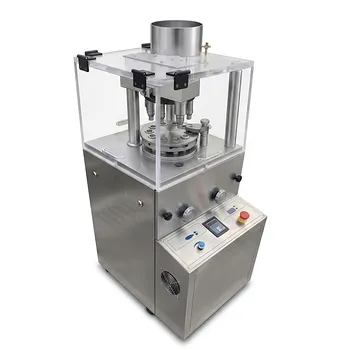
Enhanced 9 Punch Rotary Tablet Press for Powder Compaction
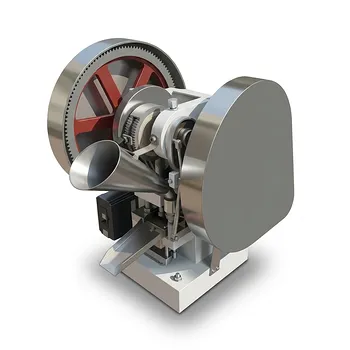
6 Ton Variable Frequency Single Punch Tablet Press